


A confidential letter from the Russian company TSK-Vektor, addressed to Rostec CEO Sergey Chemezov, reveals Moscow’s efforts to develop and mass-produce new electronic warfare (EW) systems in partnership with Chinese firms to counter Ukrainian drones and Western satellite communications.
Hacktivist collective Black Mirror has released another data dump containing internal correspondence related to the Russian state defense conglomerate Rostec, exposing communication from the email address [email protected], which appears to belong to personnel affiliated with Russian defense industrial enterprises.
Dated August 30, 2023, the document was signed by TSK-Vektor General Director A. M. Yamshchikov and outlines a proposal “to develop, produce, and supply electronic warfare complexes jointly with a group of companies from the People’s Republic of China.” The letter, part of a recent Black Mirror hacker leak, exposes plans to deepen defense cooperation between Russian and Chinese entities despite Western sanctions.
According to the text, the Chinese group includes “a research institute developing modern EW systems, a full-cycle production enterprise capable of launching serial output, a logistics company with all necessary delivery channels, and a Chinese insurance company.”
TSK-Vektor told Rostec that cooperation with Chinese partners had already begun under contracts from Russia’s Ministry of Defense for the testing and combat use of Chinese-made systems “in the conditions of the special military operation.” The letter adds that Russian and Chinese engineers are working on “devices for detecting and destroying UAVs controlled over 4G cellular networks, as well as systems to counter the American Starlink satellite network.”
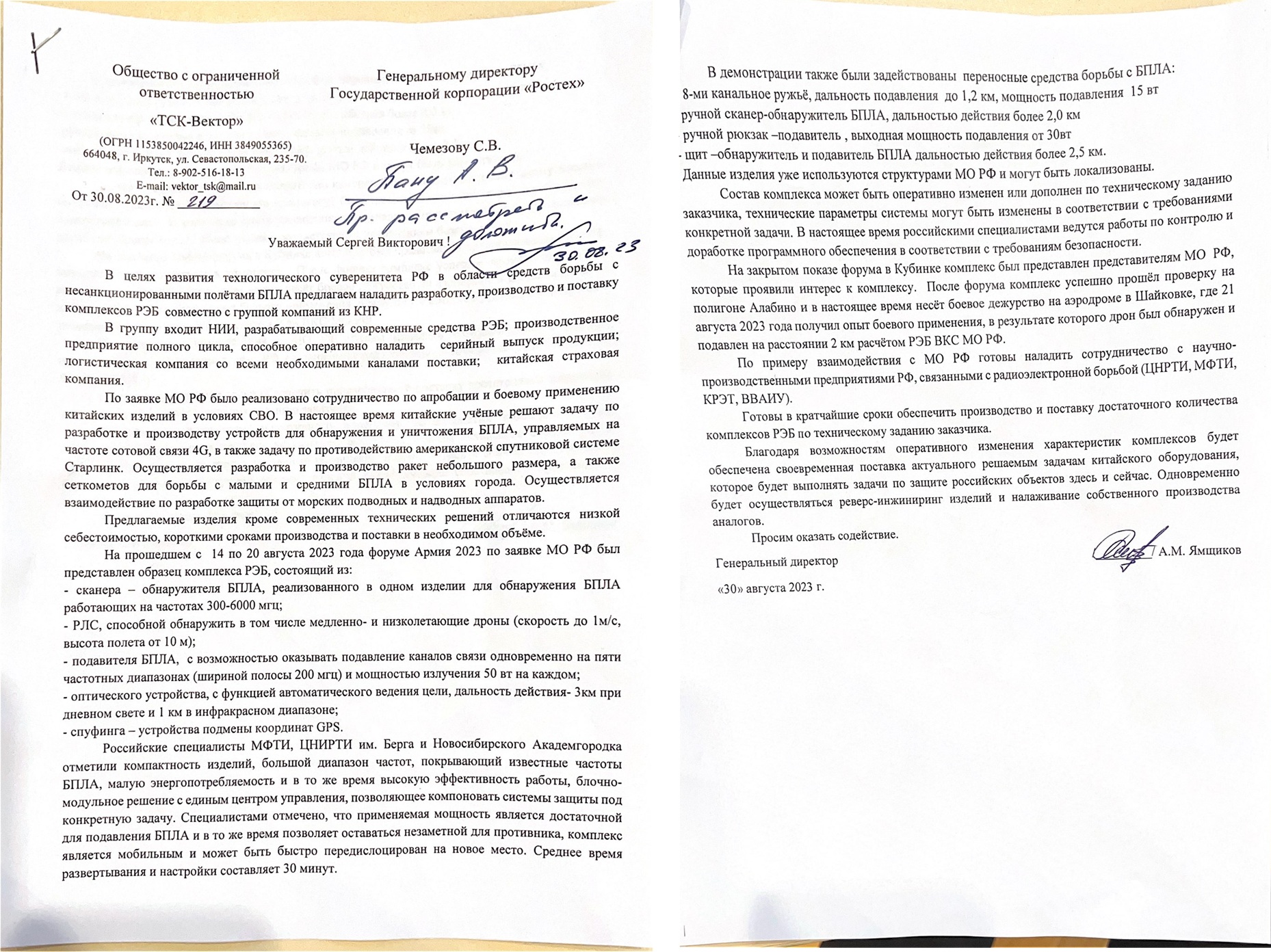
The company said it is developing “means of detection and small-sized anti-drone missiles, as well as networked systems for combating small and medium UAVs in urban environments.” The project reportedly includes “joint development of systems for naval and underwater use.”
At the Army-2023 defense forum, held August 14–20, 2023, TSK-Vektor presented a prototype EW complex under a Russian Ministry of Defense request. The proposed system includes:
- a drone detection scanner operating in the 300–6000 MHz band,
- a radar capable of spotting slow and low-altitude UAVs flying below 10 meters,
- a jammer able to block multiple communication channels simultaneously with 50 W power per channel,
- optical tracking with automatic guidance and a range of 3 km by day or 1 km in infrared,
- and a spoofing device for GPS signal disruption.
TSK-Vektor noted that Russian specialists from MIPT, TsNIRTI, and the Novosibirsk Akademgorodok praised the system’s compactness, wide frequency coverage, and modular layout. The company wrote that its configuration “allows flexible adaptation of protection systems for specific tasks.”
The letter highlights that the EW complex “remains mobile and can be redeployed within 30 minutes,” a feature Russian experts described as crucial for frontline survivability.
TSK-Vektor also demonstrated portable anti-drone systems, including “8-channel rifles with a suppression range of up to 1.2 km and power output of 15 W,” a handheld scanner with “a detection range of more than 2 km,” and a handheld jammer rated at 30 W. These items, the letter claims, “are already being used by Ministry of Defense structures.”
According to the company, the equipment passed field tests at the Alabino training ground and was later deployed at the Shaikovka airbase, where on August 21, 2023, a drone was reportedly detected and suppressed at a distance of 2 km “by the EW unit of the Aerospace Forces of the Ministry of Defense.”
TSK-Vektor expressed readiness “to establish cooperation with Russian scientific and production enterprises engaged in electronic warfare—TsNIRTI, MIPT, KRET, and VVAUI.” The firm promised “to ensure rapid production and delivery of EW systems according to the technical specifications of the customer.”
The company emphasized that its systems could be quickly modified “to meet the changing requirements of Chinese equipment” and proposed “reverse engineering of foreign products and localization of domestic analogues.”
The letter concludes with a request for Rostec’s support:
“We ask for assistance,” Yamshchikov wrote, calling for Rostec’s coordination in advancing joint Russian-Chinese EW production and deployment under Ministry of Defense oversight.