

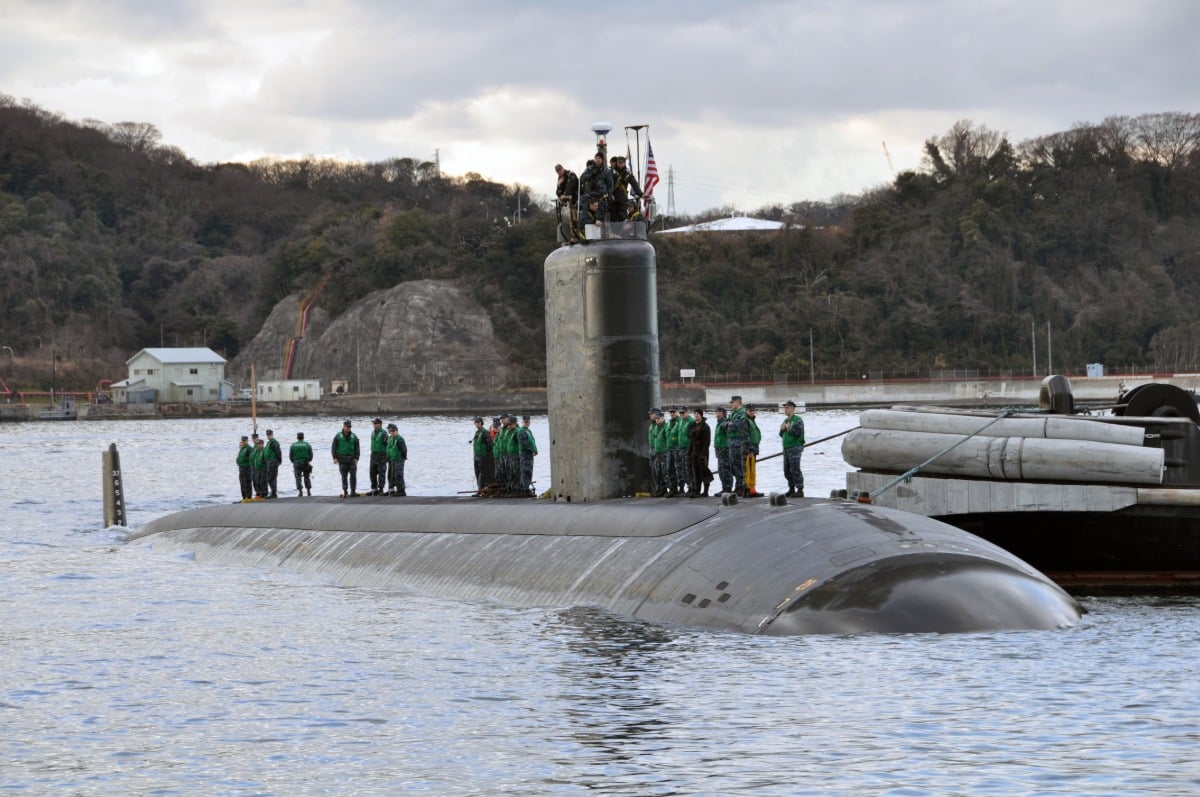
- USS Tucson, a Los Angeles-class fast-attack submarine, arrived at its new homeport of Naval Base Guam on July 10, 2026.
- Tucson replaces USS Jefferson City, which relocated to Pearl Harbor, and joins Submarine Squadron 15 alongside USS Minnesota and other forward-deployed submarines.
The fast-attack submarine USS Tucson (SSN 770) slid into Apra Harbor on July 10, swapping its old home in Pearl Harbor for a new one at Naval Base Guam, in a routine-looking port call that carries real weight for how the U.S. Navy positions its undersea forces against a rapidly expanding Chinese fleet.
Tucson, a Los Angeles-class boat commissioned in 1995, becomes the newest addition to Submarine Squadron 15, based at Polaris Point on Guam, joining what the Navy described as three other forward-deployed fast-attack submarines already stationed there. The move is part of what the Navy calls its Strategic Laydown Plan, a term that simply means deciding where to permanently station ships and submarines so the most capable forces sit closest to the places they might actually be needed, rather than being spread out for administrative convenience. Tucson’s arrival came days after USS Jefferson City, another Los Angeles-class boat, departed Guam for a new homeport at Pearl Harbor, effectively a one-for-one swap that keeps the squadron’s overall footprint roughly steady while rotating in a different hull.
“The entire crew is honored and excited to arrive in Guam,” said Cmdr. Vince Bove, commanding officer, USS Tucson.
“Tucson brings an exceptional crew of Sailors who represent the very best of our submarine force. We are proud to join the forward-deployed team, strengthen warfighting readiness, and support U.S. strategic objectives across the region. We also look forward to becoming part of the Guam community that plays such a vital role in enabling our mission,” Bove said.
The Guam island sits roughly 2,900 kilometers (1,800 miles) from the Chinese coastline, close enough to reach contested waters in the South China Sea and around Taiwan quickly, yet still sovereign U.S. territory, which means American forces there don’t need the kind of host-nation permissions that can slow deployments from bases in Japan, South Korea, or the Philippines. That combination, proximity without political friction, has turned Guam into what defense planners increasingly treat as a cornerstone of American deterrence in the Pacific, alongside Andersen Air Force Base’s rotating bomber presence and the Marine Corps’ still-under-construction Camp Blaz.
Tucson is a Flight III, or 688i, variant of the Los Angeles class, one of 20 boats built to that improved standard and the 59th Los Angeles-class submarine overall out of 62 ever constructed. The class has formed the backbone of the Navy’s attack submarine force since the Cold War, running about 110 meters (360 feet) long and displacing roughly 6,900 tons submerged, with a top publicly acknowledged speed above 25 knots (46 km/h), though naval analysts have long estimated the true figure runs considerably higher. Powered by a single nuclear reactor, these boats carry essentially unlimited range and endurance, limited mainly by crew food supplies rather than fuel, and the 688i variants like Tucson add 12 vertical launch tubes for Tomahawk cruise missiles on top of four torpedo tubes capable of firing Mark 48 heavyweight torpedoes and Harpoon anti-ship missiles.
That weapons mix matters because it lets a single submarine credibly threaten targets on land, at sea, and underwater without surfacing or exposing its position, which is precisely the kind of ambiguity submarine forces rely on for deterrence. Guam’s roster increasingly blends these aging but still-capable Los Angeles-class hulls with the newer Virginia-class, represented by USS Minnesota, which became the first Virginia-class boat forward-deployed to the island when it arrived in November 2024. The Virginia class is gradually replacing the Los Angeles class fleet-wide as older boats reach the end of their service lives, and Tucson’s continued deployment reflects how that transition is playing out gradually rather than all at once, with proven Cold War-era submarines still doing frontline work alongside their newer counterparts.
“I would like to extend a warm welcome and Hafa Adai to the Sailors and families of Tucson,” said Capt. Christopher Carter, commander, Submarine Squadron 15.
“Naval Base Guam remains a strategic outpost in the Western Pacific and plays a vital role in maintaining regional stability and deterrence. Tucson brings a proud legacy of strength, resilience, and warfighting excellence to our forward-deployed undersea force and arrives at a time when forward presence and readiness matter. Their service will strengthen our posture and enhance deterrence across the region. We are excited to welcome the crew to the team and look forward to the impact they will have while serving at the tip of the spear,” Carter said.
The Navy has leaned harder into visible submarine activity around Guam over the past year, including a rare December 2025 exercise in which two Los Angeles-class boats, USS Asheville and USS Annapolis, surfaced together off the island in a coordinated photo exercise that analysts described as deliberate signaling toward Chinese military planners watching the region. Submarines typically maximize stealth and avoid any visibility, so choosing to surface two of them side by side, even briefly, tends to read as a message rather than an accident, and it reflects a broader pattern of the U.S. military using Guam-based assets to remind regional actors of persistent American undersea capability without needing to sail submarines all the way from the continental United States each time tensions flare.