

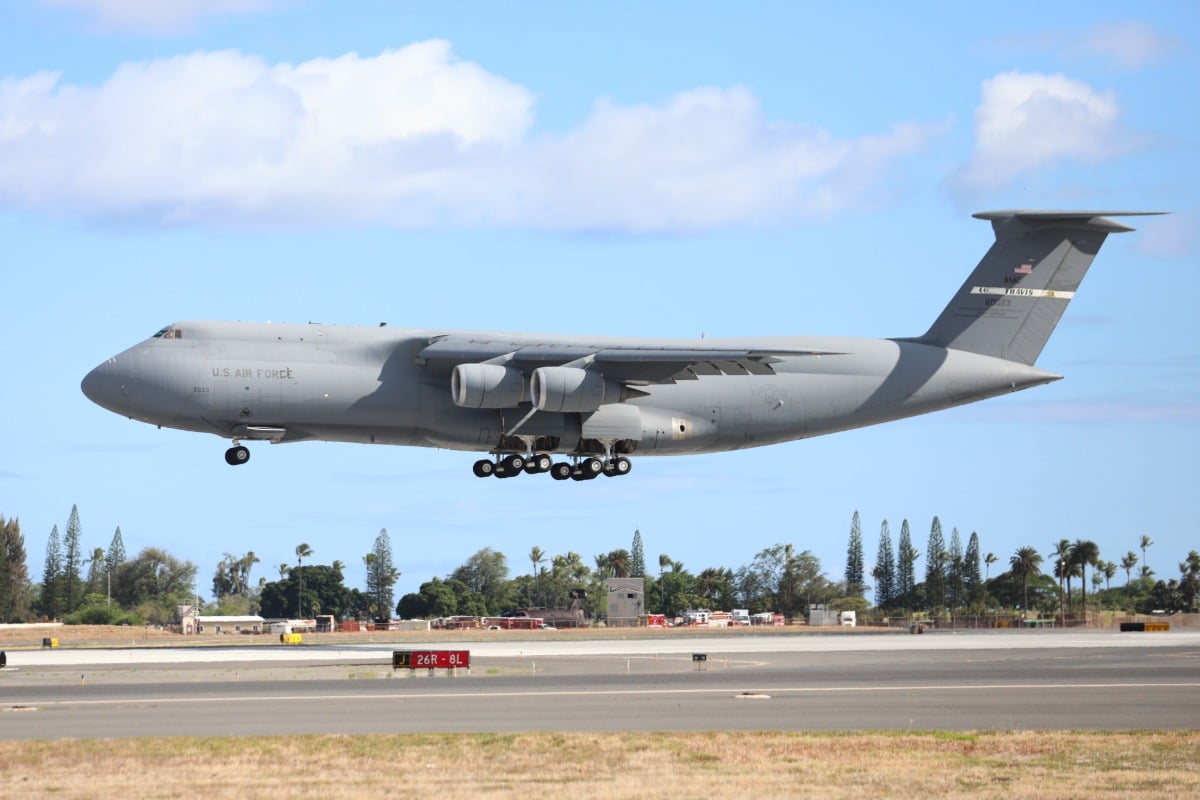
- The Air Force awarded Lockheed Martin a $142.9 million contract for software sustainment services on the C-5M Super Galaxy.
- Work will run through May 2032 at Lockheed facilities in Marietta, Georgia, and Greenville, South Carolina.
The biggest airplane in the entire U.S. Air Force fleet just got a $143 million tune-up, and it has nothing to do with engines, wings, or landing gear. The Air Force awarded Lockheed Martin a contract worth $142.9 million to keep the software running inside the C-5M Super Galaxy, the massive cargo hauler capable of carrying two Abrams tanks in a single flight, a reminder that even the most physically imposing machines in America’s arsenal now run on code as much as they run on jet fuel.
The C-5M Super Galaxy is the largest aircraft in the Air Force’s inventory, a strategic airlifter built to move outsized cargo, tanks, helicopters, entire combat units and their gear, across intercontinental distances without needing a specialized port or airfield built for oversized loads. The Air Force currently operates roughly 52 of these aircraft, each one capable of hauling up to 281,000 pounds (127,460 kg) of cargo over thousands of miles, and each one carrying a cargo hold large enough to swallow three CH-47 Chinook helicopters or 36 standard equipment pallets at once. Every one of the current fleet has already been upgraded to the C-5M standard, a modernization program that replaced the original engines with more powerful General Electric units and overhauled the avionics, the electronic systems that handle navigation, communication, and flight instruments, specifically to keep the aircraft flying reliably into the 2040s.
Under the agreement, Lockheed Martin Aeronautics will provide what the Air Force calls software sustainment services for the C-5, meaning the company will keep issuing software updates, maintain the digital systems used to certify that the aircraft meets safety and performance standards, and keep running the ground-based labs used to test new software changes before they ever get loaded onto an actual airplane. The contract also covers ongoing engineering and technical support, the kind of behind-the-scenes work that catches problems before they become in-flight emergencies, ensuring that a plane built during the Vietnam War era can keep talking to modern air traffic control systems, satellite navigation networks, and the rest of the digital infrastructure that today’s military aviation depends on.
Work under the contract will happen at two Lockheed Martin facilities, one in Marietta, Georgia, where the company has built and modernized C-5 aircraft for decades, and another in Greenville, South Carolina, and the Air Force expects the effort to run all the way through May 20, 2032, giving Lockheed roughly six years to keep the fleet’s software current. The Air Force structured the deal as an indefinite-delivery, indefinite-quantity contract, a type of agreement, often shortened to IDIQ, that sets a maximum dollar ceiling the government can spend without committing upfront to exactly how much work will happen or when, giving the service flexibility to order specific tasks as needs come up rather than locking in a fixed scope from day one. To get the work started, the Air Force has already obligated just over $19.3 million in fiscal year 2026 operation and maintenance funding, a fraction of the full $142.9 million ceiling that will be spent over the life of the contract as additional task orders come through.
Notably, the Air Force awarded this contract as a sole source acquisition, meaning it went directly to Lockheed Martin without opening the work up to competing bidders. That is not unusual for aircraft sustainment work tied to a specific manufacturer’s proprietary systems, since Lockheed Martin designed and built the C-5 originally and has continued modernizing it ever since, giving the company institutional knowledge of the aircraft’s software architecture that a new contractor would need years to replicate. The Robins Air Force Base C-5 Contracting Branch in Georgia is overseeing the deal, the same office responsible for managing the aircraft’s broader sustainment programs across its operational life.
Beyond moving tanks and helicopters, the aircraft has served as a critical link in nearly every major U.S. military deployment for half a century, from resupplying Israel during the 1973 Yom Kippur War to building the air bridge that supported coalition forces during the 1991 Gulf War, and it remains one of only two aircraft in the world, alongside Ukraine’s Antonov An-124, capable of carrying the Air Force’s heaviest and bulkiest cargo over intercontinental distances without needing specialized port infrastructure. As the U.S. military increasingly focuses on the vast distances of the Pacific theater, where fighter squadrons, bombers, and support equipment may need to reach remote island airstrips far from established bases, the C-5’s unmatched cargo capacity has taken on new relevance under a strategy the Air Force calls Agile Combat Employment, which relies on spreading aircraft and supplies across multiple smaller locations rather than concentrating them at a handful of major bases that would make easier targets in a future conflict.
The Air Force has already signaled that the C-5 will not fly forever. Air Force officials have discussed a future program known as the Next-Generation Airlifter, intended to eventually replace both the C-5 and the smaller C-17 Globemaster III with a single new aircraft type, though that program is not expected to begin procurement until 2038 at the earliest, meaning the current C-5M fleet will need to remain fully capable and current for well over another decade regardless of what comes next. That timeline is exactly why keeping the aircraft’s software current now carries real weight, since a strategic airlifter with outdated avionics or uncertified systems is not simply inconvenient, it is an aircraft the Air Force cannot fully trust to fly the missions that depend on it working exactly as designed, whether that mission is moving tanks into a war zone or delivering emergency supplies after a natural disaster on the other side of the planet.