

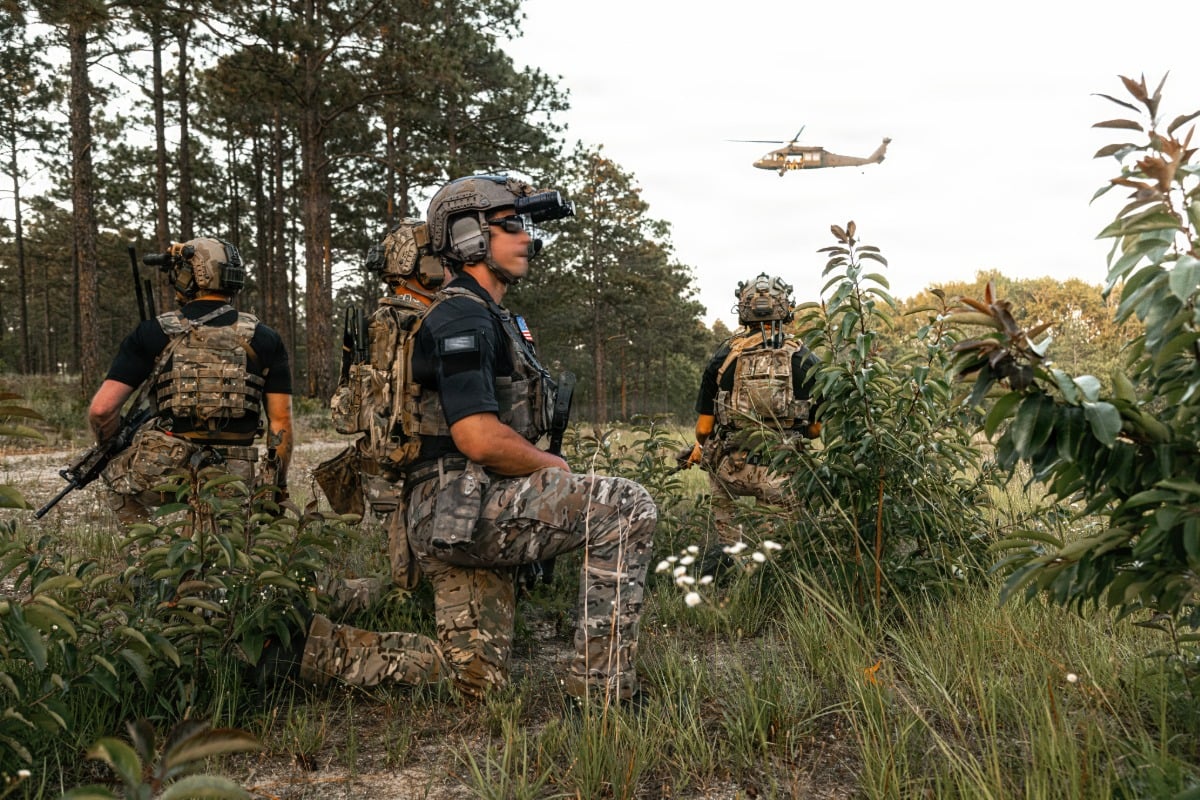
- American military personnel have been observed frequently entering and exiting Wuhan Camp, home to Taiwan's Army Special Warfare Command in Longtan, Taoyuan.
- Taiwan's Army Command declined to confirm details, saying only that it conducts annual military exchanges with the United States under existing plans.
A steady flow of American personnel moving in and out of Wuhan Camp in Longtan, Taoyuan, some driving civilian rental cars and others on foot, has drawn renewed attention to the scale of the U.S. military’s ongoing special operations presence in Taiwan, according to a report circulating from United Daily News (UDN) article and amplified by an open-source observer’s post detailing firsthand sightings around the base.
Wuhan Camp houses the Republic of China Army’s Special Warfare Command headquarters, the umbrella organization overseeing Taiwan’s elite special operations units, making any sustained foreign military footprint there a matter of direct interest to anyone tracking the U.S.-Taiwan defense relationship.
The observer describes the Americans as well integrated into camp life rather than visiting on short rotations. When personnel leave the base, they wear Army-issued green undershirts, black shorts, black socks, and black sneakers, the same uniform new Taiwanese recruits wear, according to the post. Many of the men reportedly have full beards, uncommon among active-duty Taiwanese soldiers, while the women have been seen wearing Ray-Ban style sunglasses, small details that let a local observer distinguish them from Taiwan’s own troops even at a distance. During the camp’s daily afternoon physical training period, known informally as “Period 8,” personnel wearing sand-colored tactical vests have reportedly been seen on the road outside the main gate conducting rucksack marches and weighted runs, a training signature closely associated with U.S. Army Special Forces conditioning routines. The observer also notes that these personnel frequent Zhongxing Road near the base to buy daily necessities and street food, and that local residents have grown accustomed to the presence of foreigners with this particular look.
None of this amounts to confirmation of unit identity or exact headcount; however, it is a body of prior open-source reporting establishing that U.S. Army Special Forces, known widely as Green Berets, have maintained a growing footprint in Taiwan since at least 2023. SOFREP and multiple Taiwanese outlets, including UDN and the Central News Agency, reported that under provisions tied to the U.S. National Defense Authorization Act for Fiscal Year 2023, a three-person team from 1st Special Forces Group’s 2nd Battalion, Alpha Company, began serving as permanent training observers embedded with Taiwan’s Army Aviation and Special Forces Command units, including the elite 101st Amphibious Reconnaissance Battalion and the High Altitude Special Service Company. A U.S. Special Operations Forces Liaison Element, reported to be based at the Longtan camp since roughly 2023, has been described as coordinating all American special operations activity on the island and managing high-value equipment, including Black Hornet Nano micro-drones used for reconnaissance training. Retired U.S. Navy Rear Adm. Mark Montgomery testified before Congress that the American training presence in Taiwan had grown to roughly 500 personnel, a figure he argued should expand toward 1,000 to build a genuinely combat-capable joint training relationship.
Taiwan-U.S. special forces exchanges trace back to 2007, when the American side first initiated contact, with exchange activity gradually resuming from 2009 onward. In 2014, Taiwan’s Army Aviation branch reportedly sent a reconnaissance platoon to the continental United States for joint training, an event described as the first time since the 1979 severance of formal diplomatic ties that a organized Taiwanese ground unit deployed to American soil for exercises. The pace of exchange reportedly accelerated further from 2018, with several training programs becoming routine rather than occasional.
What remains unconfirmed is the exact size of the current American contingent at Wuhan Camp, whether it has grown beyond the roughly 500-person estimate Montgomery gave Congress, and whether the increasingly visible presence, complete with beards, sunglasses, and grocery runs on Zhongxing Road, reflects a deliberate loosening of operational security or simply the natural byproduct of a small foreign contingent living inside a tight-knit Taiwanese base community for months or years at a time. Either way, the pattern described fits a broader trend that has been building since 2023, one in which the American security relationship with Taiwan is increasingly visible not because Washington or Taipei wants headlines, but because embedding real people in a real training pipeline for years at a stretch is very hard to keep entirely out of sight.