

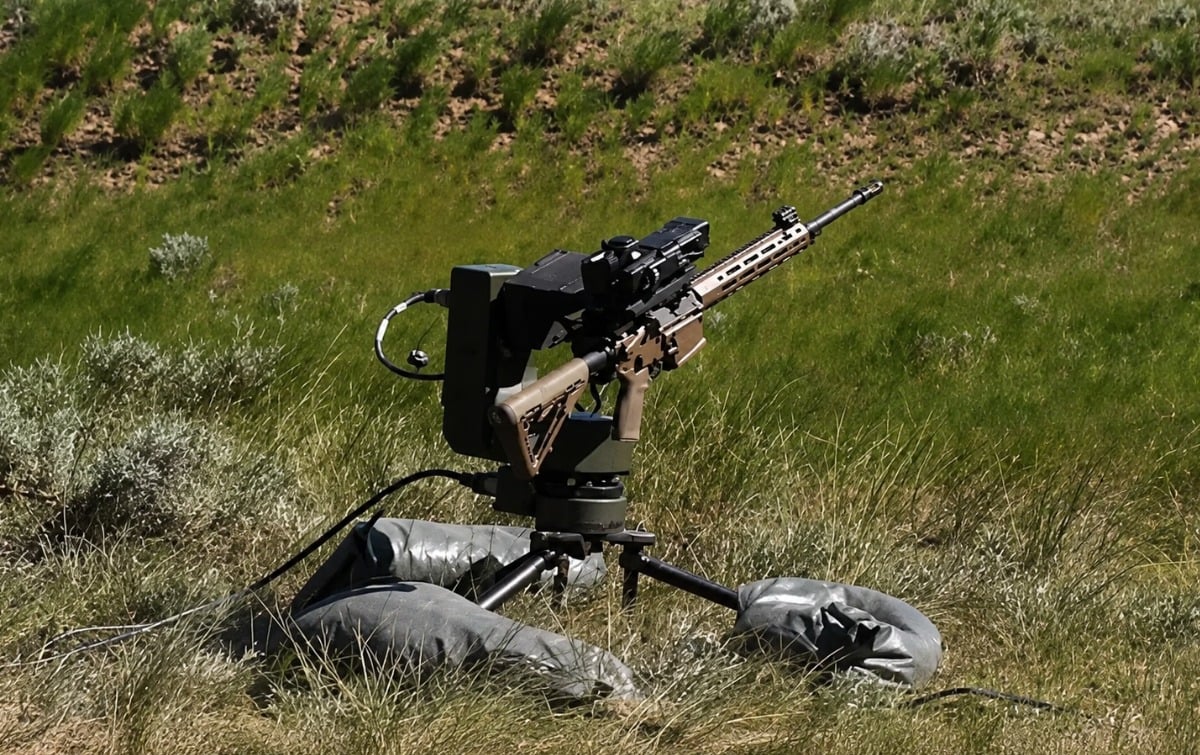
- Smart Shooter announced on June 16, 2026, a new Israeli Ministry of Defense contract for SMASH Hopper systems valued at up to $2.5 million, including options, with delivery by end of 2026.
- The contract follows a May 20 Israeli MoD agreement worth up to NIS 14.6 million and multiple 2026 U.S. military contracts with base values exceeding $15 million across the Army, Navy, and Marine Corps.
A remote-controlled weapon station with AI-assisted targeting that uses image processing to help the operator detect and track ground and aerial targets, and that lets its human operator stay behind cover rather than behind a rifle sight, has been in service with the Israeli military for several years, and Smart Shooter announced a new Israeli Ministry of Defense contract on June 16 covering additional supplies of its SMASH Hopper lightweight remote-controlled weapon station, including spare parts and related services, with delivery expected by the end of 2026. Smart Shooter said the agreement is valued at up to NIS 7.4 million ($2.5 million), including options, with the base agreement covering systems, spare parts, and services, and a six-month option to expand spare parts procurement accounting for the remainder.
Smart Shooter has not disclosed the quantity of systems covered by the agreement, which is standard practice for Israeli defense contracts that touch on operational security considerations, but the contract’s structure, base delivery plus an option covering consumables and services, suggests a program intended to sustain and expand a fleet already in active use rather than to introduce the system to a new unit for the first time.
The press release confirms that SMASH Hopper systems have been in use by the IDF for several years, which distinguishes the platform from the majority of AI-assisted weapons systems currently being marketed at defense exhibitions around the world that exist only as prototypes or demonstrators without operational track records.
Weighing approximately 15 kg (33 lb), the SMASH Hopper is a modular remote-controlled weapon station designed for rapid deployment on tripods, fixed masts, light vehicles, robots, and unmanned ground platforms, and it applies AI-based image processing to help the operator detect, track, and engage both ground targets and aerial threats including small drones. That counter-drone capability has become one of the most operationally relevant problems in modern warfare as cheap commercial and military-grade drones proliferate across every conflict environment from Ukraine to Lebanon to Gaza, and a weapon station that can engage small aerial threats with rifle-caliber ammunition from a remote position, without requiring soldiers to expose themselves, addresses a tactical problem that conventional air defense systems were never designed to solve at the price points modern drone saturation demands.
The system’s AI-assisted fire control works by processing imagery from its onboard cameras to identify and track a target, then computing a firing solution and releasing the weapon only when the calculated probability of a hit meets the operator-defined threshold, a process the company describes as “one shot, one hit” capability that reduces ammunition expenditure and the risk of collateral damage compared to unaided human marksmanship in fast-moving engagements against aerial targets. Smart Shooter’s SMASH fire-control systems have been used by the IDF for several years across a range of infantry applications, giving the broader product family a combat track record that predates most of the international competition in the AI-assisted fire control category, though the press release does not specify the precise operational history of the SMASH Hopper remote weapon station variant in particular.
Michal Mor, CEO of Smart Shooter, framed the renewed procurement in terms of the system’s validated operational role within a broader defensive architecture. “The Israeli Ministry of Defense’s decision to expand its procurement of Smart Shooter systems reflects continued confidence in their operational value,” Mor said. “Our systems, which can be operated either as standalone systems or as part of a layered defense architecture, are designed to address a range of battlefield threats for both maneuvering and defensive forces. We view this contract as an important step in further strengthening and expanding our cooperation with the IDF.”
The reference to “layered defense architecture” describes how the SMASH Hopper functions within defensive doctrine, not as the sole line of protection for a position but as one element of a multi-tier system that combines observation, electronic warfare, interceptor drones, and direct-fire weapons to address the full spectrum of drone threats at different ranges and altitudes. A remote-controlled weapon station positioned at the outer perimeter of a facility or forward base can engage threats that penetrate the outer detection ring without requiring soldiers to expose themselves in the open, which addresses one of the fundamental tactical problems of defending fixed positions against small drone attacks where the attacker has the initiative on timing and approach.
The new contract follows a May 20 agreement between Smart Shooter and the Israeli Ministry of Defense for remote-controlled weapon stations potentially valued at up to NIS 14.6 million, roughly $5 million at current exchange rates, which covered a separate procurement with different options and quantities. Together the two agreements reflect a sustained Israeli institutional commitment to the SMASH Hopper platform at a moment when drone threats along Israel’s northern border with Lebanon have remained active despite the formal ceasefire between the two countries, and when the operational lessons of watching drone warfare evolve in Ukraine have reinforced the value of low-cost, rapidly deployable remote weapon stations capable of engaging aerial targets.
The Israeli contracts represent only one strand of a rapid international expansion that has positioned Smart Shooter as one of the most widely adopted AI-assisted fire control companies in the world over the past two years. In June 2026 alone, before the latest announcement, the company disclosed a contract award for soldier-portable fire control systems for the United States Marine Corps valued at approximately $3.4 million and potentially up to $5.8 million if options are exercised, and a first significant contract with the United States Navy valued at approximately $1.8 million, adding two new American military customers within the same month. Earlier in 2026, the company announced a United States Army contract valued at approximately $10.7 million and a March 2026 award for systems for the United States Joint Interagency Task Force 401, valued at approximately $2.4 million and potentially up to $4.7 million if options are exercised, bringing the total base value of confirmed 2026 United States military contracts to more than $15 million before options. The SMASH family of systems is now deployed by defense and security forces in the United States, Israel, the United Kingdom, Germany, NATO member countries, and additional allied nations, according to Smart Shooter.