

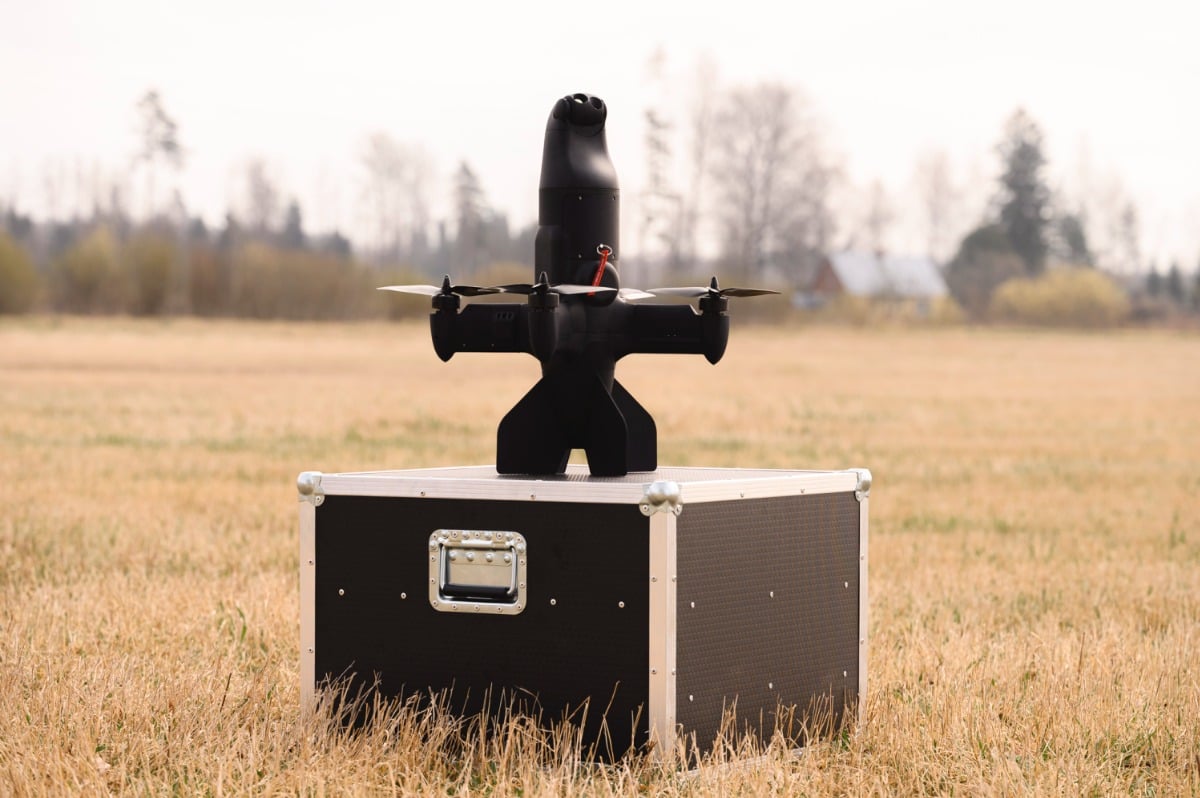
- France's Armed Forces selected the BLAZE autonomous interceptor drone system from Latvia's Origin Robotics and French partner DSV, confirmed at Eurosatory 2026 on June 16, 2026.
- First units will be delivered within weeks, with DSV establishing local BLAZE assembly and manufacturing in France under a technology transfer from Origin Robotics.
According to a company announcement at Eurosatory 2026, France selected the BLAZE interceptor drone system from Origin Robotics and French partner DSV, with local assembly and manufacturing expected to be established in France in the coming months
France’s military has selected a drone-interception system from a Latvian startup to counter the growing threat of enemy unmanned aircraft, and the deal announced Monday at the Eurosatory 2026 defense exhibition in Paris comes with a technology transfer that will establish local manufacturing in France within months, making this simultaneously a procurement decision, an industrial policy statement, and a signal about where European counter-drone capability is being built and by whom.
Origin Robotics, the Riga-based autonomous weapons developer behind the BLAZE interceptor drone system, and DSV, a French defense technology integrator that will serve as the local partner and supplier, confirmed the contract with the French Armed Forces after a competitive multi-phase evaluation conducted by the French Defence Procurement Agency, known by its French acronym DGA, the government body responsible for equipping France’s military.
The BLAZE system is an autonomous interceptor drone, meaning it is designed to find, track, and physically destroy or disable enemy unmanned aircraft in the air rather than jamming their signals or shooting them down with a gun or missile, a distinction that matters operationally because jamming can be defeated by drone designs that do not rely on radio control links, and kinetic ground-based interceptors require trained operators and clear lines of sight to the target. An interceptor drone like BLAZE can pursue a threat into terrain, between buildings, or at altitudes and angles that ground-based systems cannot cover, and it does so autonomously, reducing the operator workload at a moment when drone threats are arriving faster than human reaction times reliably allow. BLAZE has already been delivered to Latvia, Belgium, and Estonia, establishing a record in real military use rather than laboratory conditions alone, and the system carries NATO codification, the standardized identification system that facilitates logistics, spare parts supply, and technical documentation sharing across alliance members.
France’s selection of BLAZE followed what both Origin Robotics and DSV describe as a rigorous evaluation assessing the system’s performance across operational requirements including counter-drone effectiveness and force protection scenarios, with the DGA’s process involving testing across multiple competing suppliers before making its selection, according to the announcement. Agris Kipurs, CEO and co-founder of Origin Robotics, framed the outcome in terms of the system’s proven track record rather than its technical specifications alone. “France’s selection of BLAZE reflects the operational credibility the system has built through its deployments across Europe,” Kipurs said. “We went through a demanding evaluation process and we are proud that BLAZE met every requirement the DGA set.”
The industrial dimension of the contract is as significant as the procurement decision itself, because DSV will not simply import finished BLAZE systems from Latvia but will establish local assembly and manufacturing capabilities in France in partnership with Origin Robotics, forming part of a broader technology transfer explicitly designed to build French industrial and technological sovereignty in the counter-drone domain and to develop a domestic supply chain operating under the “Made in France” label. That framing connects the BLAZE contract directly to France’s longstanding industrial policy of maintaining sovereign production capability for critical defense systems, a policy that has historically favored French-developed platforms but is now being adapted to accommodate allied technology transfers when the operational requirement is urgent and the domestic alternative does not yet exist at the required scale or maturity.
Eric de Trétaigne, CEO and founder of DSV, described the arrangement as building a sovereign industrial capability in a domain he characterized as increasingly critical to national defense. “Following a thorough evaluation process conducted by the DGA, we are pleased to confirm that BLAZE has been selected to meet the French Armed Forces’ counter-drone requirements,” de Trétaigne said. “In the coming months, we will work together to establish local assembly and manufacturing of BLAZE in France, building a sovereign industrial capability in a domain that is increasingly critical to national defence.”
The timing of the announcement, confirmed at Eurosatory 2026 on June 16, places the French contract in the context of an alliance-wide acceleration of counter-drone investment that has been building since Russia’s full-scale invasion of Ukraine demonstrated the decisive and disruptive role of cheap unmanned systems in modern warfare. If confirmed, France would join Latvia, Belgium, and Estonia among European BLAZE customers, adding institutional weight and industrial scale to a platform that has already seen delivery to three NATO member militaries. Latvia, where Origin Robotics is headquartered, has invested heavily in counter-drone capabilities and domestic drone production, and the system’s potential adoption by France would extend its footprint from NATO’s eastern flank into one of the alliance’s largest and most industrially capable members.
The first BLAZE units are scheduled for delivery to the French Armed Forces within weeks of the announcement, with training to begin immediately upon delivery, a timeline that reflects both the urgency of the operational requirement and the maturity of a system that has already been through delivery to multiple national militaries and does not require the extended integration period that a newly developed platform would demand. Origin Robotics has not publicly disclosed BLAZE’s full technical specifications, including its speed, endurance, or engagement range, but the system’s selection by the DGA after a competitive multi-supplier evaluation provides an independent performance benchmark that company claims alone cannot supply.
The counter-drone market that France is buying into has expanded dramatically since 2022 and is now one of the fastest-growing segments of the global defense industry, with governments across NATO competing to field systems that can address threats ranging from commercial quadcopters modified for surveillance or attack through purpose-built military loitering munitions capable of carrying significant warheads over extended distances. Interceptor drones occupy a specific and increasingly valued position in that market because they offer the ability to neutralize threats kinetically without the limitations of jamming in GPS-denied or signal-hardened environments and without the cost and complexity of missile-based intercept systems, and the delivery record that BLAZE has accumulated across three European customers before the French announcement gives France a foundation of real-world performance data that a newly developed system simply cannot match.