

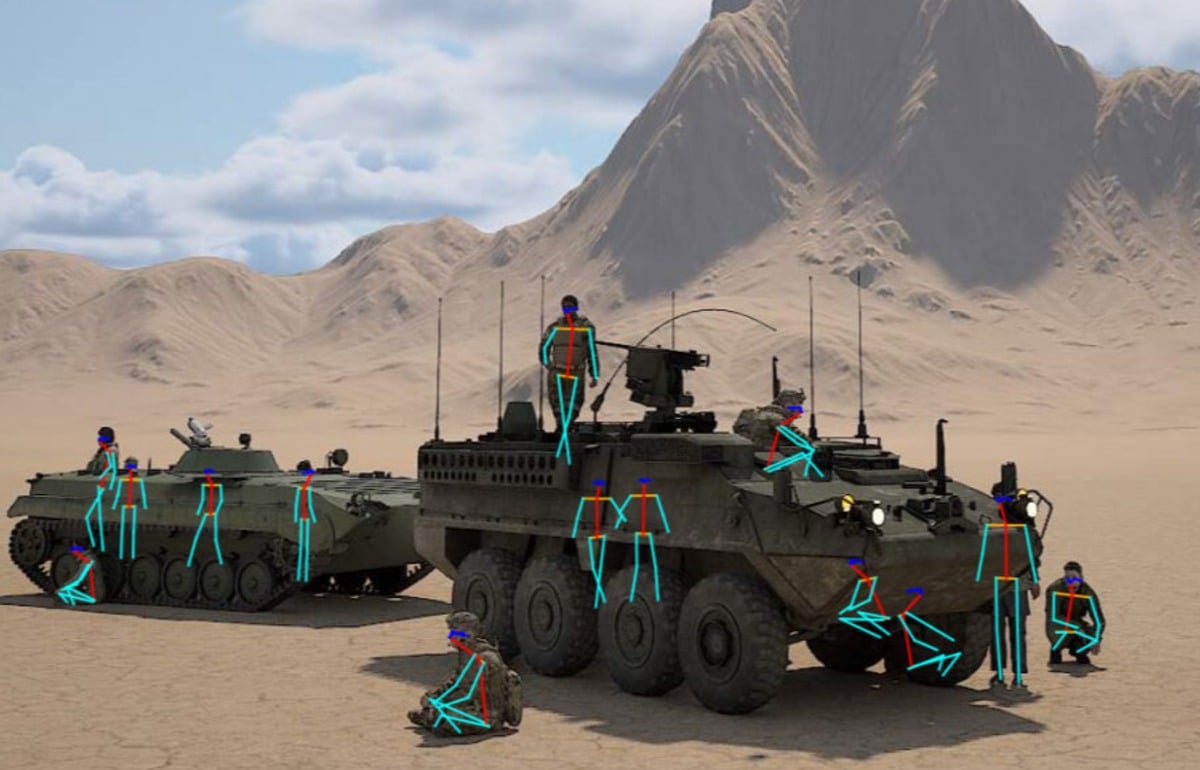
- Swedish edge AI company Scaleout and French synthetic data firm AI Verse, both 2025 NATO DIANA innovators, announced a partnership combining synthetic training data and federated learning for defense computer vision at the edge.
- The partnership aims to train and continuously improve counter-drone and ISR AI models in the field while reducing the need to move raw operational data between sites.
Teaching a military AI system to recognize enemy drones requires showing it thousands of examples of those drones under real battlefield conditions, across different lighting, weather, angles, and sensor types, but the footage collected in active operations is often too sensitive to move, too difficult to transmit in bandwidth-constrained environments, and too time-consuming to label by hand at the volumes modern computer vision models actually require for reliable performance.
According to a company statement, Scaleout and AI Verse are partnering on a combined synthetic-data and federated-learning approach designed to train and improve models at the edge while reducing the need to move raw operational data, with both companies having been selected independently as 2025 innovators under NATO’s Defence Innovation Accelerator for the North Atlantic, known as DIANA.
NATO’s DIANA program, established in 2021 and formally launched in 2022 to connect deep technology startups with Allied defense programs, operates as the alliance’s primary mechanism for accelerating dual-use innovation from the private sector into operational military capability, running challenge programs that select companies working on critical technology areas including AI, autonomous systems, and cybersecurity. Both Scaleout and AI Verse earned their places in the 2025 cohort independently, which makes their subsequent partnership a convergence of complementary capabilities rather than a preassigned collaboration, with each company bringing a distinct solution to a problem neither could fully address alone.
AI Verse, headquartered in France, has built a platform called GAIA that generates photorealistic computer-generated imagery of battlefield environments complete with the annotated labels that AI systems require to learn from them, meaning that every synthetic image comes pre-tagged with the information that would otherwise require hours of manual human labeling to produce for a single real-world photograph. AI Verse addresses the core objection to synthetic training data, the performance gap that occurs when a model trained on synthetic imagery is deployed against real-world sensor data, through physics-based rendering that simulates actual sensor physics including infrared thermal signatures, lens distortion profiles, motion blur at specific shutter speeds, atmospheric scattering across operational distance ranges, and surface material reflectance. The result is not a stylized approximation of what a battlefield looks like but a physically accurate simulation of what a specific sensor would actually capture under specific conditions, which the company argues closes the domain gap that has historically made synthetic training data unreliable for precision defense applications.
The practical significance of that capability for counter-drone and ISR applications, where ISR stands for Intelligence, Surveillance, and Reconnaissance, becomes clear when you consider what collecting real-world training data for those missions actually requires: flying missions in operational areas, capturing footage of drones and other threats under the specific atmospheric and lighting conditions relevant to the deployment environment, and then labeling every frame of that footage by hand before any AI model can begin to learn from it. AI Verse says its synthetic imagery is used or tested by defense organizations operating in Ukraine, including Soloma Avionics and STARK Defence, providing a degree of real-world validation for the technology’s claims that laboratory demonstrations alone cannot supply, though the specific performance improvements achieved in those deployments have not been independently verified.
Scaleout, founded in 2017 as a spin-off from Uppsala University’s Department of Information Technology in Sweden, specializes in a technique called federated learning, a method of training AI models across distributed locations without requiring the underlying data to be centralized or transferred between sites, which allows sensitive operational footage to remain where it was collected while the intelligence derived from it propagates across the network as model updates rather than raw imagery. The company’s FEDAIR project, conducted under NATO’s DIANA program, investigates the application of federated learning in networks of distributed drones and sensors, focusing on secure, decentralized machine learning in scenarios where data sovereignty and network efficiency are critical constraints, and Scaleout’s platform has been presented by Sweden’s Defence Minister Pål Jonson as an example of sovereign edge AI infrastructure deployed in active defense programs.
This approach combines two existing methods, synthetic data and federated learning, for defense computer-vision use at the edge, addressing the full training and deployment lifecycle for military computer vision systems in a way that the companies argue neither technology could achieve alone. AI Verse’s GAIA platform provides the synthetic training data needed to build effective initial models before sufficient real-world footage exists, solving the cold-start problem that has delayed the deployment of AI-enabled threat detection capabilities in new operational environments where real footage is scarce, classified, or practically impossible to collect at the required volume. Scaleout’s federated learning infrastructure then enables those models to continue improving once deployed, adapting to local conditions, new threat signatures, and evolving operational environments while reducing the volume of data that needs to leave the site or requires a persistent cloud connection to support, which makes the combined system more viable in contested environments where connectivity is intermittent, unreliable, or actively disrupted.
The data sovereignty dimension of this architecture has become a critical requirement for NATO-aligned defense AI programs, not merely a privacy preference but a hard operational and legal constraint that conventional cloud-based machine learning architectures cannot satisfy in the environments where military AI most needs to function. Classified operational footage cannot legally or securely transit most network architectures, forward-deployed systems frequently operate in environments where cloud connectivity is unavailable, and the intelligence value of raw sensor data is precisely what adversaries seek to intercept if it moves across any network boundary, making the combination of synthetic pre-training and local model improvement a practically relevant approach for defense programs that need AI to work where it is actually deployed rather than where connectivity conditions are ideal.
The broader context for this partnership is a NATO alliance that has recognized AI-enabled autonomous systems as one of its highest-priority technology areas and has been systematically working through DIANA to accelerate the transition of private sector innovation into operational military capability faster than traditional defense procurement cycles allow. Counter-drone AI in particular has emerged as one of the most urgent capability gaps across NATO member militaries, driven by the demonstrated effectiveness of unmanned systems in Ukraine, where the volume and diversity of drone threats has outpaced the ability of human operators to detect and classify them in real time without AI assistance, and where the data generated by those encounters is operationally sensitive in ways that complicate sharing it with the training pipelines that could use it most effectively.