

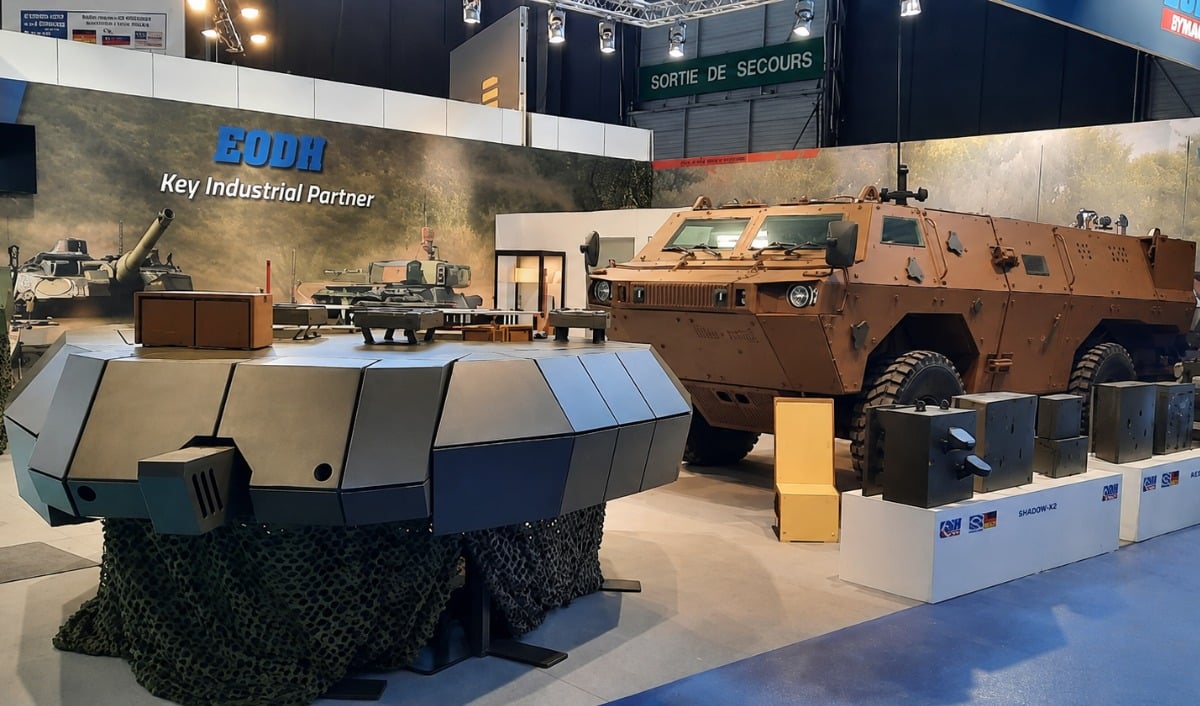
- EODH S.A. is exhibiting at Eurosatory 2026 in Paris, displaying the ASPIS NG-MBT protection system on a Leopard 1A5 turret mock-up for the first time as an integrated upgrade solution.
- EODH is building a new 10,000 square meter facility in Greece expected to begin operations in 2027, creating approximately 200 new jobs in its first phase.
A small Greek defense company that supplies armor protection for Germany’s most advanced tanks arrived at Eurosatory 2026 in Paris this week with a product that addresses the threat keeping every armored vehicle commander awake at night: the drone coming from directly above.
EODH S.A., a defense technology specialist headquartered in Thessaloniki, Greece, is exhibiting at the Paris Nord Villepinte exhibition center for the tenth consecutive time, and for the first time in its Eurosatory history it is presenting not just protection materials but complete integrated upgrade systems for existing armored vehicles, centered on the latest generation of its ASPIS protection platform.
EODH is not a household name outside defense procurement circles, but its products sit on some of the most important armored vehicles in NATO’s inventory. The company has secured agreements with KNDS Deutschland, the manufacturer of the Leopard 2 main battle tank, for the integration of its ASPIS protection system into the Leopard 2A8, the most advanced current variant of the Leopard 2 family, with the agreement running through 2035 and encompassing protection solutions for both current Leopard family vehicles and the next-generation main ground combat system. EODH products have also been integrated into the German Army’s PUMA infantry fighting vehicle and the BOXER 8×8 armored vehicle family, making the company a key supplier to the German armored vehicle industrial base even though it operates from Greece rather than from within Germany itself.
The centerpiece of EODH’s Eurosatory 2026 display is a Leopard 1A5 main battle tank turret mock-up fitted with the ASPIS Modular New Generation MBT protection system, referred to in shorthand as ASPIS NG-MBT, with ASPIS standing for Advanced Shielding Platform Integrated System. The Leopard 1A5, a 1960s-era German tank still operated by Ukraine and several other nations, represents exactly the kind of legacy platform that faces an acute survivability problem on the modern battlefield, where top-attack drones and loitering munitions have made the thin roof armor of Cold War designs a critical vulnerability. By displaying the system on a Leopard 1A5 turret, EODH is making an implicit and commercially pointed argument: that its protection technology can give old tanks a meaningful chance of surviving threats that their designers never anticipated.
The ASPIS system addresses that top-attack vulnerability through a combination of passive armor and active countermeasures that EODH’s press release describes as designed to counter multiple hits sequentially, with individual armor modules replaceable in the field by the crew after each impact. The active element for top-attack protection uses autonomous millimeter-wave radar sensors, a type of radar that operates at frequencies between 30 and 300 gigahertz and can detect small fast-moving objects at short range with high precision, distributed across the roof of the turret. When those sensors detect an incoming threat approaching from a high elevation angle, meaning a drone or loitering munition diving from above, the system initiates directed explosive charges to neutralize the threat before it reaches the vehicle. That approach, using the radar to cue a defensive explosive response rather than relying on passive armor alone, is the same logic underlying the Trophy active protection system already fielded on Israeli Merkava tanks and a growing number of NATO vehicles including the Leopard 2A8.
The ASPIS system’s design to counter not just top-attack threats but also tandem-warhead anti-tank guided missiles and the latest generation of long-rod APFSDS penetrator rounds, which are kinetic energy projectiles fired by enemy tanks and capable of punching through most conventional armor, reflects the full spectrum of lethality the system must address. A tandem warhead fires two sequential shaped charges, the first to defeat reactive armor and the second to penetrate the base plate beneath it, and countering both stages simultaneously requires a protection architecture more sophisticated than any single layer of passive armor can provide.
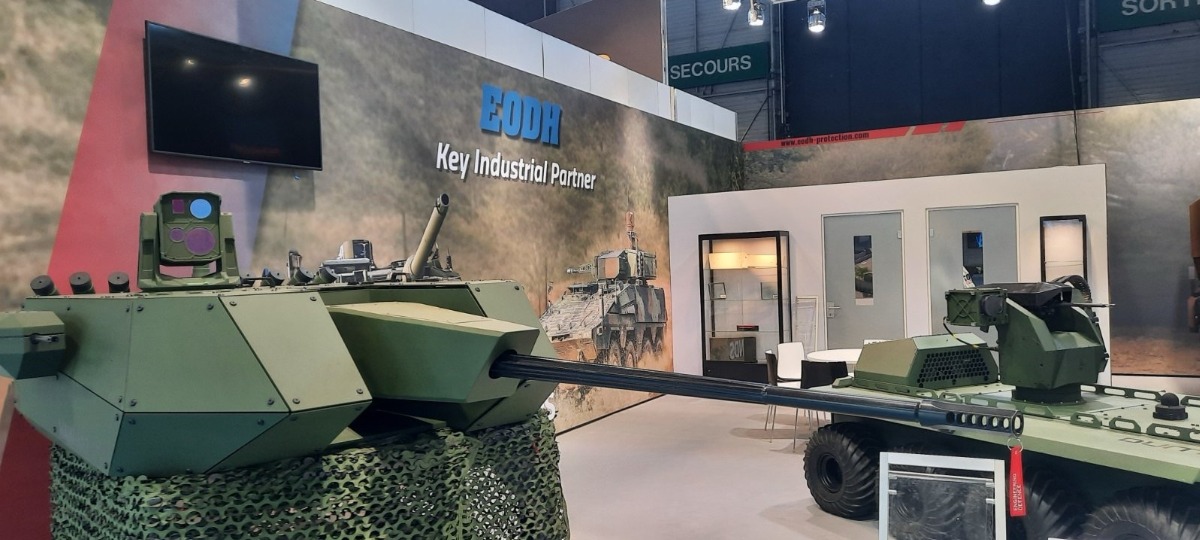
In addition to the Leopard 1A5 display, EODH is showing two collaborative projects that extend the ASPIS concept to lighter platforms. Working with Belgian-Spanish company DUMA, a named industrial partner, EODH is displaying the 4×4 ASV350 MRAV, a medium-weight armored vehicle, fitted with an ASPIS Light mock-up configured for the lighter protection requirements of wheeled vehicles operating in roles where the full MBT-grade system would be too heavy. DUMA’s SPECTRE unmanned ground vehicle, a remotely operated platform, is also on display at the booth, fitted with a LOKI 7.62 mm (0.3 in) remote weapon station turret produced by Slovenian company VALHALLA, another EODH industrial partner. The SPECTRE and LOKI combination represents EODH’s vision for how unmanned vehicles armed with remote weapon stations could integrate into conventional maneuver units, reducing the number of soldiers exposed to direct fire while maintaining the unit’s ability to engage targets.
The Slovenian partnership extends to a fourth display item: a MANGART 25 turret mock-up, presented as a proposal for upgrading armored fighting vehicles with a 25mm cannon and associated fire control systems. The MANGART is positioned as an upgrade package applicable to vehicles whose existing armament has become inadequate for current threat environments, rather than as a new-build system, fitting the broader theme of EODH’s Eurosatory presence this year, which is built around what the company can do to existing platforms rather than what it can sell as a clean-sheet design.
Underlying all of this display activity is a company that has been growing rapidly enough to attract external recognition. The Financial Times named EODH one of the fastest-growing companies in Europe in 2022, and the company received the Diamonds of the Greek Economy recognition for three consecutive years between 2023 and 2025. To support the next phase of that growth, EODH has established a wholly owned subsidiary called EODH Dynamics, focused specifically on integrated platform upgrade programs, and is building a new 10,000 square meter industrial facility equipped for the construction, assembly, and upgrade of land combat platforms, expected to begin operations in 2027 and create approximately 200 new jobs in its first phase.
That factory investment matters for a reason that goes beyond corporate expansion. EODH has indicated it can currently supply between 50 and 100 armor protection kits per year from existing capacity, a constraint that limits how quickly its systems can reach the vehicles that need them. As NATO members accelerate armor protection programs in response to the lessons of the Ukraine war, a supplier that cannot scale its output will lose contracts to competitors who can, regardless of how capable its technology proves to be. The new factory is EODH’s answer to that constraint, and the Eurosatory display of integrated upgrade packages is the commercial argument for why that increased capacity will find buyers.
A Greek company supplying armor to Germany’s most advanced tanks, partnering with Belgian, Spanish, and Slovenian firms to field unmanned systems, and building a new factory to meet demand generated by a war in Ukraine is not a story that fits any simple narrative about where defense capability resides in Europe. EODH’s presence at Eurosatory 2026 is a reminder that the defense industrial base rebuilding itself to meet today’s threats is distributed, entrepreneurial, and in some cases headquartered in places that would have surprised the planners who designed the alliance’s original force structure.