

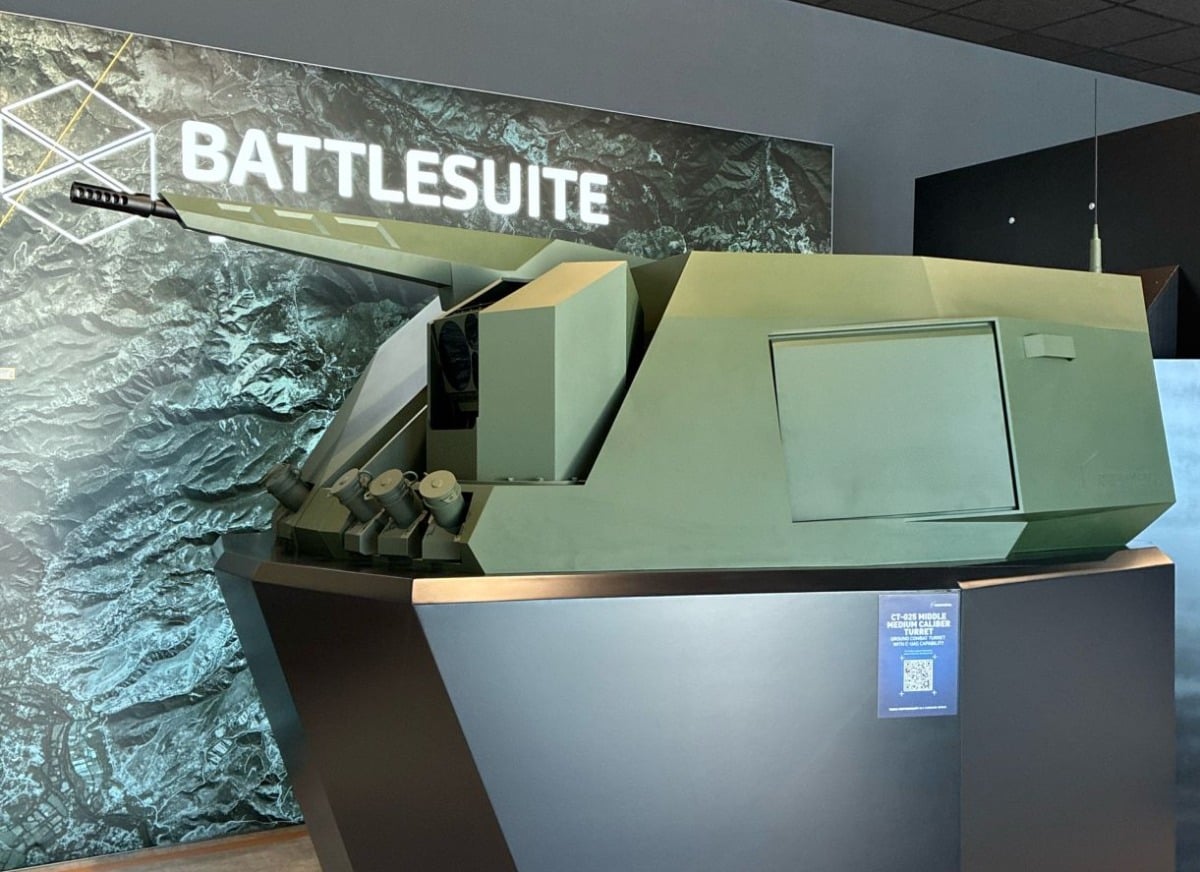
- Rheinmetall unveiled the CT-025 20 unmanned turret at Eurosatory 2026 in Paris, integrating SEOSS 320 sensors, AESA radar, and a KBA 25 mm cannon for counter-UAS and ground combat.
- Germany's Bundeswehr placed the first major CT-025 series order in February 2026, covering 274 turrets for the Luchs 2 reconnaissance vehicle with delivery by 2031.
Nobody has to be inside it, and that is entirely the point, because on today’s battlefield a crewed turret is a target and the soldier behind the gun is the first to die when it gets hit.
At Eurosatory 2026, the defense trade show running this week in Paris, Germany’s Rheinmetall unveiled the CT-025 20, the latest evolution of its unmanned turret family, a compact weapons station designed to engage both ground targets and drones from a fully remote position, keeping the crew sealed inside the hull while the turret does the killing above them.
Eurosatory, held every two years in the Paris region with the 2026 edition taking place at Paris Nord Villepinte, draws militaries and defense contractors from across the globe and ranks as one of the most consequential venues in the world for ground forces technology. Rheinmetall, the Düsseldorf-based defense and armaments giant whose revenues have surged since Russia’s full-scale invasion of Ukraine, used the platform to push a system it is clearly betting on heavily.
The company arrived in Paris under the motto “Strong and Clear – Across all Domains,” promising capabilities for future operations spanning land, air, sea, space, cyber, and information environments. The CT-025 20 sits squarely at the center of that ambition, combining cannon firepower, radar-guided drone detection, and AI-assisted networking into a single unmanned package light enough to mount on vehicles that previously had no business carrying a weapon this capable.
According to Rheinmetall’s announcement, the CT-025 20 fuses three key elements into a single unmanned turret housing: the SEOSS 320 stabilized electro-optical sensor suite, a gyro-stabilized camera and thermal imaging system built for tracking fast-moving aerial targets; an integrated AESA radar, short for Active Electronically Scanned Array, a type of radar that can track multiple targets simultaneously and is far more resistant to jamming than older designs; and the proven Rh KBA 25 mm (0.98 in) automatic cannon. Together those three components produce a system that can find a drone in the air, lock onto it, and engage it with the same gun it would use to punch through the armor of a light vehicle on the ground, with no human hand on the trigger and no crewman exposed to do it.
The KBA cannon fires in three modes and feeds from a double belt, with an effective range of up to 2,500 meters (1.55 miles), according to Rheinmetall, and a stabilized SEOSS 320 electro-optical sensor combined with radar enables precise engagement of both ground and air targets, including drones. That dual-role capability is not incidental to the design but is the entire selling point, because a military unit equipped with the CT-025 20 does not need a separate counter-drone weapon stationed alongside its armored vehicles. The turret on the vehicle itself handles both missions, simplifying logistics, reducing the number of systems a unit must maintain in the field, and keeping the crew inside the hull while the turret works.
The SEOSS 320 sensor suite, optimized for air defense due to its angular velocity and stabilization characteristics, includes a CMOS color day camera with 2,464 by 2,056 resolution, a cooled mid-wave infrared thermal imager with a 1,024 by 768 sensor, and a laser rangefinder with a range in excess of 12 km (7.5 miles). That cooled thermal imager is critical for drone detection, because small commercial quadcopters and military loitering munitions are hard to spot with the naked eye and difficult to track optically in low-light conditions, and a sensor running through a gyro-stabilized mount at those specifications changes the engagement calculus considerably.
The KBA 25 mm cannon has been manufactured more than 6,000 times, operates in three firing modes including burst fire at around 600 rounds per minute, and can penetrate the armor of most modern armored personnel carriers. Rheinmetall has also developed new 25 mm proximity-fuse ammunition specifically designed for drone engagement, rounds that detonate near a target rather than requiring a direct hit, which against a small fast-moving drone transforms a near-miss into a kill.
The CT-025 family is not a new concept, and the Eurosatory appearance is not a debut so much as an evolution. Rheinmetall first unveiled the CT-025 at DSEI 2025 in London, positioning it as a powerful, lightweight, and compact turret particularly suited for transport vehicles, light armored vehicles, and reconnaissance platforms. The CT-025 20 presented at Eurosatory 2026 expands the family with enhanced situational awareness and what Rheinmetall describes as greater operational flexibility, though the company has not publicly detailed the specific technical differences between the two variants beyond the integration of AESA radar capabilities and the updated sensor configuration.
The turret’s open digital architecture is designed to plug directly into Rheinmetall’s Battlesuite ecosystem, the company’s AI-assisted battlefield networking platform visible on the exhibition hall wall behind the hardware in photographs from the show floor, and that integration allows functions such as AI-supported target tracking, connecting the turret’s sensors and fire control into a broader networked picture of the battlespace. In practice that means the CT-025 20 is not a standalone weapon but a node in a larger system, sharing target data with other platforms and receiving cues from external sensors like aerial surveillance drones or ground radar stations, which multiplies its effectiveness well beyond what the hardware alone could achieve.
The broader context for systems like the CT-025 20 is a battlefield that has fundamentally changed since Russia’s full-scale invasion of Ukraine began, one where drone attacks have forced armies to reconsider every armored vehicle in their inventories, not just whether a vehicle can survive a missile but whether it can detect and defeat the cheap commercial quadcopters and improvised first-person-view drones that now hunt tanks by the dozens. A turret that integrates drone detection, radar cueing, and a cannon capable of killing both the drone and the vehicle that launched it represents a genuine architectural answer to that problem, rather than a bolt-on solution grafted onto a design that was never meant to handle it.