

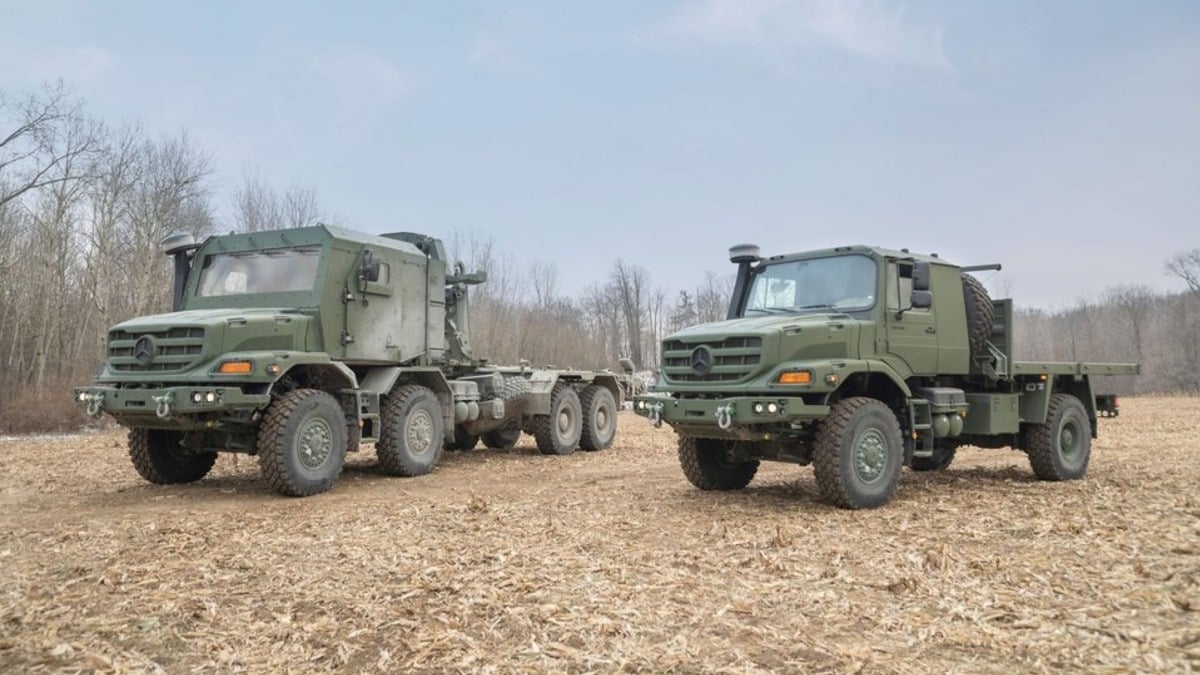
- Daimler Truck launched "Daimler Truck Defence" as a global brand at Eurosatory 2026, targeting one billion euros in defense revenue by 2028 with a mid-three-digit million-euro investment.
- Confirmed contracts include 7,000 Zetros trucks for France, at least 1,500 logistics trucks for Canada, and a Bundeswehr order in the three-digit unit range.
Daimler Truck, the German commercial vehicle giant whose Mercedes-Benz and Unimog trucks have hauled military cargo across NATO exercises and combat zones for decades, announced Monday that it is converting its defense activities from a side business into a strategic priority, launching a unified global brand called Daimler Truck Defence and setting a target of one billion euros, roughly $1.1 billion, in defense revenue by 2028.
The announcement, timed to coincide with Daimler Truck’s presence at the Eurosatory 2026 defense exhibition in Paris, comes with a commitment to a mid-three-digit million-euro investment over the coming years in engineering, manufacturing, sales, and service capacity.
The scale of that ambition requires some context. Daimler Truck is already one of the world’s largest commercial vehicle manufacturers, producing heavy trucks under the Mercedes-Benz, Freightliner, Western Star, FUSO, and BharatBenz brands across factories on multiple continents. Its defense business has existed for years as a subset of that commercial activity, supplying militarized versions of commercial trucks to armed forces in Germany and elsewhere. What Monday’s announcement establishes is that the company no longer wants to treat defense as a byproduct of its commercial operations but as a dedicated global business with its own brand identity, leadership structure, and growth targets.
Dennis Kinzelmann, named as CEO of Daimler Truck Defence, framed the pivot in direct terms. “Demand for reliable military mobility is growing worldwide,” Kinzelmann said. “With our global manufacturing network, resilient supply chains, strong partnerships and expanded product portfolio, we can deliver military vehicles and mobility solutions quickly, at scale and with high standards.” That phrase, “at scale,” is the operative one. Defense customers, particularly NATO members racing to rebuild military stocks depleted by years of underinvestment and accelerated by support for Ukraine, need trucks in numbers that bespoke defense manufacturers often struggle to supply. A company that already produces commercial vehicles by the hundreds of thousands has a fundamentally different capacity ceiling.
The trucks Daimler Truck Defence plans to offer span a wide range. The Mercedes-Benz Unimog, a high-mobility utility vehicle that has served in military roles since the 1950s and remains in widespread use with the German Bundeswehr and dozens of other armies, forms part of the portfolio alongside the Zetros, a rugged truck designed for extreme off-road conditions and used in military applications by several countries, and the Arocs, a heavy construction and logistics platform adapted for military use. The Zetros is particularly notable in the current context: the press release confirmed a framework agreement with the French Armed Forces, in partnership with French defense company Arquus, covering 7,000 trucks based on the Zetros platform, a contract whose scale illustrates exactly the kind of high-volume program Daimler Truck Defence is positioning itself to execute.
The French contract is not the only major program already on the books. Daimler Truck confirmed a Bundeswehr order for military logistics vehicles in the three-digit unit range, meaning at least 100 but fewer than 1,000 trucks, and a contract with the Canadian Armed Forces executed in cooperation with General Dynamics Land Systems covering at least 1,500 logistics trucks. Those three contracts alone, before any new business generated under the Daimler Truck Defence brand, demonstrate that the company is not making aspirational claims from a standing start. It already has the orders and now wants the organizational structure to match.
The manufacturing backbone for the European portion of this ambition rests on two facilities. The Wörth am Rhein plant in Germany, one of the largest truck manufacturing facilities in the world, producing more than 60,000 vehicles annually at peak capacity, will serve as the primary driver of the defense growth strategy and is expected to generate demand for additional skilled workers as programs scale up. The Molsheim facility in France, which has long handled specialty and military vehicle variants, provides the European manufacturing depth that large defense contracts require. Both plants offer the ability to integrate military variants directly into existing commercial production lines, which matters enormously for cost efficiency and delivery timelines on high-volume orders.
Karin Rådström, CEO of Daimler Truck, connected the defense expansion explicitly to the company’s global footprint. “We are making targeted investments in our production facilities, the development of new solutions, and the expansion of our sales and service network,” Rådström said. “We are leveraging Daimler Truck’s global strengths across regions and brands to scale our defence business significantly.” The service network dimension of that statement carries real operational weight. Militaries deploying vehicles in remote or contested environments are acutely aware that a truck without parts and maintenance support is a liability, not an asset. Daimler Truck’s approximately 5,000 service locations across more than 160 countries gives it a logistics and support reach that pure-play defense manufacturers cannot easily replicate, and the company is investing to make that network more responsive specifically for defense customers.
The technological direction the company plans to pursue extends beyond conventional military truck supply. The press release noted that Daimler Truck Defence plans to advance innovations in autonomous driving technologies and unmanned systems integration, working with industry partners to adapt commercial vehicle technology for military applications. That is a significant signal. The unmanned logistics vehicle, a truck that can resupply forward positions without putting a driver in the cab, has moved from speculative concept to active military requirement as the Ukraine war demonstrated the vulnerability of supply convoys to drone and artillery attack. A company with deep commercial expertise in heavy vehicle automation and a global manufacturing network is well positioned to compete in that space.
The launch at Eurosatory 2026, where Daimler Truck is displaying Unimog, Zetros, and Arocs vehicles with mission-specific configurations developed with industry partners, puts the new brand in front of the NATO procurement officials and allied defense ministers who represent its primary customer base at the moment they are making decisions about vehicle fleets that will be purchased over the next decade.
Whether the company reaches its one-billion-euro revenue target by 2028 will depend on contract awards that have not yet been announced and political decisions that have not yet been made. But the structural argument for Daimler Truck Defence is straightforward: armies need trucks in numbers that the defense industry alone cannot produce, and the largest truck manufacturer in Europe just decided it wants the business.