

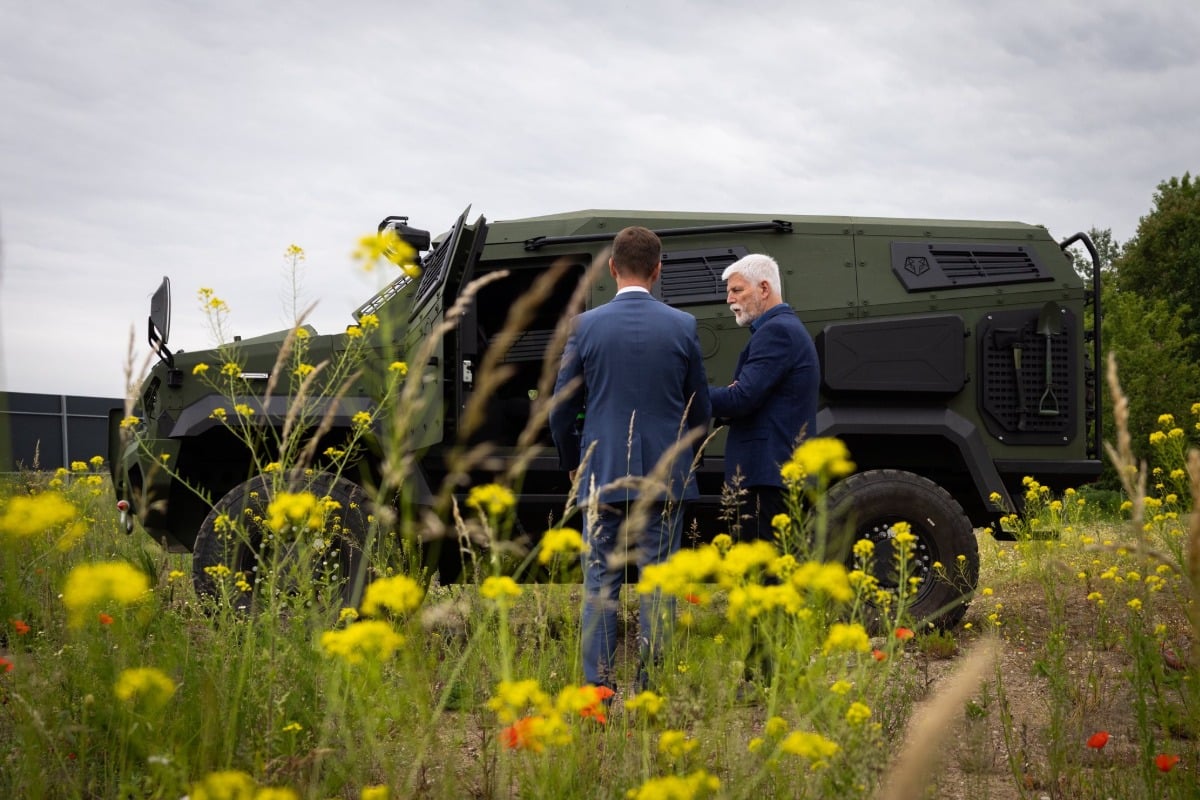
- Two counter-drone variants of the Slovak Wolf armored vehicle are confirmed operating in Ukraine as of June 3, 2026.
- Chropyňská strojírna holds a 60 percent stake in Wolf manufacturer DefTech and could host part of production if Czech and Slovak army contracts follow.
Two anti-drone variants of the Slovak-made Wolf armored vehicle are already fighting in Ukraine, Czech President Petr Pavel confirmed during a visit to the vehicle’s Czech manufacturing partner on June 3, according to iDnes.
Pavel made the visit to Chropyňská strojírna, a metalworking and engineering company in the Moravian town of Chropyně in the Czech Republic’s Zlín Region, as part of a two-day tour of the region focused on defense technology and industrial capability. During the visit he rode in the Wolf armored vehicle alongside his wife, getting a firsthand look at a platform that has moved from factory floor to active combat in Ukraine in its specialized counter-drone configuration. The visit gave the Wolf its most prominent political endorsement yet from a Czech head of state, and it arrived with a specific piece of confirmed operational news attached: two drone-modified Wolves are already in the field.
The Wolf is produced by DefTech, a Slovak defense company, and represents a category of light protected vehicle designed to balance mobility, protection, and affordability in a way that heavier armored personnel carriers cannot. Chropyňská strojírna holds a 60 percent ownership stake in DefTech, giving the Czech firm a direct industrial and financial interest in the platform’s success. The vehicle is currently undergoing evaluation by the Slovak Army, and if procurement contracts follow from both Slovakia and the Czech Republic, a portion of Wolf production is expected to move to the Chropyně facility, bringing manufacturing work and jobs directly to the region Pavel was visiting.
The counter-drone variant of the Wolf that has reached Ukraine represents a significant development in how Eastern European manufacturers are responding to the drone-dominated battlefield that the war has created. Since Russia’s full-scale invasion in February 2022, Ukraine has become the world’s most intensive testing environment for unmanned aerial systems used in strike, reconnaissance, and electronic warfare roles. The density of drone activity across the front line, from cheap first-person-view kamikaze drones costing a few hundred dollars to larger loitering munitions with ranges exceeding 100 km (62 miles), has forced every military operating in that environment to develop vehicle-level counter-drone capability rather than relying solely on dedicated air defense units positioned further back.
Fitting a counter-drone system to a light armored vehicle like the Wolf allows frontline units to carry organic protection against aerial threats without depending on the arrival of specialized air defense assets. The Wolf’s mobility, suited to the kinds of terrain and road conditions found across eastern Ukraine, makes it a practical platform for that role in ways that heavier vehicles are not. The two units currently operating in Ukraine represent a live operational test of that concept under real combat conditions, and the results of that testing will directly inform any future procurement decisions by Slovak and Czech defense authorities.

Czech President Petr Pavel, a former Chairman of the NATO Military Committee from 2015 to 2018, the first officer from a former Eastern Bloc country to hold that position, before his election to the Czech presidency in January 2023, brought particular weight to the factory visit given his military background. His assessment of Chropyňská strojírna was direct.
“Czech companies can also grow from relatively modest conditions to a state that we can be proud of around the world. The fact that you supply for renowned companies is proof that you do quality and good work,” Pavel said.
The president received a metal scale model of the Wolf, machined by Chropyně workers specifically for the visit, a detail that underlines the precision manufacturing capability the factory brings to the partnership with DefTech.
A vehicle built in Slovakia, part-owned by a Czech engineering firm in a Moravian town, fighting drone threats on Ukrainian soil. The supply chains of Central European defense now run all the way to the front line.