

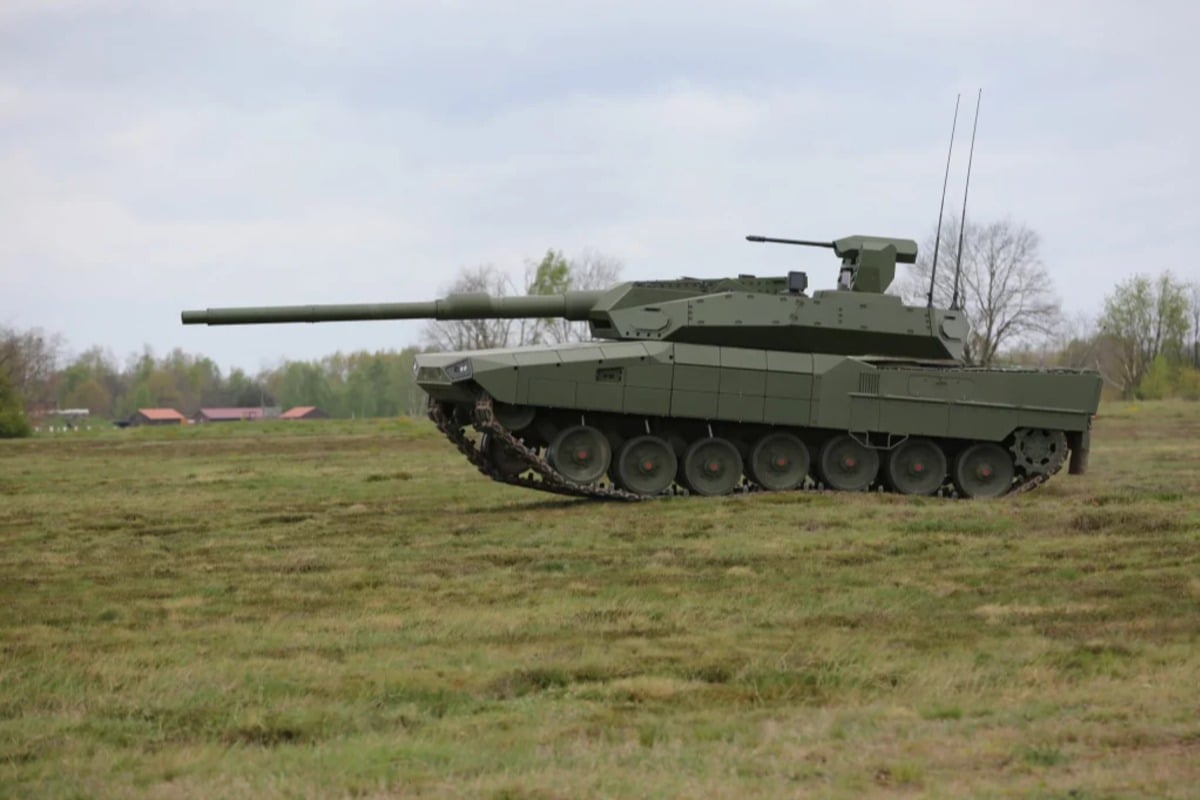
- Germany and France reduced their joint Main Ground Combat System tank program to shared "platform-independent technology" following a July 17 ministerial council.
- France is separately developing an interim tank combining a French ASCALON-armed turret with a German-built chassis, targeting roughly 200 vehicles.
Germany and France just reduced one of Europe’s most ambitious tank programs to a single, carefully worded sentence about “platform-independent technology,” and defense analysts reading between the lines say that sentence effectively confirms the joint program is dead in everything but name, Waldemar Geiger reported for the German defense outlet hartpunkt.
The Main Ground Combat System, known as MGCS, was supposed to give both countries a shared family of next-generation armored vehicles built on a single common chassis to replace Germany’s Leopard 2 and France’s Leclerc tanks starting around 2040. Following the 26th Franco-German Ministerial Council, held July 17 at Schloss Augustusburg in Brühl and the Nörvenich air base, Germany’s Defense Ministry described the program’s future in language that no longer mentions a shared vehicle platform at all.
Germany’s ministry now says the two countries will develop what it calls platform-independent technology for future manned and unmanned armored vehicles and their networked interaction with battle tanks, a description that drops any reference to the single, jointly procured chassis both nations agreed to build when MGCS launched in 2017. hartpunkt’s analysis draws a direct parallel to what happened with the Future Combat Air System, the parallel Franco-German fighter jet program that has already been quietly narrowed down to cooperation on a shared “Combat Cloud” networking layer rather than a jointly built aircraft, following Chancellor Friedrich Merz’s confirmation that Germany and France would not develop a joint next-generation fighter jet together.
MGCS was designed from the start as a broader system of systems rather than a single vehicle in the way a fighter jet is a single aircraft, developed jointly by KNDS, the holding company formed in 2015 by Germany’s Krauss-Maffei Wegmann and France’s Nexter Systems, along with Rheinmetall, which joined the program in 2019 and immediately complicated the carefully balanced industrial workshare both countries had negotiated. When Germany and France signed a memorandum of understanding on MGCS industrial responsibilities in April 2024, the agreement still stated unambiguously that a single chassis would serve as the foundation for the entire MGCS vehicle family, covering the gun platform, missile platform, and combat support platform alike, a commitment that negotiators split into eight development areas the industry calls pillars, covering everything from the vehicle chassis and automated navigation to sensors, protection systems, and simulation environments, with leadership of each pillar assigned to Germany, France, or shared jointly between both nations.
Even that 2024 agreement carried visible cracks from the outset, most notably in Pillar Two, the gun, turret, and ammunition system widely seen as the most contentious piece of any tank program, where negotiators could not agree on a single turret design and instead postponed the decision entirely, allowing each country to develop its own gun system first, followed by comparative testing before choosing a winner later. That compromise already broke with the program’s founding principle of avoiding duplicated development work between the two nations, and observers following the Franco-German tank effort have described the relationship behind the scenes as far from harmonious in the years since.
Rather than waiting quietly for Germany to sort out its differences, France has moved forward on its own parallel track. French armaments chief Patrick Pailloux presented three possible scenarios in February for an interim tank solution targeting roughly 200 vehicles, and French Defense Minister Catherine Vautrin confirmed to the National Assembly in April that Paris is funding a study into that interim capability directly. According to reporting from the outlet SUV, an internal French arbitration process has since favored an integration approach combining a French turret, most likely armed with KNDS France’s ASCALON gun, a weapon system tested in 120 and 140 millimeter (4.7 and 5.5 inch) configurations since 2022, mounted on a German-built chassis. French officials have been explicit that they see this as more than a stopgap measure, describing it instead as the first building blocks of an entirely new tank generation that could become fully French if cooperation with Germany does not advance, a hedge that lets Paris move forward on its own timeline regardless of what Berlin ultimately decides.
The July 17 council produced more than a quiet retreat on tanks, with Germany and France also agreeing to deepen nuclear cooperation, marked symbolically when French nuclear-capable Rafale jets and German Eurofighters conducted joint mid-air refueling for the first time, and confirming plans to continue the JEWEL early-warning initiative, which aims to build a shared European capability for detecting missile launches and tracking their trajectories. Officials also disclosed that Germany, France, and the United Kingdom are discussing development of a long-range precision strike capability exceeding 2,000 kilometers (1,243 miles), suggesting Franco-German defense cooperation is not collapsing entirely so much as consolidating around a narrower set of shared priorities.