

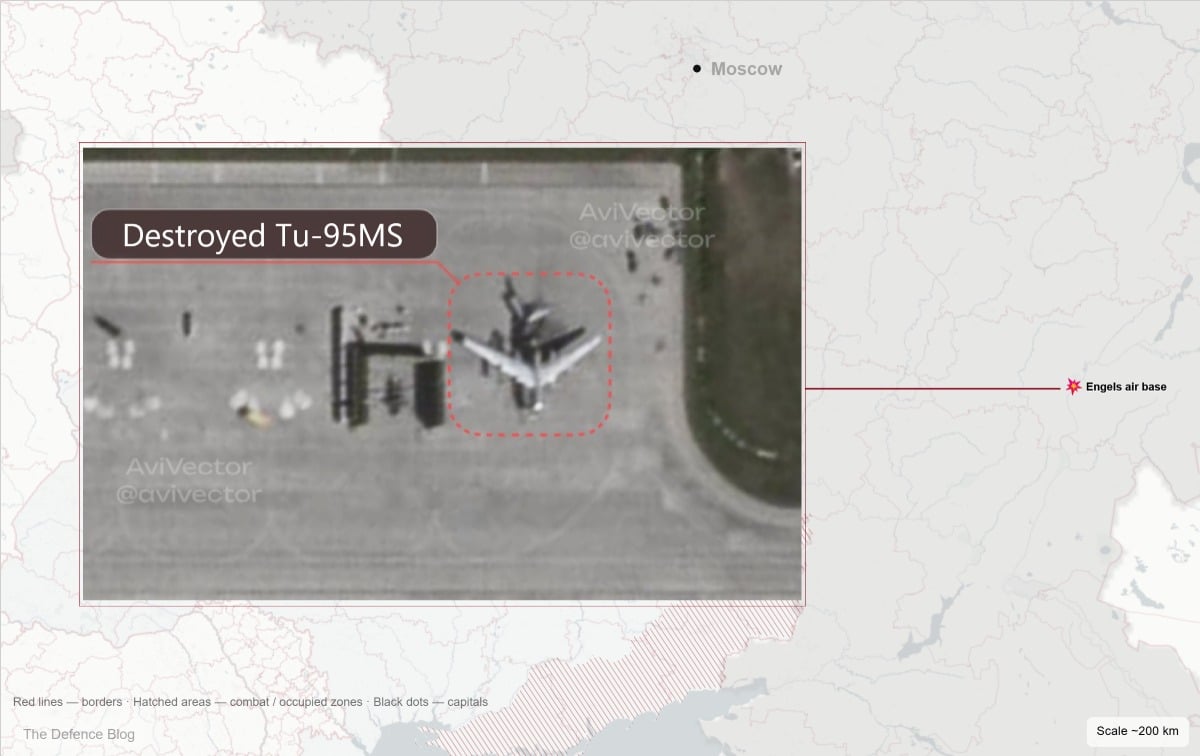
- AviVector published a Planet Labs satellite image dated July 19 showing a destroyed Tu-95 bomber at Engels-2 airfield in Russia.
- President Zelenskyy said Friday that Ukraine's SBU destroyed a Tu-95 at Engels following a drone attack reported overnight into July 16.
A satellite photograph taken Sunday appears to confirm what Ukraine’s president claimed just two days earlier: a Russian strategic bomber sitting at Engels air base did not survive a recent drone strike.
The open-source monitoring community AviVector published commercial satellite imagery from Planet Labs PBC, dated July 19, showing what the group identified as a destroyed Tu-95 bomber on the tarmac at Engels-2 airfield in Russia’s Saratov region.
President Volodymyr Zelenskyy announced Friday that Ukraine’s Security Service, known as the SBU, had destroyed a Tu-95 strategic bomber at Engels as part of a broader round of long-range strikes, a claim that followed a drone attack Russian Telegram channels and local officials reported overnight into July 16. Residents of Saratov and Engels began posting about explosions and a large number of drones in the sky starting around 2:30 a.m. that night, with a fire subsequently breaking out at the military airfield. Sunday’s satellite image, if it holds up to further scrutiny, would mark the first independent visual confirmation that the strike actually destroyed an aircraft rather than causing damage limited to infrastructure or equipment on the ground.
Based on the imagery, AviVector’s analysis suggests drones struck the rear portion of the bomber, triggering a fire that destroyed the aircraft’s fuselage structure. The tail section of the fuselage was completely torn away, extending back to the internal weapons bay where the aircraft would normally carry its cruise missiles, an assessment that, if accurate, points to catastrophic structural failure rather than a survivable, repairable strike. The Tu-95 has not been in production for decades; repairing that kind of damage is most likely impossible and impractical, an inference based on the aircraft’s status rather than a confirmed engineering assessment from any aviation authority, though it aligns with how defense analysts have generally characterized Tu-95 losses throughout the war.
The Tu-95, a Soviet-era turboprop bomber that first flew in 1952, remains one of the oldest combat aircraft still flying anywhere in the world, and Russia has continued relying on it specifically for its ability to carry long-range cruise missiles like the Kh-101 far outside the reach of Ukrainian air defenses before launching them toward Ukrainian cities. Engels-2 hosts two of Russia’s heavy bomber regiments, the 184th and the 121st Guards, making it one of only two primary staging grounds, alongside a base in Ukrainka in Russia’s Far East, from which Russia has launched the bulk of its long-range bomber campaign since the full-scale invasion began. Every Tu-95 lost at Engels carries outsized weight precisely because Russia can no longer build replacements, meaning each destroyed airframe represents a permanent reduction in Moscow’s long-range strike capacity rather than a setback new production could eventually reverse.
Russia has invested heavily in protecting its remaining bombers in response to that pattern. Satellite imagery obtained by The War Zone and dated June 20 showed construction underway on at least 17 new hardened shelters at Engels, sized specifically for the Tu-95 and Tu-160’s large wingspans, and separate Planet Labs imagery reviewed by the outlet in September showed Russian crews painting two-dimensional decoy silhouettes of Tu-95 bombers directly onto the tarmac in an apparent attempt to confuse drone operators or satellite analysts scanning the base for real aircraft. Neither measure appears to have stopped this latest reported loss, and the gap between how much Russia has spent hardening Engels and how often aircraft there keep getting destroyed says something meaningful about how difficult that base has become to fully protect.
According to the open-source loss-tracking project Oryx, which counts only losses confirmed through photographic or video evidence, Russia has lost at least 10 Tu-95MS bombers since the start of the full-scale invasion, a figure that does not yet include this latest reported loss at Engels. Nearly all of those confirmed losses share a common thread worth underscoring: they happened on the ground at Russian airbases, destroyed by drones while parked, rather than in aerial combat or shot down by the very air defense systems Russia has spent years building to protect its own skies.