

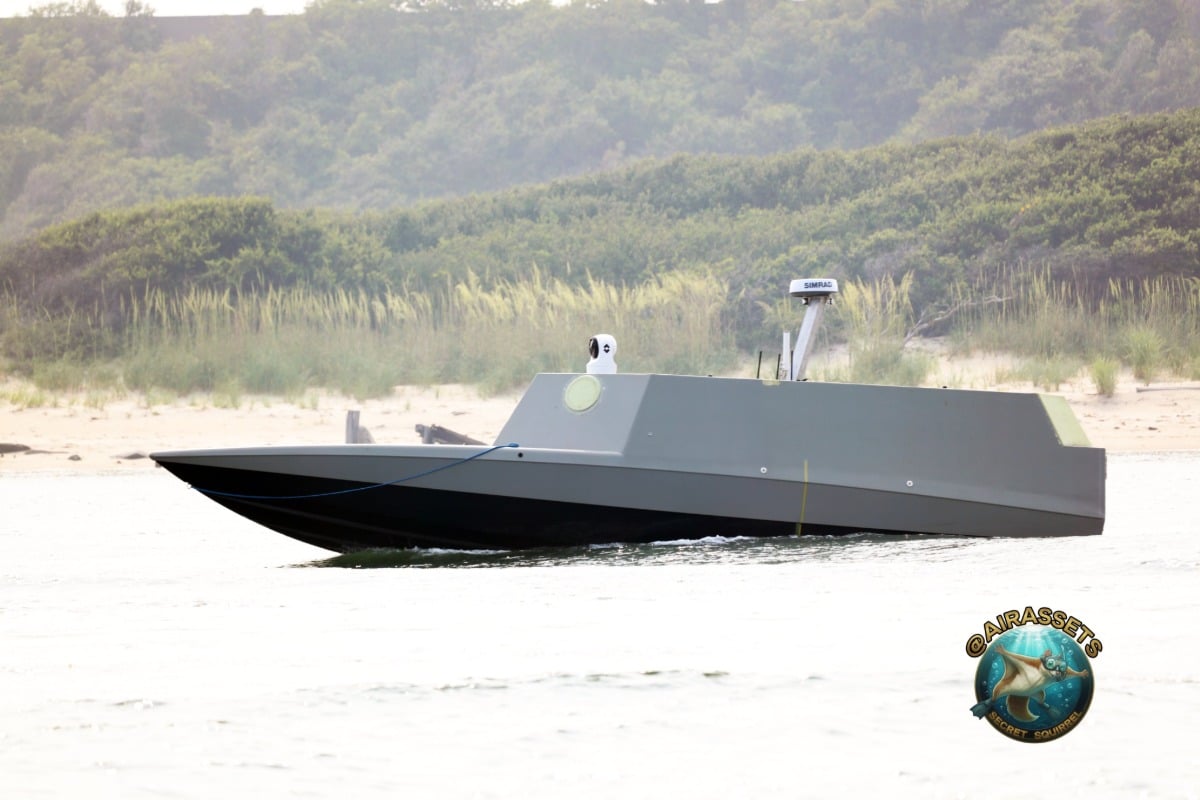
- An unidentified uncrewed surface vessel was photographed under Navy security escort leaving Naval Amphibious Base Little Creek in Virginia Beach.
- The open-source account Aviation and Naval Assets identified a marine radar, camera turret, mesh antennas, and possible dual synthetic aperture antennas on the vessel.
A U.S. Navy security boat escorted an unfamiliar uncrewed vessel out of Naval Amphibious Base Little Creek, and the open-source account Aviation and Naval Assets shared photos and video of a boat that does not match any publicly known U.S. Navy drone design currently in service.
The account, which tracks military aviation and naval hardware sightings, posted the images showing the vessel under armed escort as it left the Virginia Beach base, home to the Navy’s Atlantic Fleet amphibious forces and a major hub for Naval Special Warfare training.
Based on the published imagery, the unidentified craft appears to carry a marine radar consistent with commercial Simrad-brand systems, the kind widely used on both civilian and military vessels for basic navigation and collision detection, alongside a rotating sensor turret combining daylight and thermal imaging cameras that would let an operator track targets or obstacles in darkness or poor visibility. Aviation and Naval Assets also identified mesh networking antennas on the hull, a type of communications system that lets multiple vessels or vehicles relay data to each other without needing a single centralized signal tower, a setup increasingly common on unmanned platforms designed to operate as part of a coordinated group rather than in isolation.
What sets this sighting apart from a routine unmanned boat spotting is a detail Aviation and Naval Assets flagged specifically in its post describing the vessel’s onboard sensors.
“Has synthetic aperture antenna on back (x2) and some type of collision avoidance sensors/mm radar or something on front,” the account wrote.
A synthetic aperture radar system works by combining multiple radar readings taken as a vessel or aircraft moves, mathematically reconstructing them into a far more detailed image than a single stationary radar antenna could ever produce, a technique commonly used for high-resolution surface mapping, target identification, and detecting objects that might otherwise blend into background clutter. Mounting two of these antennas on the rear of an uncrewed surface vessel, if accurately identified, would suggest a platform built for serious surveillance or reconnaissance work rather than a simple test boat, though the exact function and manufacturer behind this specific unit remain unconfirmed based on the publicly available imagery alone. The unidentified front-mounted sensors described as possible millimeter-wave radar or collision avoidance equipment would serve a more mundane but equally important purpose, helping the vessel detect and avoid other boats, buoys, or debris while operating without anyone physically at the helm.
The drone also has a landing platform or deployment structure toward the rear of the vessel, a feature that, if confirmed, could indicate the boat is designed to launch and recover a secondary payload, such as a smaller drone, an inspection tool, or specialized mission equipment, though the source material does not provide enough detail to say definitively what that structure is built to carry or deploy.
None of these specific design details have been confirmed by the Navy, and no official statement has identified the vessel by name, program, or manufacturer. That silence is not unusual for early-stage unmanned surface vessel prototypes, which the Navy has increasingly tested under limited public disclosure as competition among contractors intensifies. The service’s Medium Unmanned Surface Vessel program selected seven companies in late May to build prototype vessels for at-sea testing, with trials beginning in June and wrapping up by October 2026, according to USNI News, and the Navy has said companies whose designs pass those trials could see follow-on production contracts, with a goal of fielding five to ten operational vessels by fiscal year 2027. Whether the boat spotted at Little Creek belongs to that specific program, a separate special operations-focused effort, or an entirely different initiative remains unclear from the available imagery, and the base’s role as a center for amphibious and special warfare operations makes it a plausible testing ground for several different categories of unmanned maritime systems rather than a strong indicator pointing toward any single program.
The broader push toward unmanned surface vessels has accelerated sharply across the Navy over the past two years, driven partly by demonstrations like the Saildrone Surveyor’s expanded role at this year’s RIMPAC exercise and partly by a wider recognition that autonomous boats can gather sensor data, conduct surveillance, and support fleet operations at a fraction of the cost of crewed vessels. Textron’s TSUNAMI USV family has already seen operational testing in counter-narcotics missions in the Caribbean, and rival navies have moved in parallel, with China publicly testing a swarm of autonomous L30 unmanned surface vessels off Zhuhai in March, underscoring how quickly this category of naval technology is proliferating across multiple militaries at once.