

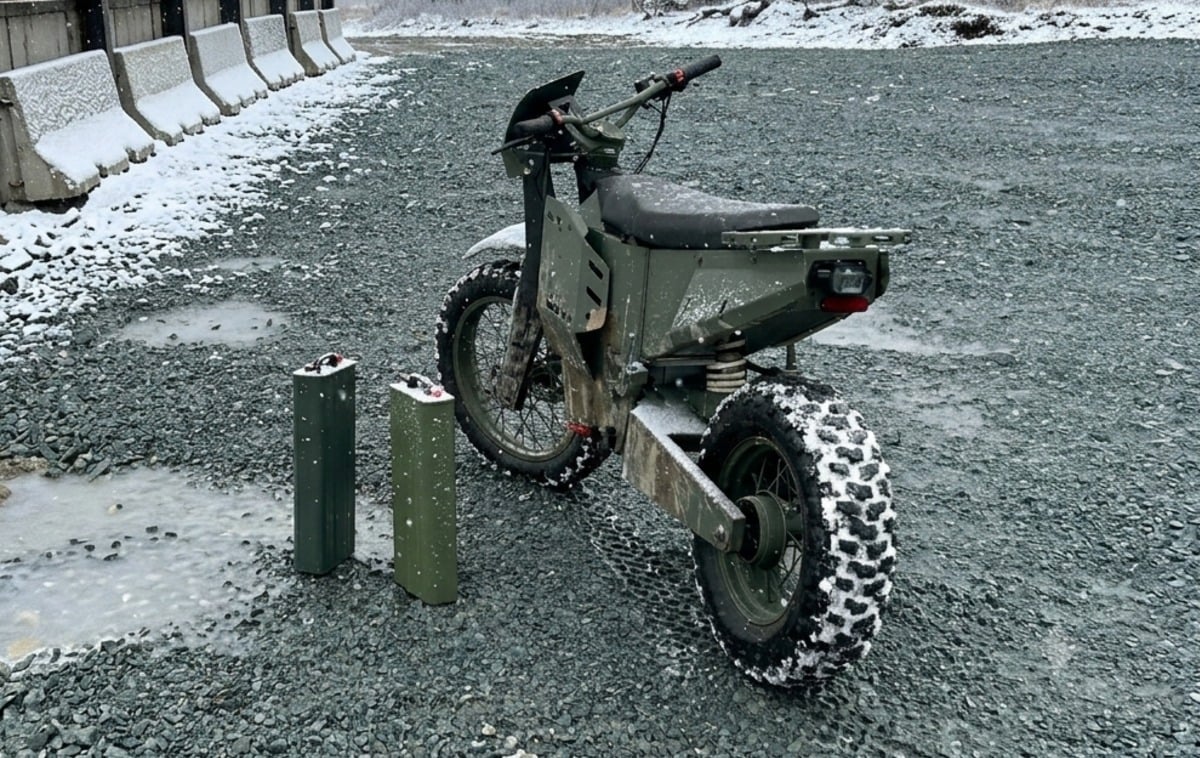
- NorthForge announced June 16, 2026, that its Dispatch all-electric tactical motorcycle has completed design and is ready for Canadian Armed Forces trials.
- The Dispatch weighs 140 kg loaded, operates below 50 decibels, survives minus 45 to plus 45 degrees Celsius, and carries 200 kg of cargo with a 200 km range.
A Canadian startup has completed the design of what it describes as the first all-electric motorcycle purpose-built for military intelligence and reconnaissance missions, and the vehicle is now ready for trials with the Canadian Armed Forces, bringing a platform that operates below 50 decibels of acoustic noise, survives temperatures from minus 45 degrees Celsius to plus 45 degrees Celsius (minus 49 to 113 degrees Fahrenheit), and carries 200 kg (441 lb) of cargo on a chassis weighing just 140 kg (308 lb) fully loaded with its three battery modules.
NorthForge, headquartered in Rocky Mountain House, Alberta, announced June 16 that the Dispatch has completed its design phase and entered the trials-ready stage after nearly four years of development conducted in direct consultation with active Canadian Armed Forces members and military advisors from the United States, Europe, and Asia.
The military motorcycle occupies a niche that defense forces have consistently struggled to fill with commercially derived solutions, because the requirements for a genuine tactical motorcycle, silent operation, extreme climate survival, field repairability without specialized tools, and the ability to sustain damage and keep moving, conflict fundamentally with the design priorities of consumer and sport motorcycle manufacturers who optimize for performance, comfort, and cost rather than survivability and operational resilience. NorthForge’s approach was to discard the consumer vehicle starting point entirely and design the Dispatch from first principles around the specific requirements that Canadian Armed Forces members identified through direct consultation, an approach that Trevor Hayter, CEO and founder of NorthForge, described in explicit terms. “The design was developed over more than three years, working with active CAF members and other key stakeholders and advisors,” Hayter said. “Some earlier iterations and concepts were tested and failed, just as most up-fitted consumer models we investigated. Our conclusions and final specifications came from military service members themselves and via real world testing.”
The acoustic performance specification is one of the most operationally significant numbers in the Dispatch’s design sheet, because a reconnaissance motorcycle that generates less than 50 decibels of noise, approximately the level of a quiet office or a residential refrigerator running, can approach observation positions, traverse forward lines, and conduct route reconnaissance without producing the engine noise that conventionally powered vehicles generate and that can be detected by opposing forces at distances of several hundred meters under typical field conditions. Electric propulsion eliminates that acoustic signature entirely during operation, replacing it only with the tire and mechanical noise that any vehicle of similar weight would produce moving across the same terrain, and the Dispatch’s 140 kg (308 lb) loaded weight, which NorthForge notes puts it in the same weight class as a 300cc combustion-powered competition motorcycle, means those rolling and mechanical noise sources are minimized by the vehicle’s light mass.
The battery system that powers the Dispatch is a deliberate departure from the consumer electric vehicle battery technology that most electrified defense vehicle concepts have adapted from commercial sources, and NorthForge has instead partnered with SysNergie of Magog, Quebec, a company that specializes in rugged mission-critical battery systems already undergoing field testing in four-season navigation buoy deployments by the Canadian Coast Guard in conditions that include salt water exposure, freeze-thaw cycling, and continuous outdoor operation across Canada’s full seasonal temperature range. The three modular battery units that the Dispatch carries are arranged for redundancy, meaning the vehicle can continue operating even if two of the three modules fail, batteries can be swapped in under a minute, and the system accepts charge from any available power source rather than requiring a specific charging infrastructure that may not exist in a forward operating environment.
Michael Uhlarik, Chief Product Officer at NorthForge and the Dispatch’s lead designer, explained the structural philosophy that allowed the company to achieve a vehicle weight of 140 kg (308 lb) while meeting military durability requirements that far exceed civilian standards. “We achieved the seemingly contradictory requirement, a low weight but super strong vehicle, thanks to the aerospace monocoque construction methodology we employed,” Uhlarik said. “It was the single most important architectural decision in the Dispatch design process.” The monocoque approach, derived from aircraft construction, integrates structural and load-bearing functions into the vehicle’s outer shell rather than building them around a separate internal frame, which eliminates the weight of the frame while actually increasing torsional rigidity, the resistance to twisting forces that determines how a vehicle handles rough terrain without flexing or failing at connection points.
The practical consequence of that construction approach extends to field maintenance, because the aluminum monocoque structure can be disassembled using only three tools, the complete vehicle packs into a crate measuring approximately 1.5 by 0.9 by 0.6 meters (5 by 3 by 2 feet), all electrical components share standardized quick connectors rated for extreme cold to prevent the connector failures that plague electronic systems in sub-zero temperatures, and replacing the entire power unit requires removing a single shaft rather than the multi-hour procedure that most vehicle drivetrain replacements involve. The Dispatch carries five dedicated cargo hard points on its chassis plus two additional racks on the front forks, giving it a total cargo capacity of 200 kg (441 lb) that NorthForge describes as achievable “without hesitation,” supported by solid girder front forks suspended by CNC-machined control arms rated to handle three times the stress of conventional telescopic forks found on civilian motorcycles.
The vehicle’s key performance specifications include a range of up to 200 km (124 miles), a top speed of 110 km/h (68 mph) with an optional narrower rear tire configuration, a seat height of 780 mm (30.7 inches) designed to accommodate a wide range of operator heights, and the 200 kg (441 lb) cargo capacity that the chassis hard points support. The 92 kg (203 lb) empty weight figure, meaning the vehicle without its three battery modules, illustrates how effectively the monocoque construction methodology concentrates mass in the energy storage rather than the structure itself.
The Dispatch is more than 80 percent Canadian-made, with offshore components sourced exclusively from NATO member countries, and its battery system, which NorthForge describes as 100 percent Canadian, with no dependence on batteries, motors, or software sourced from non-allied nations, makes the platform one of the more complete expressions of sovereign defense industrial policy in the Canadian startup ecosystem.
Hayter placed the Dispatch’s development within a broader argument about what modern defense mobility requires in an operating environment where drone surveillance has made conventional vehicle movement increasingly detectable and dangerous. “A destabilized world demands safe, reliable and enduring defence machinery,” Hayter said. “NorthForge exists to contribute to that national mission, building silent, resilient and flexible mobility systems here at home, with Canadian partners, for Canadian and allied forces.”