

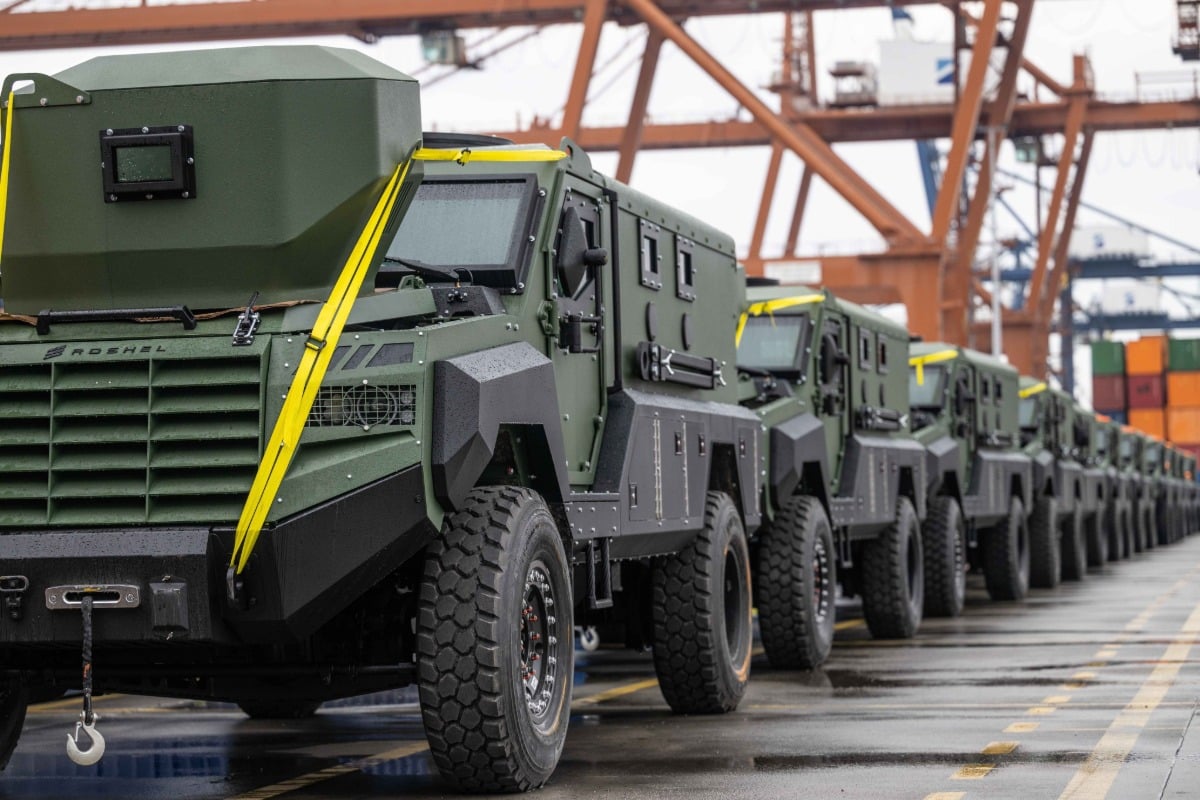
- Canada delivered a new batch of Roshel Senator MRAP vehicles to Ukraine, part of a 383-vehicle donation announced February 24, 2026.
- The Senator MRAP meets NATO STANAG 4569 Levels 2 and 3 and can survive detonation of charges up to 8 kg (17.6 lb) TNT equivalent.
A new batch of Canadian-built Roshel Senator armored vehicles has arrived in Europe, being unloaded and prepared for final handover to Ukraine under Operation UNIFIER, Canada’s long-running military support mission. Images released by the Canadian Armed Forces confirm the delivery is underway, adding to a fleet that has already proven its worth on some of the most dangerous roads in the world.
Built on a commercial Ford F-550 truck chassis by Roshel, a defense manufacturer based in Brampton, Ontario, the Senator belongs to a category of vehicles the military calls MRAPs, short for mine-resistant ambush protected, meaning vehicles engineered from the ground up to survive the detonations that kill troops in ordinary trucks. The Senator’s defining feature is a V-shaped hull, angled specifically to deflect blast waves and fragmentation away from the crew compartment when a mine or improvised explosive device detonates beneath the vehicle. That geometry, combined with high ground clearance, four-wheel drive, and a reinforced suspension system designed for the punishment of unpaved roads and cratered terrain, makes the Senator one of the most practical survivability tools available to Ukrainian forces fighting across mined and shell-scarred landscapes.
Ukraine’s Ministry of Defence confirmed that the Senator MRAP variant was developed based on operational experience gained by Ukrainian forces using the vehicle in combat conditions, a feedback loop between battlefield reality and engineering that has shaped each successive batch. The vehicles now arriving in Ukraine carry refinements informed by what actually happens when they get hit. According to Ukraine’s Ministry of Defence, the Senator MRAP features an armored steel body and windows, a blast-resistant hull, run-flat tires, and a central tire inflation system, enabling the vehicle to withstand explosions and maintain mobility after sustaining damage.
The Roshel Senator MRAP is certified to NATO STANAG 4569 Levels 2 and 3, meaning it can withstand armor-piercing 7.62×39 mm rounds — the standard caliber for AK-pattern rifles — shrapnel from 155 mm artillery shells, and the detonation of a charge up to 8 kg (17.6 lb) in TNT equivalent. That last specification matters enormously in eastern Ukraine, where Russian forces have seeded vast areas with antitank mines and where Ukrainian troops regularly encounter booby-trapped roads. A vehicle that can absorb a mine blast and keep its crew combat-effective is not a battlefield luxury; it is the difference between a patrol that completes its mission and one that does not come back.
Powered by a 6.7-liter V8 diesel engine, the Senator can reach approximately 110 km/h (68 mph) and achieve a road range of around 1,000 km (621 miles), with four-wheel drive enabling effective operation off-road and in demanding battlefield conditions. The vehicle’s adaptability across mission types is another reason Ukrainian forces have embraced it at scale, with the Senator platform configurable for troop transport, medical evacuation, command-and-control operations, or humanitarian demining work depending on what a given unit needs.
The current delivery forms part of a much larger commitment Canada announced on February 24, 2026, the fourth anniversary of Russia’s full-scale invasion. Canada committed the donation of 383 Senator armored vehicles from Roshel and 66 LAV-6 light armored vehicles from General Dynamics Land Systems Canada, drawing from approximately $2 billion in military assistance allocated for fiscal year 2026-27. The LAV-6 is a heavier 8×8 wheeled fighting vehicle that forms the backbone of Canada’s own armored formations, and sending 66 of them to Ukraine while retaining operational capability at home reflects the depth of political commitment Ottawa has made to Kyiv.
Canada’s Minister of National Defence David McGuinty visited Roshel’s production facility in Brampton in March 2026 to underscore the industrial dimension of the commitment, noting that the Senator program supports close to 500 jobs in Brampton and Mississauga. That framing reveals how deeply the Ukraine support effort has become woven into Canadian defense industrial policy, not simply a humanitarian gesture but a sustained production commitment with real domestic economic consequences.
Operation UNIFIER, the Canadian military training mission for Ukraine’s armed forces, was simultaneously extended for three additional years through 2029 with an expanded personnel contingent, with Canadian forces having trained over 47,000 Ukrainian troops since the mission began in 2015. The vehicles and the trainers together represent two complementary strands of Canadian strategy: equip Ukrainian units to survive contact with the enemy, and give those units the tactical skills to exploit that survivability in the field.
Roshel has confirmed that it has now supplied more than 2,500 Senator family armored vehicles to the Ukrainian military, a number that speaks to the scale and durability of the relationship between a single mid-sized Canadian manufacturer and a country fighting for its existence. Those vehicles have moved troops under fire, evacuated the wounded, and absorbed blasts that would have killed their occupants in an unprotected truck.