

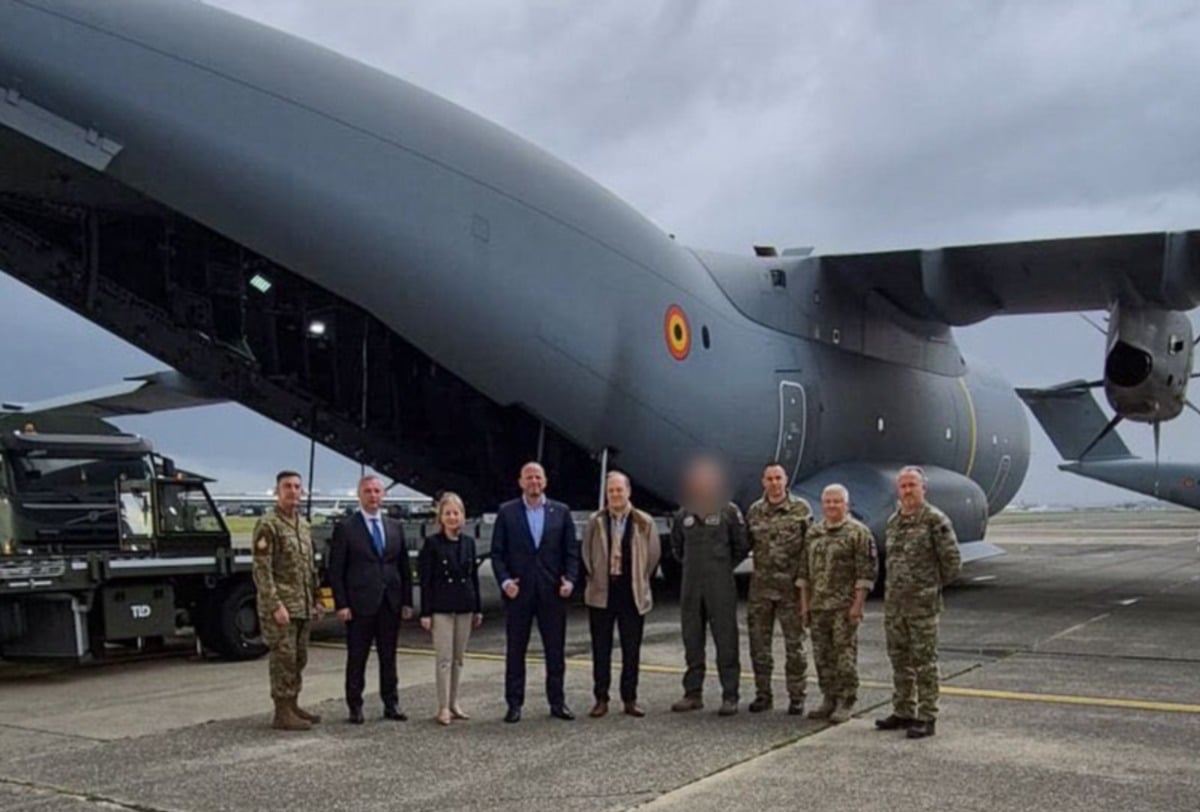
- Belgian Defense Minister Theo Francken confirmed on Sunday that the 15th Wing tactical air transport unit spent Saturday delivering protective weapons systems from Canadian stocks to Ukraine.
- Francken described the cargo as systems designed to intercept drone and ballistic missile attacks, without disclosing the specific weapons type delivered.
A Belgian military transport aircraft spent an entire day flying protective weapons systems from Canadian military stocks to Ukraine, in a priority delivery that Belgian Defense Minister Theo Francken announced on Sunday with enough detail to confirm the mission happened but not enough to reveal what was actually delivered.
The deliberate opacity around the cargo is the point: operational security around weapons transfers of this kind has become a standard practice among NATO allies supporting Ukraine, and Francken’s decision to announce the mission publicly while withholding the specifics reflects the balance between transparency with voters and discretion with adversaries.
Francken, Belgium’s Defense Minister and Foreign Trade Minister who has been among the most outspoken European officials on the urgency of weapons deliveries to Ukraine, posted the announcement on Sunday describing the operation in direct and emotional terms.
“Yesterday our 15th Wing tactical air transport was busy all day to urgently deliver such protective weapons systems, from Canadian stocks, to our Ukrainian friends. It succeeded,” he wrote, crediting the wing’s personnel and stating explicitly: “With this you have saved many lives.”
The 15th Wing, based at Melsbroek Air Base near Brussels, is the Belgian Air Component’s tactical air transport unit and operates the Airbus A400M Atlas, a large four-engine turboprop military transport aircraft capable of carrying up to 37 tonnes (81,600 lb) of cargo over intercontinental ranges. The A400M is one of the most capable tactical airlifters in the European inventory, combining the range and payload of a strategic transport with the ability to land on unprepared airstrips that larger jets cannot use, making it well suited for the kind of urgent logistics mission Francken described. The 15th Wing has been a consistent contributor to European airlift operations supporting Ukraine throughout the war, and Saturday’s mission represents a continuation of a pattern of Belgian tactical airlifts that have delivered a range of military equipment to Ukrainian hands since February 2022.
The weapons came from Canadian military stocks, a detail Francken included without elaborating on what those stocks contained or how Belgium came to coordinate their urgent delivery. Canada has been a consistent supporter of Ukraine throughout the war, with Operation UNIFIER, the Canadian Armed Forces military training and capacity building mission in support of Ukraine launched in 2015, training more than 47,000 Ukrainian military and security personnel in battlefield tactics and advanced military skills. Canada’s military aid commitments have included air defense components, with Ottawa allocating approximately $21.8 million for Ukrainian drones as well as AIM-9 missiles and electro-optical sensors as part of its 2026 contribution package. The specific items delivered on Saturday remain undisclosed, and neither the Belgian nor Canadian defense ministries had published further details as of the time of Francken’s post.
Francken’s framing of the cargo as “protective weapons systems” points toward air defense rather than offensive strike capability, a characterization consistent with the operational context he described at length in his post. He wrote that Ukraine faces mass attacks with drones and ballistic missiles as a daily reality, and that Russia has been escalating its strikes with increasingly heavy weapons including the Oreshnik, a Russian intermediate-range ballistic missile, and the Zirkon, a hypersonic cruise missile that Russia has used against Ukrainian targets.
“They come at hypersonic speed and have been fired at entire residential neighborhoods for several weeks. Terrible,” Francken wrote, establishing the threat context for why the delivery was urgent enough to occupy an entire wing’s aircraft for a full day.
Belgium’s total military support to Ukraine has reached approximately €2.4 billion since 2022, including F-16 training, ammunition, and mine-hunting support, making it one of the more substantial per-capita contributors among NATO members. The country committed to €1 billion in military assistance for 2026 alone, and Francken has repeatedly pushed for faster and larger deliveries, publicly criticizing delays and bureaucratic constraints that have slowed weapons transfers across the alliance. His decision to announce Saturday’s mission personally and to credit the 15th Wing by name is consistent with his practice of using public communications to build domestic political support for continued military aid and to signal to Ukrainian partners that Belgium’s commitments translate into action rather than just pledges.
The secrecy around the cargo type, while frustrating for those tracking what specific capabilities Ukraine is receiving, serves a purpose beyond operational security. Announcing that protective weapons systems arrived from Canadian stocks without specifying what they are denies Russia the ability to prepare countermeasures or adjust targeting before the systems are deployed. Every day between delivery and operational deployment represents a window of advantage that the Ukrainians need to exploit, and weapons that arrive unannounced and are deployed quietly before Russia adjusts are more effective than weapons whose arrival is broadcast in advance.