

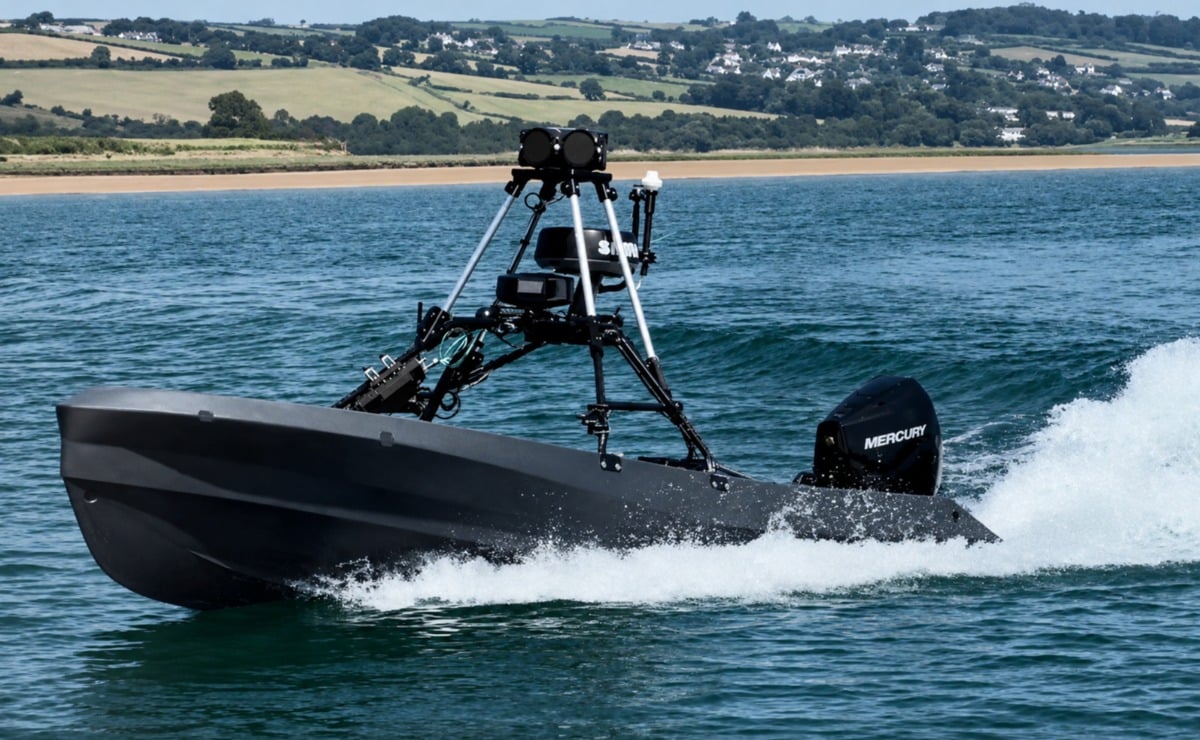
- SYOS Aerospace supported the Trident Sprint trial at RMB Chivenor with its SM300 uncrewed surface vessel.
- CRFS integrated passive RF sensing technology onto the SM300 and connected it to an RFeye network with TDOA and AOA capabilities.
A New Zealand-built drone boat became a moving radio-sensing platform during a British military trial at RMB Chivenor, where SYOS Aerospace supported the Trident Sprint series with its SM300 uncrewed surface vessel and helped integrate CRFS passive RF sensors into a wider battlefield network.
The trial, led by the UK Ministry of Defence and MarWorks, focused on digital integration, information warfare and autonomous systems in conditions closer to field use than a trade-show demonstration. SYOS said it was the only autonomous vehicle manufacturer taking part, providing the SM300 USV as a mobile maritime platform while CRFS integrated its passive radio-frequency sensing technology into the vessel and linked it into the company’s RFeye network.
SYOS said the RFeye network used during the trial had both time difference of arrival and angle of arrival capabilities. Time difference of arrival, usually shortened to TDOA, estimates where a transmitter is by comparing when the same signal reaches multiple sensors. Angle of arrival, or AOA, estimates the direction from which a signal reaches a sensor array. Used together, the methods can help build a more reliable picture of where an emitter sits, especially when several sensors are networked across land, sea or air nodes.
The SM300 gave that network a maritime node rather than another static position on land. SYOS markets the vessel as a multi-role uncrewed surface vessel for persistent offshore operations, with modular payload capacity and electronic-warfare-resilient performance. Public reporting on the platform has described the SM300 as carrying payloads of up to 300 kg (661 lb) and reaching about 1,204 km (748 miles), or 650 nautical miles, depending on mission profile and configuration.
Those numbers explain why the platform is useful for more than harbor demonstrations. A boat that can carry a meaningful sensor payload and remain at sea for extended missions can push surveillance, relay or electronic support equipment away from a crewed ship or shoreline. That matters in maritime operations because the sensor may need to sit closer to the threat than commanders would want to place sailors.
SYOS said its role at Trident Sprint was to integrate quickly, operate reliably and generate direct feedback from end users in the field. The company said all objectives were achieved, and that the CRFS team highlighted the speed and ease of integration. SYOS said CRFS noted it was the fastest the team had been able to network into a vehicle system.
“Our role was simple — integrate quickly, operate reliably, and generate feedback from the field,” SYOS Aerospace said in its announcement.
The Royal Navy has described earlier Trident Sprint activity as part of a push to test autonomous and unmanned technologies for digital and information warfare, with Navy Develop and Navy Digital involved in work tied to the service’s RN2029 readiness goals. The series brings companies, military users and experimental systems into the same testing environment, where failures and field feedback can be more valuable than polished demonstrations.
The latest trial took place at Commando Logistics Regiment, RMB Chivenor, a Royal Marines site in Devon that gives industry teams access to military users who understand what would make a system useful in deployed conditions. For autonomy companies, that kind of setting is important because a platform must survive more than smooth water and controlled scripts. Operators care about setup time, transport, power, maintenance, payload swaps, data flow and whether the system can be trusted when communications or conditions degrade.
The CRFS payload adds another layer because electronic sensing is becoming central to both drone warfare and naval security. CRFS makes RFeye systems used for spectrum monitoring, signal detection, direction finding and geolocation, with some RFeye sensor models covering signals up to 18 GHz. In simple terms, these systems help users see who is transmitting, where they may be located and how the electromagnetic environment is changing.
That capability has become more valuable as drones and electronic warfare reshape combat. Small unmanned systems depend on control links, video feeds, satellite navigation and data relays, while counter-drone forces try to detect or disrupt those signals. Naval forces face similar problems at sea, where crewed ships, uncrewed vessels, airborne drones and shore-based networks all create a crowded radio environment that can reveal intent or expose a target.
Putting RF sensing on a USV gives commanders a way to extend that electronic picture without risking a crewed craft. The vessel can move to a better listening position, carry sensors along a patrol route or act as a node in a distributed network. If the sensor boat draws attention or operates in a higher-risk area, the immediate danger falls on a machine rather than sailors.