

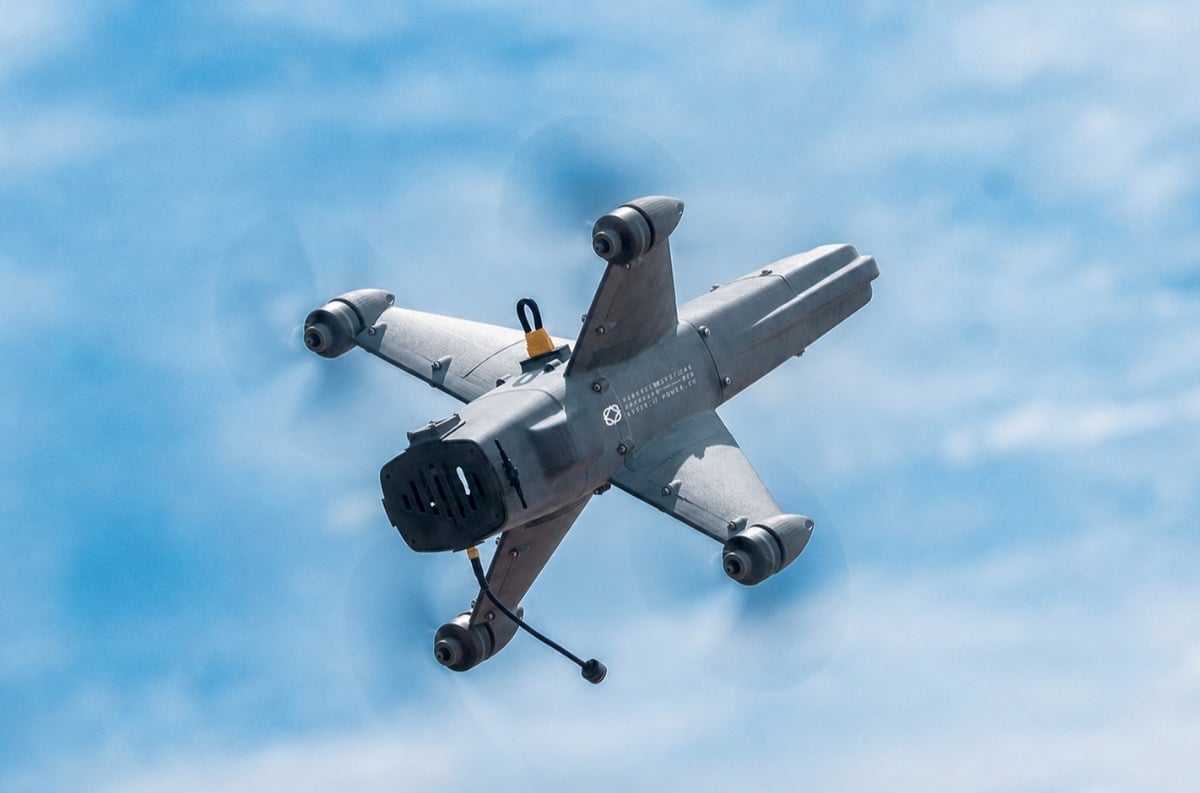
- Powerus posted imagery of its Guardian rotary-wing drone interceptor on June 30, 2026, citing thousands of field intercepts against Group 3 drone threats.
- The U.S. Air Force placed a limited purchase order for the Guardian following a successful demonstration, announced April 30, 2026.
Powerus, an autonomous systems company co-founded by former U.S. Army Special Operations veterans and headquartered in West Palm Beach, Florida, posted imagery of its Guardian interceptor on X on June 30, 2026, specifically linking the system’s capabilities to weekend strikes on Bahrain and naming the Shahed-136 and Geran-2 as the primary threats the platform is built to defeat.
The post described Guardian as a low-cost rotary-wing interceptor proven in the field with thousands of intercepts, trusted by American soldiers and allied forces, and built to address what the company calls the fundamental economics of modern drone warfare: when the interceptor costs more than the drone it stops, the attacker wins by attrition long before the defender runs out of targets.
Powerus has been public about Guardian’s development since March 2026, when the company introduced the Guardian-1, a lightweight, single-operator counter-drone platform built around a reinforced carbon fiber airframe capable of reaching speeds of 290 to 340 km/h (180 to 211 mph), fast enough to overtake and intercept the Shahed-136, which cruises at approximately 185 km/h (115 mph).
The system completed flight demonstrations during war-gaming exercises at the National Training Center at Fort Irwin, California, where U.S. servicemembers launched and operated the interceptor against simulated threat profiles, confirming in Powerus’s account what the company has been calling “real-world operational use,” though the specific intercept numbers the June 30 post cited, described as thousands, have not been publicly verified against independently confirmed engagement records.
The economics Powerus is positioning Guardian against are real and well-documented. Current intercept costs for defeating one-way attack drones through conventional missile defense run between $500,000 and $2 million per shot, according to the company’s own product documentation, against target drones costing approximately $20,000 to $30,000 each. Those figures are consistent with publicly reported costs cited by defense officials in Congressional testimony and by analysts tracking the Ukraine-Russia war, where the systematic use of Shahed-series drones against Ukrainian cities began demonstrating the unsustainability of missile-heavy counter-drone responses well before the problem migrated to other theaters. The Bahrain strikes referenced in Powerus’s June 30 post came as part of a broader pattern of Iran-linked aerial attacks across the Persian Gulf region that have accelerated through 2025 and 2026, with Iranian-origin or Iranian-design drones increasingly used by allied proxy forces against Gulf state infrastructure and military installations.
By April 2026, Powerus had already announced a second-generation system. The Guardian-2, a semi-autonomous evolution of the original platform, received a limited purchase order from the U.S. Air Force following a successful demonstration, with Powerus describing the Air Force as testing the system to address critical capability gaps for small teams operating outside the wire in the Middle East, seeking lightweight, deployable capability to detect, track, and defeat small unmanned aerial threats at the squad level. The Air Force order, described by Powerus as limited rather than a full production contract, represents the first confirmed U.S. government procurement of Guardian systems and validates the company’s claim that military customers have moved past evaluation and into actual acquisition.