

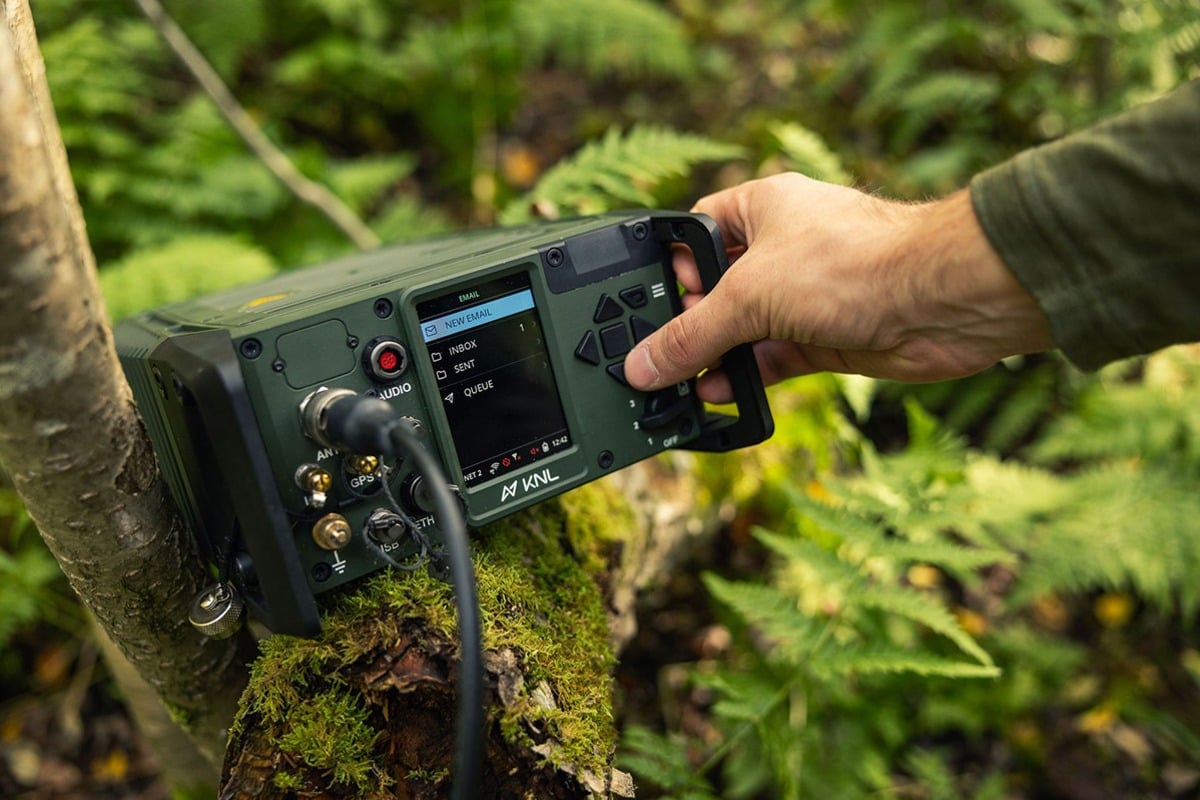
- KNL, a Finnish Telenor subsidiary, was appointed to the UK Tactical Communication Systems Framework covering Lot 2 Systems and Lot 3 Components, valued at approximately $10.5 billion over eight years.
- KNL specializes in HF software-defined radios and long-range tactical networking designed for electronically contested environments, with existing framework agreements with Finnish and Swedish defense forces.
A Finnish defense communications company has secured a place on the United Kingdom’s largest tactical communications procurement framework, gaining access to a purchasing vehicle valued at approximately $10.5 billion that will govern how British armed forces buy military radio and communications systems for the next eight years.
KNL, a defense communications subsidiary of Telenor Group, the Norwegian telecommunications giant, announced its appointment to the UK Tactical Communication Systems Framework, known by its government reference RM6393, with admission to both Lot 2 covering complete communications systems and Lot 3 covering individual components and specialized technologies. Lot 2 carries an estimated value of approximately $6.2 billion and Lot 3 an estimated $958 million, with the full framework valued at roughly $10.5 billion across its eight-year duration. Admission to both lots rather than just one reflects the breadth of KNL’s product portfolio, covering everything from complete integrated communications solutions to the specialized hardware components that defense customers integrate into their own systems architectures.
The UK Tactical Communication Systems Framework is the primary mechanism through which British defense and security customers procure tactical radio and battlefield networking equipment, providing a pre-approved supplier list and a streamlined purchasing process that eliminates the need for each government buyer to conduct a full competitive tender from scratch for every communications requirement. Suppliers admitted to the framework have already passed the qualification assessment that demonstrates their technical capability, financial standing, and security clearance status, which means individual orders can move significantly faster than traditional procurement allows. For a defense company seeking to grow its presence in the UK market, inclusion on the framework is not a guarantee of revenue but a prerequisite for competing for the contracts that generate it.
KNL, headquartered in Oulu, Finland, specializes in a category of military communications technology that has grown in operational importance as electronic warfare has become a defining feature of modern conflict. The company’s core products are high-frequency, or HF, software-defined radios and long-range tactical networking systems designed to maintain reliable communications in electronically contested environments, where adversaries actively jam, spoof, or intercept conventional radio frequencies. High-frequency communications, which operate in the 3 to 30 megahertz band, have characteristics that make them particularly valuable when other communications methods fail: HF signals can propagate over the horizon by bouncing off the ionosphere, reaching distances of thousands of kilometers without requiring satellites, relay stations, or line-of-sight between transmitter and receiver. That beyond-line-of-sight capability, combined with resilience to the GPS jamming and satellite communications disruption that Russian electronic warfare systems have demonstrated extensively in Ukraine, has made HF communications a renewed priority for Western militaries that spent the post-Cold War decades allowing their HF capabilities to atrophy in favor of satellite-dependent systems.
KNL’s CNHF communication system, which the company has delivered under a framework agreement with the Finnish Defence Forces and the Swedish Defence Materiel Administration, represents the specific product line that carries the most operational relevance to the UK defense market’s current requirements. Finland and Sweden, both of which joined NATO in 2023 and 2024 respectively, have defense requirements shaped by proximity to Russia and a deep institutional understanding of electronic warfare that dates to the Cold War era. Their procurement of KNL communications systems provides a validation signal that British defense procurement officials can assess: these are not systems tested only in benign environments but technologies evaluated by militaries that treat Russian electronic warfare as a primary design constraint rather than a theoretical consideration.
Toni Lindén, CEO of KNL, addressed the strategic significance of the UK appointment within the company’s broader international growth trajectory. “The United Kingdom is one of the world’s most important defence and security markets, and our inclusion in this framework further strengthens KNL’s position as a trusted international partner within the defence sector. We see significant long-term potential in the UK market and an opportunity to support British customers with proven communications solutions that address demanding operational requirements,” Lindén said.
The Telenor Group connection adds an institutional dimension to KNL’s positioning that purely independent defense companies cannot replicate. Telenor is one of the Nordic region’s largest telecommunications operators, with extensive infrastructure across Scandinavia and Asia, and KNL’s integration within that corporate structure provides access to telecommunications engineering expertise, cybersecurity capabilities, and international commercial relationships that support its defense communications development without requiring the company to build those capabilities entirely from scratch within a defense-only organizational context. That combination of specialized defense expertise and broader telecommunications engineering depth is increasingly relevant as military communications systems become more software-defined and more dependent on the kind of network engineering disciplines that the telecommunications industry has developed over decades.
The UK defense communications market has been undergoing significant change as the British Army, Royal Navy, and Royal Air Force all pursue modernization programs that require updated tactical networking, secure voice and data communications, and interoperability with NATO allies operating different national systems. The Tactical Communication Systems Framework provides the procurement infrastructure through which that modernization will be resourced, and the companies admitted to it will compete for orders that collectively shape what British forces can communicate, how far they can communicate, and how securely they can do so in the contested electromagnetic environments that modern warfare produces.
KNL’s admission places it alongside the established defense communications suppliers that have historically dominated the UK market, competing for opportunities where the company’s HF specialization and electronic warfare resilience credentials may differentiate it from competitors whose product portfolios were optimized for less contested communication environments.