

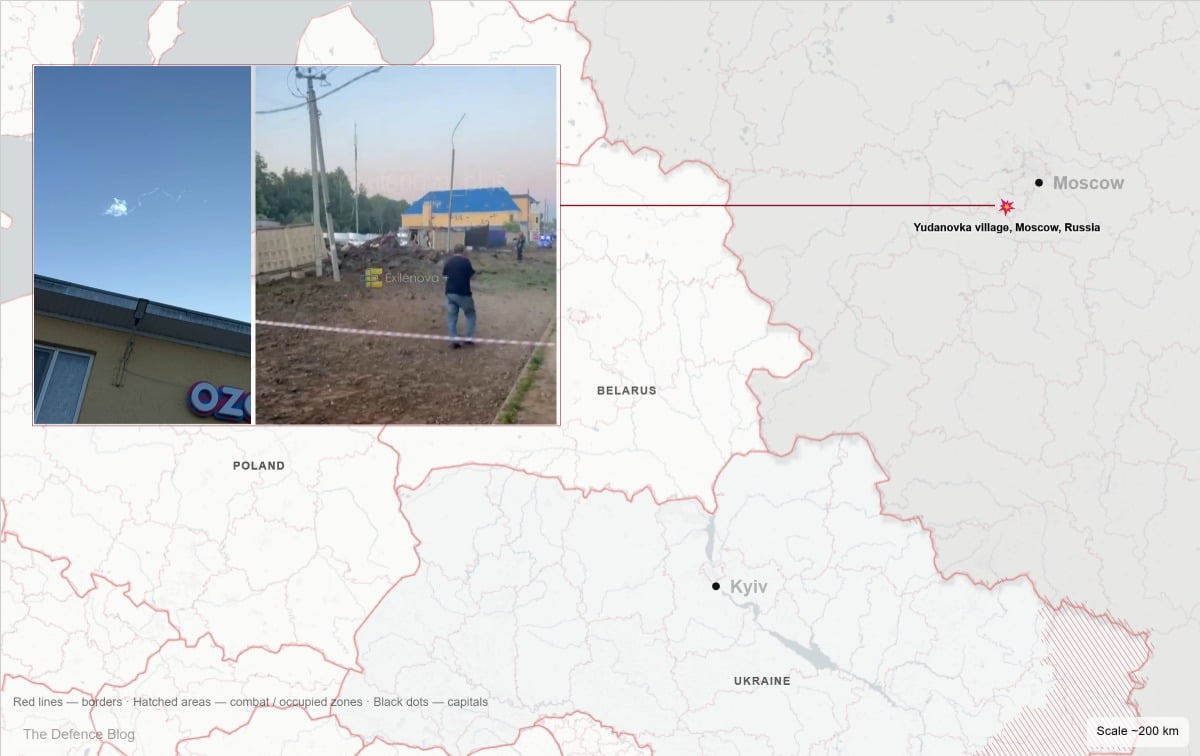
- Pro-Russian channel Voyennyy Osvedomitel reported S-300/400 activity at high altitude over Moscow Oblast during an air alert on June 30, 2026, with a large crater found at the impact site.
- Ukrainian OSINT group CyberBoroshno geolocated the crater near Yudanovka village, Moscow Oblast, along the Warsaw Highway, with no official confirmation from Ukraine or Russia.
Something unusual happened during an air raid alert over Moscow Oblast on June 30, 2026, and the debate over what it was has moved quickly through Ukrainian and Russian OSINT communities, with several analysts converging on a conclusion that neither Kyiv nor Moscow has confirmed: Ukraine may have attempted one of its first launches of a heavy ballistic missile toward the Russian capital.
No official statement from Ukraine or Russia acknowledges such a launch, and the available evidence consists entirely of indirect indicators, but the combination of radar track profiles, crater characteristics, and interception altitude reported from the scene is generating serious analytical attention.
The core observation comes from Voyennyy Osvedomitel, a pro-Russian military Telegram channel widely followed for its proximity to Russian military sources, which posted about the incident in terms notably cautious even by the community’s own standards. “During the missile alert in the Moscow region, the operation of S-300/400 air defense systems was recorded at a high altitude, uncharacteristic of the flight of a drone or a cruise missile, and a large crater on the ground from the intercepted object,” the channel wrote. “It is not excluded that this could be an intercept of a Ukrainian ballistic missile, but so far there is little information for unambiguous conclusions — only indirect signs.”
A Russian military channel using qualified language to raise the possibility of a Ukrainian ballistic missile over Moscow Oblast is itself unusual, given how sensitive Russian authorities are about acknowledging any Ukrainian strike capability reaching that region.
The Ukrainian OSINT community Exilenova+ added a separate piece of ground-level observation, posting: “The landing site of one of the missiles in the Moscow Oblast. Downed or fell short — it is hard to say, but the warhead is powerful, for such a distance.” That phrase, “for such a distance,” is analytically significant because it implies the object traveled considerably farther than a typical Ukrainian cruise missile or long-range one-way attack drone would travel before reaching the point where it came down, consistent with a ballistic trajectory originating from Ukrainian territory and traversing several hundred kilometers to Moscow Oblast.
The impact site was geolocated by the Ukrainian OSINT group CyberBoroshno, which published coordinates placing the crater near the village of Yudanovka in Moscow Oblast, along the Warsaw Highway corridor approaching Moscow from the southwest. Yudanovka sits well inside Russian territory at a distance from Ukraine’s borders that is consistent with a ballistic missile with a range of 800 km (497 miles) or more, but inconsistent with a standard cruise missile or drone travelling the same course under typical interception conditions, which generally brings such weapons down before they reach that depth into Russian air defense coverage.
Analysts who examined the combination of factors, the high-altitude intercept profile of the S-300/400 response, the large crater size, and the sheer distance from Ukrainian territory, have begun suggesting that the object may have been an FP-9 ballistic missile, Ukraine’s domestically developed heavy ballistic missile built by Fire Point. That inference is significant but unconfirmed, and it rests on circumstantial evidence rather than any direct visual identification or official acknowledgment. As CyberBoroshno and other Ukrainian OSINT accounts have noted, determining whether the object was destroyed by Russian air defense or simply fell short of its intended target remains impossible without additional data.
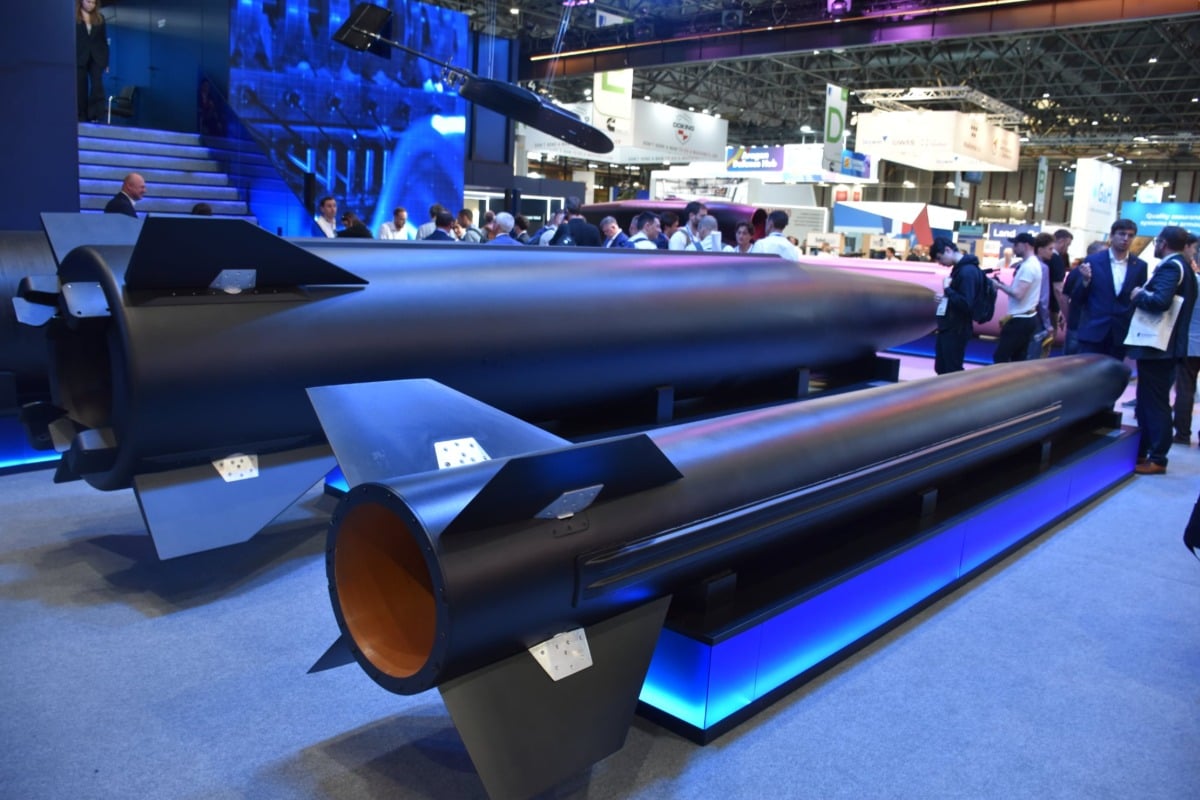
The FP-9’s known development timeline makes the speculation at least plausible on scheduling grounds. Fire Point chief designer and co-founder Denys Shtilerman said in an interview filmed at one of the company’s production facilities and published on the YouTube channel Pressing that ground testing of the missile’s solid-fuel engine was underway and that the first test flight against a target in Moscow would follow shortly after a successful engine validation. “We have everything for the FP-9, which can reach Moscow, except the engine,” Shtilerman said. “We will test the engine this month and expect to begin test flights soon. As soon as a test flight shows that everything is working properly, the next flight should be launched toward Moscow.” If that engine validation was completed in June 2026 and a test flight followed on the timeline Shtilerman described, June 30 would sit within the window he indicated.
The FP-9’s published specifications, where they exist, describe a weapon in a different category from anything Ukraine has previously fielded. The missile measures 9.5 m (31 ft) in length and 1.1 m (3.6 ft) in diameter, significantly larger than Russia’s Iskander-M ballistic missile at 7.2 m (23.6 ft) long and 0.95 m (3.1 ft) in diameter, which itself is considered a formidable short-range ballistic weapon. The FP-9’s stated design range of 855 km (531 miles) places Moscow well within its reach from Ukrainian territory, and the claimed warhead of 800 kg (1,764 lb) delivered at speeds exceeding 2,200 m/s (Mach 7) would account for both the large crater size and the high-altitude intercept profile the Russian channel described, since S-400 engagements against ballistic targets typically occur at altitudes and velocities far exceeding those of cruise missiles or drones.
What the June 30 incident has done is generate the most credible set of indirect indicators yet seen that Ukraine may be testing ballistic capabilities at range, in real operational conditions rather than controlled test ranges, at exactly the moment its lead ballistic missile developer said it would begin doing so. If confirmation eventually emerges, the implications for Russia’s air defense architecture and Moscow’s sense of distance from the front will require significant reassessment. If it does not, the incident still reveals that even the possibility of Ukrainian ballistic missiles reaching Moscow Oblast is now being discussed publicly by Russian military channels rather than dismissed outright.