

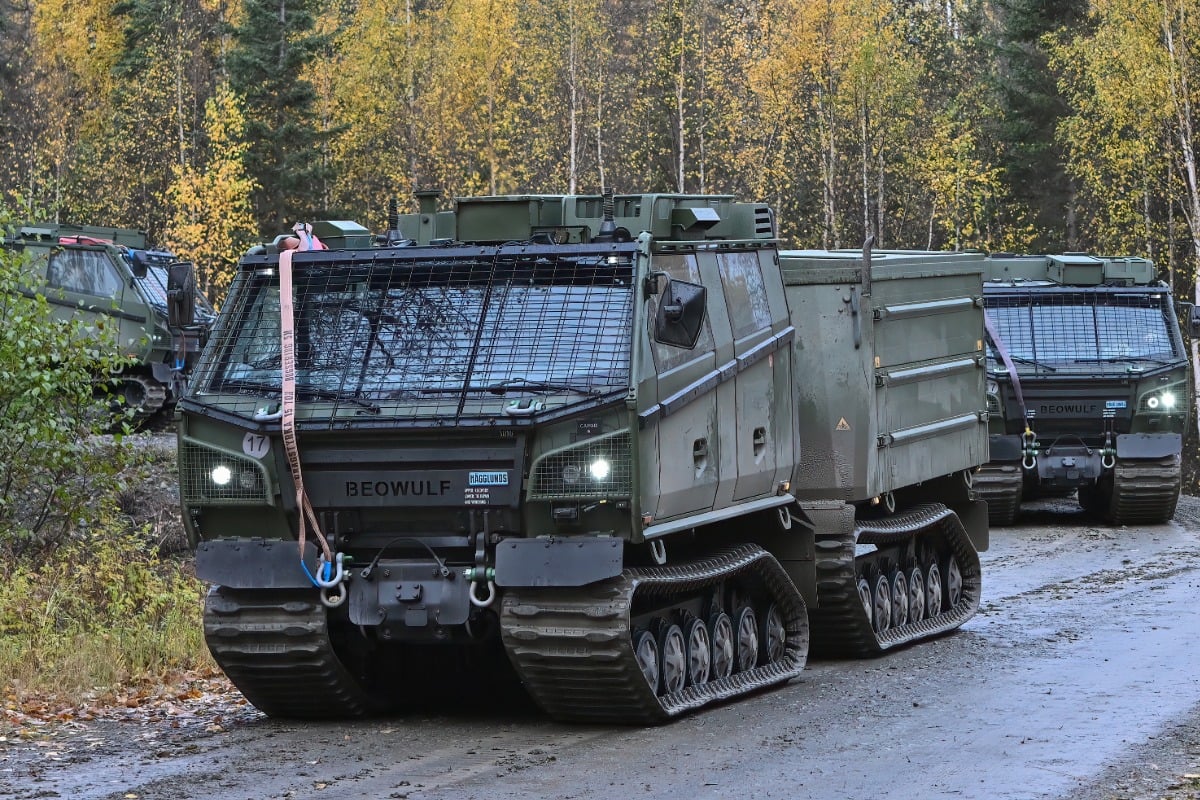
- The U.S. Army awarded BAE Systems a $35 million contract modification on June 30, 2026, for additional Cold Weather All-Terrain Vehicle production.
- The contract, managed by Army Contracting Command at Detroit Arsenal, Michigan, has an estimated completion date of December 30, 2027.
The U.S. Army awarded BAE Systems Land and Armaments a $35 million contract modification on June 30, 2026, for additional production of the general-purpose variant of the Cold Weather All-Terrain Vehicle, the tracked, amphibious troop carrier built to operate where wheeled vehicles simply cannot follow.
The Army Contracting Command at Detroit Arsenal, Michigan, made the award under an existing requirements contract, with two bids received and work locations and funding to be determined order by order, targeting an estimated completion date of December 30, 2027.
The vehicle behind this contract, known throughout the Army by its program acronym CATV, is built on BAE Systems’ Beowulf platform, designed and manufactured by BAE Systems Hägglunds in northern Sweden, a company with decades of direct experience building tracked vehicles for Arctic conditions. The Beowulf descends from the BvS10 family used by five European nations and represents an unarmored evolution of the older Bv206 and Bv206S platforms that have served NATO militaries since the 1980s.
Unlike a conventional wheeled truck, the CATV consists of two connected tracked compartments linked by an articulated joint, a design that distributes weight across a much larger surface area and allows the vehicle to flex and twist as it crosses uneven terrain rather than getting hung up or tipping over. That two-body architecture is what allows the CATV to cross terrain that would stop virtually any wheeled military vehicle: deep snow, ice sheets, muskeg bog, rocky slopes, and open water, all without requiring any preparation to transition between them.
The Army selected BAE Systems over a competing Oshkosh Defense and ST Engineering team in August 2022, awarding an initial $278 million contract for 110 vehicles after both companies’ prototypes survived a brutal evaluation period at the Cold Region Test Center in Alaska, where engineers and soldiers put the vehicles through mobility, payload, and amphibious swim testing from August to October 2021, followed by extreme cold weather trials from November 2021 through January 2022 that included operating temperatures dropping to minus 50 degrees Fahrenheit (minus 46 degrees Celsius). The CATV carries up to nine soldiers in its standard configuration, hauls a payload of up to 10,000 lb (4,536 kg), reaches a top speed of approximately 43 mph (69 km/h) on land and 2.5 mph (4 km/h) in water, and delivers a standard operational range of 250 miles (402 km), extendable to 620 miles (998 km) with modifications. Power comes from a 6.7-liter Cummins straight-six diesel engine paired with a six-speed Allison transmission, a powertrain combination chosen specifically for reliability in extreme cold where fuel can gel and metal components become brittle enough to fail under normal operating stress.
This new $35 million order continues an expansion pattern that has steadily grown beyond the Army’s original 110-vehicle requirement. BAE Systems secured a $68 million follow-on contract in late 2024 covering 44 additional CATVs, comprising a $48 million extension to the original full-rate production agreement plus a separate $20 million allocation funded for 2025, bringing the total fleet commitment toward the 163 vehicles industry analysts have identified as the Army’s broader requirement. The Army has designated the 11th Airborne Division, based at Joint Base Elmendorf-Richardson and unofficially known as “America’s Arctic Airborne Division,” as the primary recipient of the bulk of these vehicles, with the U.S. Army Northern Warfare Training Center at Fort Wainwright, Alaska, serving as the first unit equipped when deliveries began in fiscal year 2023.
The strategic rationale driving sustained investment in Arctic mobility extends well beyond replacing an aging vehicle fleet for its own sake. The Army’s 2021 Arctic strategy explicitly identifies the region as an area of growing strategic competition, citing both Russia’s extensive military infrastructure across its Arctic territory and China’s increasing assertion of interest in polar shipping routes and resource access as the ice cap continues retreating. Alaska, the only American state with Arctic territory, sits at the geographic center of that competition, and the Army has restructured significant force posture around the region accordingly, reactivating the 11th Airborne Division specifically for Arctic operations, removing Stryker wheeled combat vehicles from Alaska’s force structure in favor of platforms better suited to the terrain, and establishing one of the Army’s five Multi-Domain Task Forces with an Arctic focus.
The CATV’s mission set extends across homeland defense, defense support of civil authorities, and search and rescue operations, in addition to its core warfighting role transporting combat-loaded infantry squads, conducting medical evacuation, and serving as a mobile command and control platform. The unarmored U.S. variant shares roughly 80 percent parts compatibility with the armored BvS10 versions operated by Sweden, the United Kingdom, the Netherlands, France, and Austria, a commonality that simplifies logistics for any combined NATO operation involving multiple allied forces operating tracked Arctic vehicles together.