

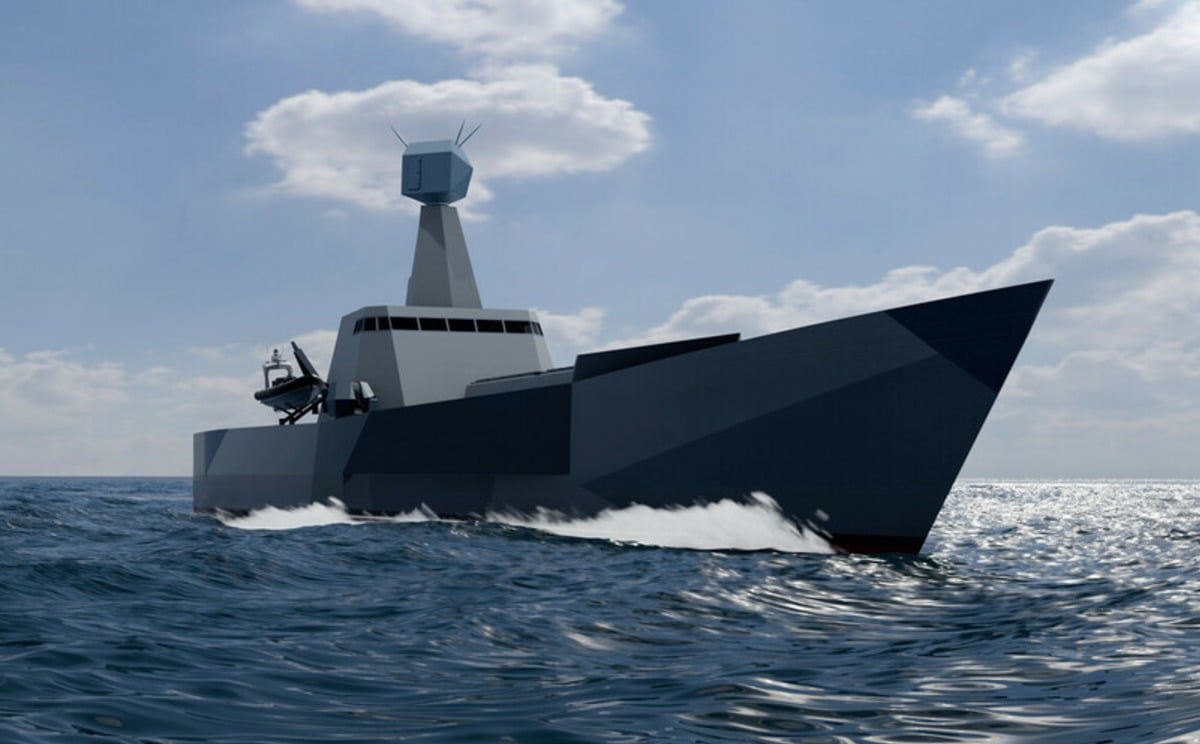
- Britain's Ministry of Defence announced at least six Common Combat Vessel hybrid warships to replace Type 45 destroyers, with first ships expected in the early 2030s.
- The announcement cancels the previously planned Type 83 destroyer, which had received only around $1.32 million in platform-specific design funding across three financial years.
Britain has abandoned plans to build a conventional successor to its Type 45 destroyers, instead ordering at least six new warships designed to command networks of autonomous drones across the air, surface, and subsurface, as reported by UK Defence Journal.
The new class, called the Common Combat Vessel, will be the Royal Navy’s first hybrid warship, replacing both the Type 45 and the previously planned Type 83 destroyer that never advanced beyond an underfunded concept. The first ships are expected to enter service in the early 2030s, well ahead of the Type 45 fleet’s planned retirement date of 2038.
The decision to cancel the Type 83 program, which was formally named as the Type 45’s successor in the 2021 defence white paper, is a frank acknowledgment that the approach never gained traction. Defence minister Luke Pollard told Parliament earlier this year that only around £1 million ($1.32 million) had been spent on platform-specific Type 83 design work across three financial years, part of roughly £6.9 million ($9.1 million) of broader related spending, and that the concept had been inherited in an underdeveloped state by the current government. The Type 83 had been positioned inside the wider Future Air Dominance System concept but never received the funding or industrial commitment needed to move from PowerPoint to shipyard, leaving the Royal Navy facing a structural gap in its future surface fleet that the Common Combat Vessel is now designed to fill.
The Type 45 destroyers the new ships will eventually replace are among the most capable air defense warships ever built for the Royal Navy, each displacing 7,350 tonnes (16.2 million lb) and measuring 152 m (499 ft) in length, built around the PAAMS Sea Viper missile system using the SAMPSON active electronically scanned array radar and the S1850M long-range search radar. They can simultaneously track hundreds of targets and engage multiple incoming missiles, and HMS Diamond demonstrated the system’s real-world effectiveness in December 2023 when she shot down a drone targeting commercial shipping in the Red Sea with a single Sea Viper missile. Despite their formidable capability, the class has been troubled throughout its service life by a propulsion design flaw in its Rolls-Royce WR-21 gas turbines that caused persistent power failures in warm water operations, and HMS Daring, the lead ship, has not put to sea for more than 3,000 consecutive days at the time of the announcement. The Power Improvement Project, designed to add diesel generators to bypass the turbine flaw, has been retrofitted across the fleet but has not fully resolved the operational tempo problems the design created.
The Common Combat Vessel’s philosophy is the inverse of everything the Type 45 represented. Rather than concentrating the Royal Navy’s air defense capability in six large, expensive, heavily crewed hulls, the new class will serve as the crewed command node for a much larger mixed fleet, coordinating autonomous platforms across all three domains. The Ministry of Defence described it as a shift that would extend the Navy’s “reach, resilience and firepower without a proportional increase in crew or cost,” a phrase that signals the government is betting on distributed, unmanned capability to compensate for the shrinking crewed fleet it can afford to operate. The drone platforms that will operate alongside the Common Combat Vessel are designated by type number in the Ministry of Defence’s announcement: the Type 91 missile platform, the Type 92 underwater sensing platform, the Type 93 extra-large uncrewed underwater vehicle, and the Type 94 sensor platform. All remain in early development, with no specifications disclosed beyond their designated roles.
Defence Secretary Dan Jarvis framed the new class as a structural response to a threat environment that the Type 45 generation was not designed to handle.
“Hybrid ships that are designed and built for the increasing threats we face,” Jarvis said. He added that the ships would be “British-built, supporting jobs across the nation,” and that the programs funded through the Defence Investment Plan were expected to sustain tens of thousands of jobs across the UK industrial base.
The announcement also tied the Common Combat Vessel directly to three new Atlantic operations that the Ministry of Defence named as Atlantic Bastion, Atlantic Shield, and Atlantic Strike, a set of programs designed to counter Russian military and intelligence activity in the North Atlantic and High North, protect the undersea cables that carry the majority of transatlantic internet and financial data, and strengthen NATO deterrence on the maritime approaches to Europe. The naming of specific Atlantic operations alongside a shipbuilding announcement is unusual and signals that the UK government wants the Common Combat Vessel understood not just as a procurement decision but as a strategic posture statement at a moment of heightened tension with Russia.
British industry had been circling the Type 83 requirement for years, and two distinct industrial concepts have emerged that will now compete to inform or supply the Common Combat Vessel program. BAE Systems, which builds the Type 26 frigate at its Govan shipyard in Glasgow, Scotland, presented at DSEI 2025 a system-of-systems architecture built around a large Air Warfare Command Ship paired with smaller adaptable combatants, with one concept based on the Triton trimaran demonstrator as a lean-crewed sensor and effector platform. BAE Systems’ Geoff Searle confirmed the company was modernising its combat management system under a contract called Re-Code to build what he described as the “foundation of the sovereign core” capability, and company representatives confirmed that evolving the Common Combat Vessel from the proven Type 26 hull was one option actively under review.
The competing industrial offer comes from Babcock, which pitched its Type 31 frigate for a different role under a concept it calls ARMOR Force. Under this approach, a Type 31 would act as the crewed controlling node for a fleet of large autonomous surface vessels built by U.S. shipbuilder HII, dispersing anti-submarine warfare, air defense, and strike capability across wide stretches of ocean using swappable containerised payloads handled through a modular system at Babcock’s Rosyth yard in Scotland.
“Our response to the First Sea Lord’s call for a re-imagined Hybrid Navy,” said Babcock chief executive Sir Nick Hine, describing ARMOR Force as built on open NATO standards to operate alongside allied forces.
The Type 26 frigate has already been selected by Australia, Canada, and Norway as the basis for their own future surface combatant programs, creating a common hull and combat system family across five navies. If the Common Combat Vessel builds on the Type 26 platform, as BAE Systems has suggested is possible, the UK’s domestic investment effectively supports an alliance-wide warship program whose production runs and industrial efficiencies span the entire Anglosphere.