

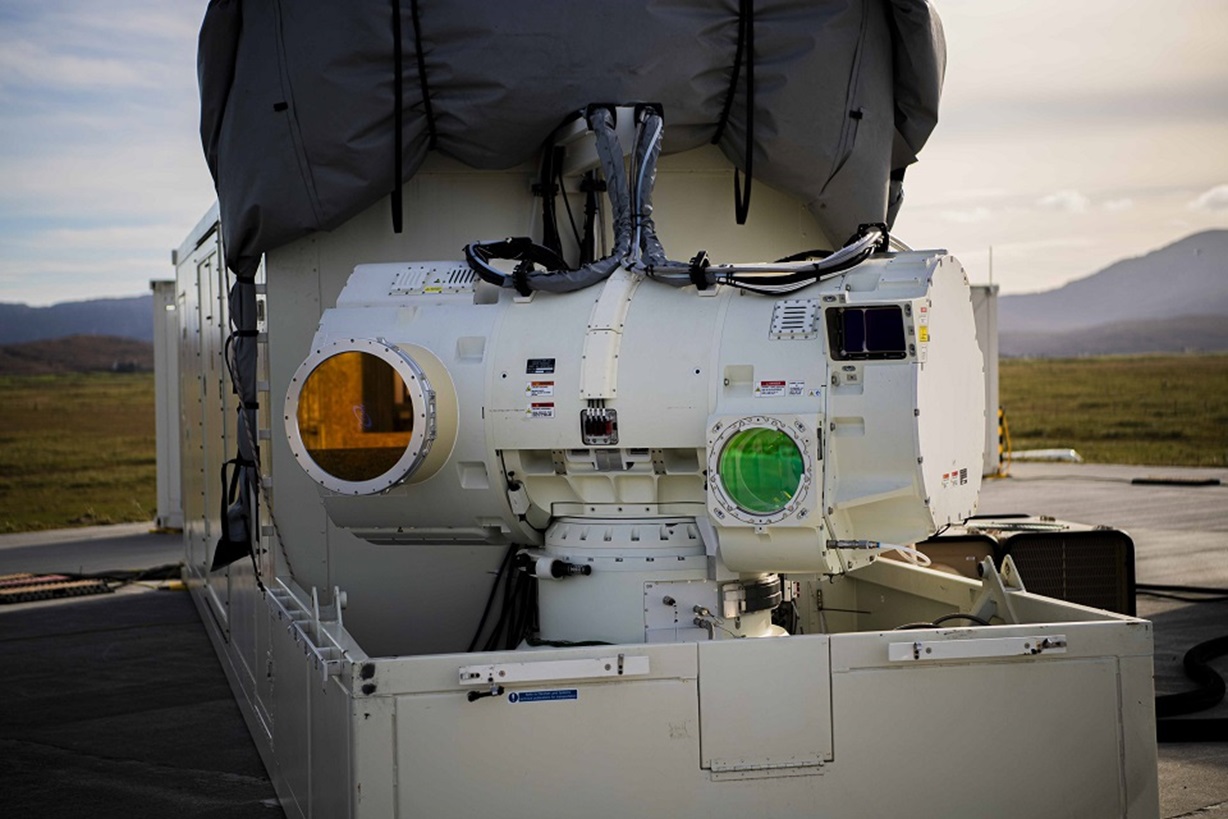
The UK Ministry of Defense (MOD) announced on Friday that it had achieved the country’s first high-power firing of a laser weapon against aerial targets during a trial at the MOD’s Hebrides Range.
The DragonFire laser directed energy weapon (LDEW) system, developed through a £100 million ($126 million) joint investment by the MOD and industry partners, demonstrated pinpoint accuracy and low long-term costs, marking a milestone in the advancement of laser-directed energy weaponry.
DragonFire, classified in its range but designed as a line-of-sight weapon, can engage any visible target, showcasing its potential as a revolutionary tool in the battlespace. The precision achieved by DragonFire is exemplified by its ability to hit a £1 coin from a kilometer away.
Laser-directed energy weapons, operating at the speed of light, utilize an intense beam of light to cut through targets, leading to structural failure or impactful results if the warhead is targeted. The cost-effectiveness of DragonFire is highlighted by the fact that firing it for 10 seconds equates to the cost of using a regular heater for just an hour, positioning it as a long-term, low-cost alternative for certain tasks missiles currently perform. The operational cost of the laser is typically less than £10 ($12) per shot.
Led by the Defense Science and Technology Laboratory (Dstl), in collaboration with industry partners MBDA, Leonardo, and QinetiQ, DragonFire’s successful trial opens the possibility of integrating this technology into the future air defense capabilities of both the Army and Royal Navy.
DragonFire is an advanced military laser, being developed by @dstlmod and 🇬🇧 industry.
The laser-directed energy weapon engages targets at the speed of light, using an intense beam of energy to cut through objects, leading to structural failure.
👉 https://t.co/LmQcE9EPrg pic.twitter.com/IZRjSFxpAV
— Ministry of Defence 🇬🇧 (@DefenceHQ) January 19, 2024
Defense Secretary Grant Shapps emphasized the potential of this cutting-edge weaponry to revolutionize the battlespace, reducing reliance on expensive ammunition and lowering the risk of collateral damage. The latest milestone builds on previous successful trials, including the first static high-power laser firing and the demonstration of DragonFire’s ability to track moving air and sea targets with high accuracy at range.
The DragonFire weapon system, resulting from a £100 million joint investment, supports highly-skilled UK jobs in cutting-edge technologies, offering a significant enhancement to the UK’s capability in LDEW systems.
Dr. Paul Hollinshead, Dstl’s Chief Executive, highlighted the agency’s expertise in realizing the potential opportunities and understanding the threats posed by directed energy weapons. The DragonFire trials signify a crucial step forward in integrating this technology into the armed forces’ preparedness for the future.