

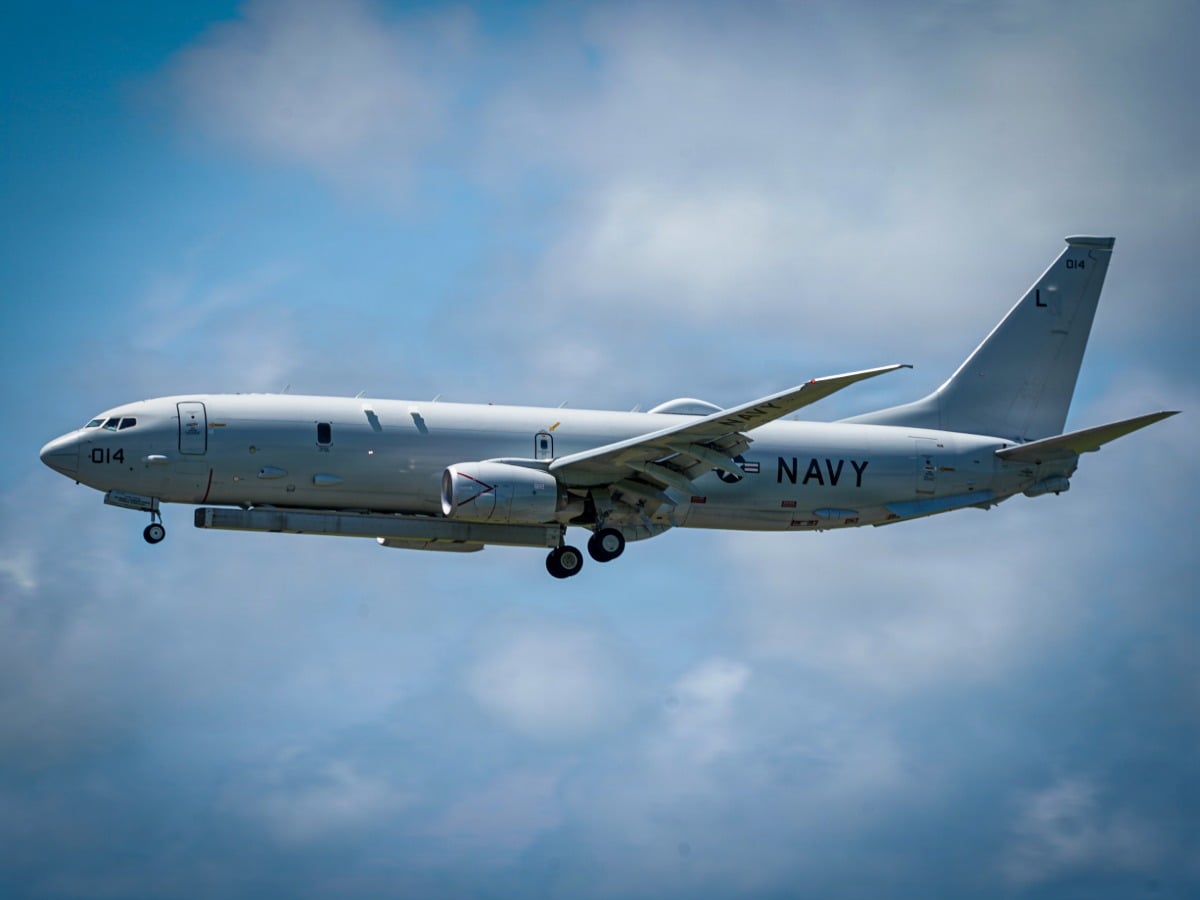
- The Navy awarded Boeing an IDIQ contract with a ceiling of $880 million on June 18 for P-8A Poseidon training systems through June 2031.
- Work spans 12 locations in nine countries, including the U.S., Australia, the UK, Germany, South Korea, Norway, New Zealand, Canada, and Singapore.
The U.S. Navy awarded Boeing a contract with a ceiling of $880 million on June 18, with no funds obligated at award, to provide training systems for the P-8A Poseidon, the workhorse aircraft the Navy uses to hunt submarines, track surface vessels, and conduct surveillance across vast stretches of open ocean. The deal covers not just American crews but operators in a string of allied nations that have bought the Poseidon and depend on the same training infrastructure to keep their fleets ready.
The P-8A Poseidon is built on the bones of a Boeing 737, the same narrow-body jet that fills commercial airline fleets around the world, but the resemblance ends at the airframe. The military version carries a suite of sensors that include the AN/APY-10 maritime surveillance radar, acoustic processing systems designed to detect and track submarines through underwater sound, sonobuoy launchers that drop underwater listening devices from altitude, and an electro-optical targeting turret for identifying surface targets. It can carry and deploy torpedoes as well as Harpoon anti-ship missiles, giving crews a direct strike capability against both submarines and surface ships. The aircraft cruises at up to 907 kilometers per hour (490 knots) and operates at altitudes up to 12,500 meters (41,000 feet), allowing it to cover enormous patrol areas that older, propeller-driven maritime patrol planes could not reach as quickly. Boeing says the global P-8 fleet has flown more than 700,000 combined hours across an operator base that now spans multiple continents and includes close U.S. allies on every ocean-facing front.
Training a crew to operate a platform this complex is not a short or simple process. The contract covers the full spectrum of what that training pipeline requires: developing and delivering new simulator devices, upgrading existing trainers, supplying the associated hardware and software, and providing the spare parts and support services that keep training systems functional over years of use. The work will be performed across 12 locations in nine countries, reflecting how thoroughly the P-8A has become NATO and allied aviation’s default maritime patrol aircraft. Boeing will perform the bulk of the work, about 80 percent, at its facilities in St. Louis, Missouri, with the remaining 20 percent distributed among P-8A training and operating sites in Jacksonville, Florida; Oak Harbor, Washington; Edinburgh in South Australia; Lossiemouth in Scotland; Ohakea in New Zealand; Gyeonsangnam-Do in South Korea; Wurster Nordseeküste in Germany; Greenwood and Comox in Canada; Singapore; and Trondheim in Norway. The contract runs through June 2031.
The Navy awarded the contract without competition, a decision that requires justification under federal procurement rules. Boeing holds a unique position as the designer and manufacturer of the P-8A and its associated training architecture, making it the only source capable of providing upgrades and modernization that integrate directly with the aircraft’s evolving mission systems and software baselines. This is a pattern that has repeated across recent P-8A support contracts: in March 2026, Boeing received a separate $167 million sole-source award for P-8A software sustainment and modernization, covering engineering analysis and hardware upgrades to address component obsolescence. The training contract announced this week follows the same logic, covering a system whose technical complexity places it beyond what a competing vendor could realistically step into and support.
The international footprint embedded in the contract’s work-share breakdown tells its own story. South Korea, Norway, New Zealand, Canada, Germany, Singapore, Australia, and the United Kingdom all appear on the list of locations where Boeing will perform work, and each of those nations has bought the P-8A as its primary maritime patrol platform. Germany received its first P-8A in November 2025 and is building out its Poseidon training and sustainment ecosystem, and Boeing won a separate $251 million contract in May 2026 specifically to deliver Germany’s P-8A training infrastructure, including operational flight simulators, weapons tactics trainers, maintenance trainers, and mission systems instruction facilities. Canada is further behind in that process: as The Defence Blog reported in February 2026, Boeing has begun fuselage integration on Canada’s first CP-8A Poseidon, making Canada the ninth nation to join the P-8 operator club, and Canadian personnel have already begun training alongside allied crews ahead of their aircraft’s delivery.
The P-8A’s mission systems, sensors, and software receive regular upgrades as threats evolve and new capabilities are fielded, and every upgrade creates a downstream requirement to update the simulators and classrooms where crews learn to use them. Letting that training infrastructure fall behind the aircraft it is supposed to replicate would degrade the readiness of every crew in every nation that flies the type, which is why this kind of sustained training contract is less optional maintenance expense than it is a non-negotiable cost of keeping a complex weapons system operationally credible. A submarine hunter is only as good as the crews flying it, and the crews are only as good as the training that prepared them.