

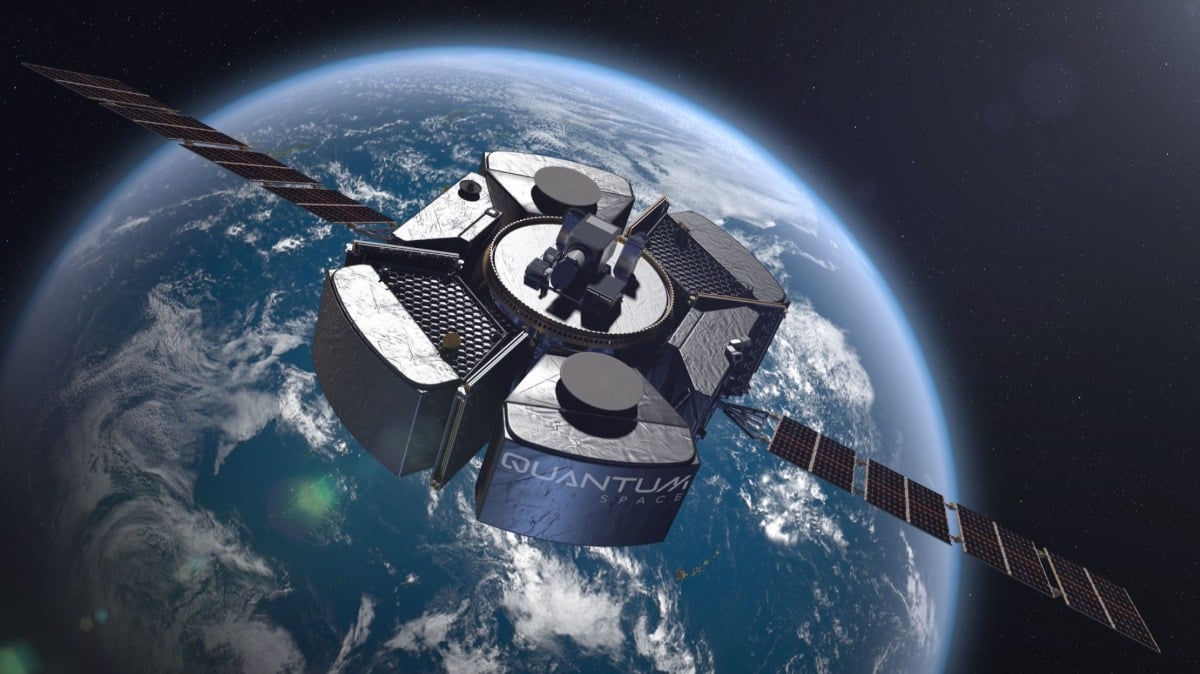
- Quantum Space secured a Department of War contract through the Operational Energy Capability Improvement Fund for a fuel depot spacecraft demonstration.
- The depot is built on Quantum Space's Ranger platform, adding to the company's existing Space Force Andromeda program contract.
A Maryland company wants to build something nobody’s ever actually flown: a working gas station in orbit, and the Department of War is now paying for it. Quantum Space announced a contract through the Pentagon’s Operational Energy Capability Improvement Fund to demonstrate a fuel depot spacecraft, built on its Ranger platform, that can refuel other satellites while they’re still working instead of letting them go dark the moment their tanks run dry.
The award adds to a federal résumé that already includes a slot on the Space Force’s flagship Andromeda program, and it lands at a moment when refueling satellites in orbit has gone from a research curiosity to something the military is actively paying multiple companies to prove out.
Right now, every satellite flying has the same built-in expiration date: its fuel tank. Once that’s empty, the satellite can’t reposition, can’t dodge debris, can’t chase down a target that’s moved. Operators usually just write it off, even if every other system on board is fine. For a military satellite, that’s worse than wasteful. An adversary who knows how much fuel a surveillance satellite has left also knows exactly when that satellite stops being a problem for them, which is exactly the kind of predictability the Space Force has spent the last few years trying to engineer out of its fleet. The service has openly admitted its research budget for this, just $16 million spread over five years, hasn’t matched how urgent it considers the need.
Quantum isn’t the only company chasing this. Northrop Grumman landed a $70 million Space Force contract last year to test a refueling payload called Elixir, working out the docking procedures any real operational system will eventually need. Astroscale is building its own orbital tanker, APS-R, under a 2024 contract aimed at refueling other satellites in geostationary orbit. What sets Quantum’s approach apart is that it’s building the depot straight into Ranger, the same spacecraft it’s pitching for jobs everywhere from crowded low Earth orbit out to geostationary orbit and into cislunar space, the stretch between Earth and the Moon that’s increasingly being talked about as the next strategic frontier.
CEO Jim Bridenstine, who ran NASA and helped stand up the Space Force in the first place, called the contract “a transformational step toward building the in-space logistics architecture the United States requires for resilient, enduring space operations.” He added that it “extends the life of high-value assets and creates operational options that fixed architectures simply cannot provide.”
Chris DePuma, who leads the fund’s Operational Energy and Combat Power portfolio, framed the award as the moment a long-standing idea finally gets real money behind it. “For years, in-space refueling has been a concept on our capability roadmaps,” DePuma said. “Today, we are investing to make it an operational reality. The OECIF award accelerates the deployment of critical refueling infrastructure, answering the urgent call for a persistent, maneuverable space logistics network.” He added that removing the fuel constraint doesn’t just keep existing satellites running longer, it opens up “entirely new mission sets and novel operations.”
Co-founder Ben Reed has the kind of resume that makes this pitch harder to wave off as pure ambition. He spent two decades at NASA, including hands-on work on three Hubble Space Telescope servicing missions, the program that first proved astronauts could actually repair a spacecraft already in orbit, before running the agency’s robotic satellite servicing effort. “The time for a shift from demonstrations toward operational depots is now,” Reed said. “The technologies are mature, the mission need is urgent, and Quantum Space possesses capital for delivery.”
Worth knowing before taking that last line at face value: Quantum Space is mid-transformation as a business right now. The company recently agreed to go public through a merger with a special purpose acquisition company, a deal expected to value it above a billion dollars once it closes later this year. Its own filings project tens of millions in revenue over the next couple of years alongside tens of millions in losses, the financial profile of a company still scaling rather than one already running mature operations. Ranger itself is still in development, with a pathfinder flight still ahead of it rather than behind it.
None of that changes the underlying problem, though. Every satellite anyone launches still runs on a tank that, once empty, ends its useful life regardless of what else still works. Whoever actually cracks refueling first doesn’t just keep a few satellites flying longer. They change what’s possible for everything that goes up after them.