

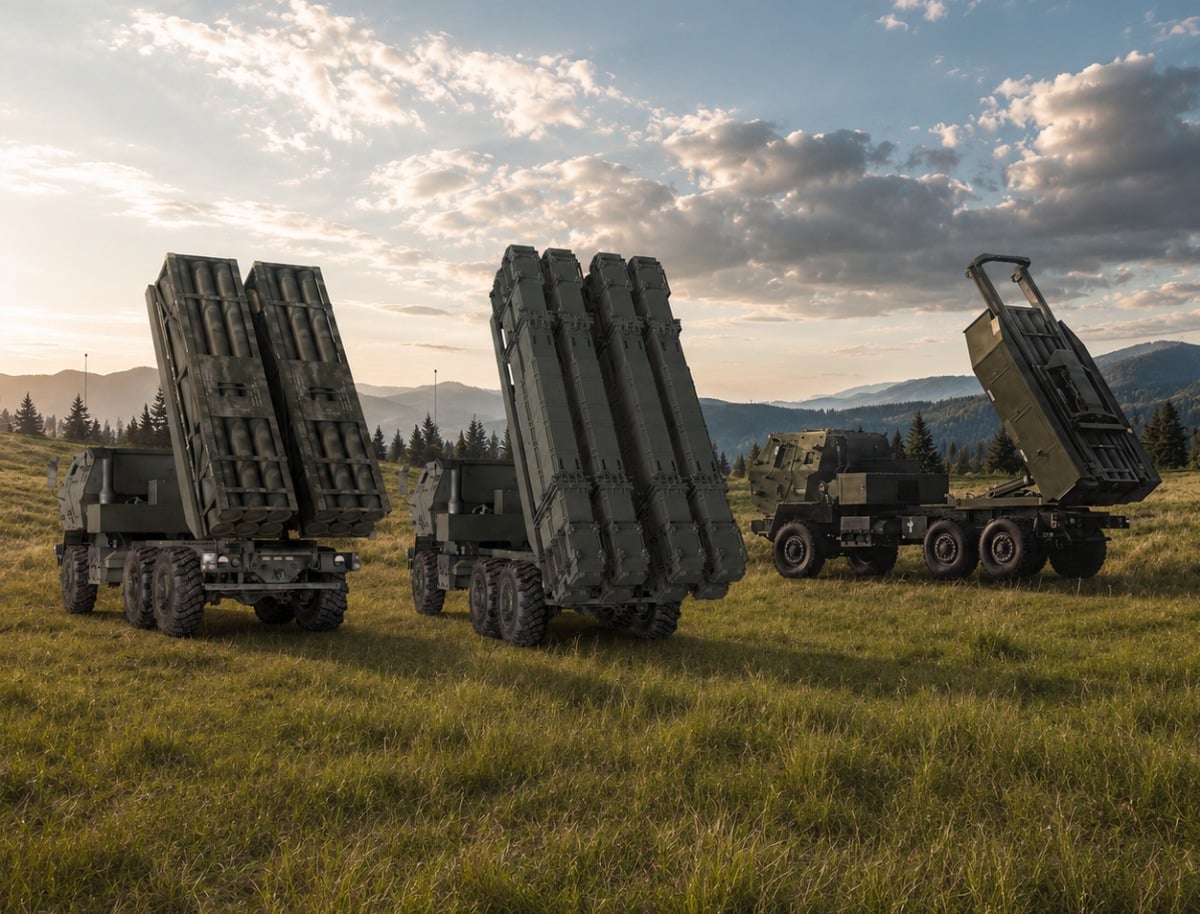
- Lockheed Martin unveiled HIMARS FLEX at Eurosatory 2026 on June 16, introducing a dual-pod launcher that doubles munitions capacity and adds air defense interceptor capability including PAC-3.
- HIMARS FLEX uses the FLEXFires technology ecosystem to offer modular loadout options, optional autonomy, and compatibility with existing NATO GMLRS, ER GMLRS, PrSM, ATACMS, and PAC-3 munitions.
Lockheed Martin announced the HIMARS FLEX on June 16, a modular evolution of the M142 High Mobility Artillery Rocket System that introduces a dual-pod launcher configuration capable of carrying double the munitions of the standard single-pod HIMARS, adds the ability to fire air and missile defense interceptors including the PAC-3 from the same chassis, and incorporates optional autonomous operation capabilities through what the company calls its FLEXFires technology ecosystem, all while retaining C-130 transport aircraft airlifting capability and NATO munitions compatibility.
A standard HIMARS carries one launch pod, typically six Guided Multiple Launch Rocket System rockets, which are GPS-guided munitions accurate to within meters at ranges out to 70 km (43 miles), or one Army Tactical Missile System ballistic missile with a range exceeding 300 km (186 miles), operated by a crew of three from an armored cab mounted on an M1140 Family of Medium Tactical Vehicles chassis. The Precision Strike Missile, with a range exceeding 400 km (249 miles), is also compatible with the HIMARS launch pod as a separate munition option. Lockheed Martin says it has delivered 750 HIMARS launchers, with more than 540 systems in service with the U.S. Army and international allies, giving HIMARS FLEX a ready-made customer audience that could give existing HIMARS customers a potential pathway to related capabilities, depending on configuration and procurement decisions.
The dual-pod configuration that HIMARS FLEX introduces is the most operationally significant element of the announcement, because it addresses one of the standard HIMARS’s most frequently cited limitations: the need to return to an ammunition resupply point after firing a single pod before being able to engage additional targets. A launcher that carries two pods can engage twice as many targets per sortie, sustain fire for longer before requiring reloading, or split its loadout between offensive rocket munitions in one pod and defensive interceptor missiles in the other, and HIMARS FLEX adds potential air and missile defense roles, including PAC-3 and IFPC munitions, creating a single vehicle capable of both attacking ground targets at long range and defending against incoming missiles and aircraft in ways the current single-pod configuration cannot achieve.
The munitions compatibility list Lockheed Martin announced for HIMARS FLEX covers the full existing NATO HIMARS and MLRS munition family including GMLRS, Extended Range GMLRS, PrSM, and ATACMS, and adds PAC-3 Missile Segment Enhancement interceptors and Indirect Fire Protection Capability munitions for air and missile defense roles. PAC-3 MSE, the most advanced variant of the Patriot missile family produced by Lockheed Martin, is a hit-to-kill interceptor capable of destroying ballistic missiles, cruise missiles, and aircraft, with engagement performance that makes it one of the most capable point defense weapons in the U.S. inventory. Integrating PAC-3 launch capability into a HIMARS-sized wheeled vehicle that can be airlifted on a C-130, deployed rapidly to forward positions, and operated by a small crew would give allied militaries a highly mobile missile defense option that current Patriot battery configurations, which require multiple large vehicles and significant setup time, cannot provide.
Tim Cahill, president of Lockheed Martin Missiles and Fire Control, framed the significance of the FLEXFires technology suite in terms of scalability and the potential for autonomous capabilities. “HIMARS FLEX will be a game changer in the future of offensive and defensive fires,” Cahill said. “Our FLEXFires technology suite will let operators scale loadout and add autonomous capabilities without sacrificing speed or accuracy.” Lockheed says FLEXFires can add autonomous capabilities to the launcher, though the exact level of autonomy has not been publicly detailed beyond the company’s description of “distributed, survivable fire across contested environments” and the ability to complicate adversary targeting through rapid repositioning.
Gaylia Campbell, vice president and general manager of Lockheed Martin Tactical Missiles, placed HIMARS FLEX within the alliance-level deterrence framework that increasingly drives European procurement decisions. “Flexibility, interoperability and proven performance are the three pillars defining today’s most effective deterrent capabilities,” Campbell said. “HIMARS FLEX brings our allies the ability to tailor offensive and defensive firepower to their specific needs while staying connected to a common, battle-proven ecosystem.”
The timing of the HIMARS FLEX announcement at Eurosatory 2026 is deliberate and commercially pointed, arriving at a moment when European NATO members are making some of the largest precision artillery procurement decisions in decades. Several European nations have recently opted for HIMARS, South Korea’s Chunmoo, or Israel’s PULS systems, and France is pursuing a domestic alternative under its Long-Range Ground Strike program, creating a competitive market where Lockheed Martin’s announcement of a significantly more capable HIMARS variant is clearly designed to influence procurement evaluations currently underway across the continent. A system that offers more firepower, air and missile defense capability, and autonomous operation options than the standard HIMARS, while retaining full compatibility with the existing NATO munitions supply chain, makes a compelling argument to any European ministry of defense currently weighing whether to buy HIMARS or pursue alternatives.
The modular design philosophy that Lockheed Martin has built into HIMARS FLEX also addresses the economic reality that not every allied nation needs or can afford the full dual-pod, air-defense-capable configuration from day one, with the company noting that customers can start with a single-pod baseline configuration and add the dual-pod FLEX loadout and autonomous capabilities incrementally as budgets and operational requirements allow, reducing the upfront cost while preserving the upgrade path. That tiered entry approach has proven effective in HIMARS marketing before, where the system’s relatively modest unit cost compared to more complex missile systems helped it win customers who might otherwise have chosen less capable but cheaper alternatives.
Lockheed Martin is presenting HIMARS FLEX as a new modular evolution of the HIMARS family, rather than a replacement for the systems already in service, which means the thousands of launchers already operated by the U.S. military and its allies continue to perform the precision strike mission that has defined the platform since Ukraine demonstrated its operational impact in 2022.