

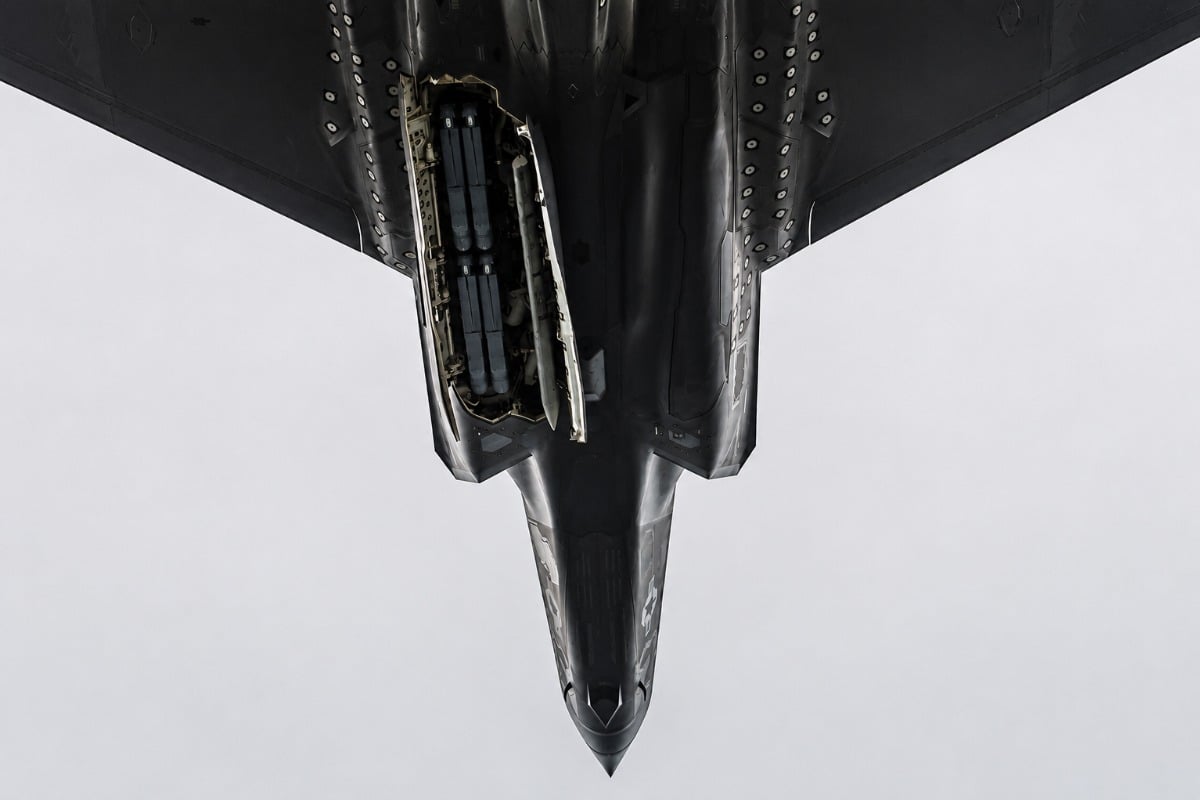
- Finnish Defence Minister Antti Häkkänen authorized the purchase of additional GBU-53 SDB II glide bombs from the United States on June 18.
- The glide bombs will arm Finland's incoming F-35A fleet and supplement a 2023 Foreign Military Sales contract.
Finland’s Minister of Defence, Antti Häkkänen, authorized the Finnish Defence Forces Logistics Command on June 18 to purchase additional GBU-53 Small Diameter Bomb II glide bombs from the United States, adding to a stockpile that will arm the country’s incoming fleet of F-35A stealth fighters with a weapon few air forces in the world currently field.
The Small Diameter Bomb II, built by the American defense contractor Raytheon, a division of RTX Corporation, is not a typical bomb. It carries no engine, instead gliding toward its target after release from high altitude, and its real innovation sits in the nose, where a tri-mode seeker combines millimeter wave radar, an infrared camera, and a laser tracker to find targets through fog, smoke, rain, and darkness, conditions that would blind older guided weapons.
That all-weather capability lets the bomb chase down moving targets, tanks, armored vehicles, mobile air defense systems, rather than just the fixed buildings and bunkers that earlier precision weapons were designed to hit, and it can do so from roughly 70 miles (110 kilometers) away under ideal release conditions, keeping the launching aircraft well clear of enemy air defenses. Weighing in at around 250 pounds (113 kilograms) and measuring just under 6 feet (1.8 meters) long, the bomb is small enough that an F-35 can carry several at once in its internal weapons bay without sacrificing the stealth profile that makes the aircraft difficult to detect in the first place.
Finland’s relationship with this particular weapon goes back further than this week’s announcement suggests. When the U.S. State Department’s Defense Security Cooperation Agency cleared Finland’s $12.5 billion purchase of 64 F-35A fighters in 2020, the package already included 500 SDB II rounds alongside other munitions like AIM-9X Sidewinder missiles, part of a broader effort to give the incoming fleet a full combat loadout from day one. Thursday’s authorization builds on that foundation through what the Finnish government describes as a supplementary purchase under the existing Foreign Military Sales arrangement, the formal U.S. government process through which allied nations buy American-made weapons, expanding on a Letter of Offer and Acceptance contract originally signed in 2023. The purchase covers not just the bombs themselves but manuals, spare parts, transport, and the manufacturer’s training and support services, the kind of unglamorous logistics tail that determines whether a weapon system actually works reliably once it reaches a squadron rather than just performing well in a test.
Colonel (ret.) Henrik Elo, who directs Finland’s F-35 program, explained why this particular capability matters to a country that has spent the past several years rebuilding its air force from the ground up.
“The precision-guided glide bombs now being procured will supplement our previous order as part of the F-35 weapon package. The SDB IIs are technologically advanced and will bring the F-35 armament the capability the Finnish Air Force did not previously have. The ability of the glide bomb to strike moving targets also in challenging weather conditions will allow using the F-35 effectively when contributing to Multi-Domain Operations across all defence branches,” Elo said.
That reference to Multi-Domain Operations points to a shift in how modern militaries think about combining air, land, sea, and cyber capabilities into a single coordinated fight rather than treating each branch as its own separate effort, and Finland’s geography makes the concept anything but abstract. The country shares an 830-mile (1,340-kilometer) border with Russia, the longest of any NATO member, and joined the alliance in 2023 in direct response to Russia’s full-scale invasion of Ukraine the year before. Finland’s defense planners have spent the years since building a force capable of operating in the brutal conditions of Nordic winter, where low cloud cover, heavy snow, and long stretches of darkness can ground aircraft and blind sensors that depend on clear skies, and a weapon that hunts moving targets through exactly those conditions fills a gap that previous Finnish strike capability simply did not have.
The F-35 itself remains a work in progress for the Finnish Air Force rather than a fielded reality. A Finnish pilot completed the first flight by a Finnish aviator in the aircraft this past April, flying from Ebbing Air National Guard Base in Arkansas, where roughly 150 Finnish personnel, including about 20 pilots, are working through a training pipeline that runs into early 2028. Eight Finnish F-35As currently sit at that base for training purposes, and the first jets are scheduled to arrive on Finnish soil in the fall of 2026, eventually heading to the Lapland Air Wing at Rovaniemi, which is set to become the first Finnish unit flying the aircraft exclusively. Finland plans to retire its aging F/A-18 Hornet fleet, originally purchased from McDonnell Douglas in 1992, as the F-35As come online, with full operational capability targeted for 2028.