

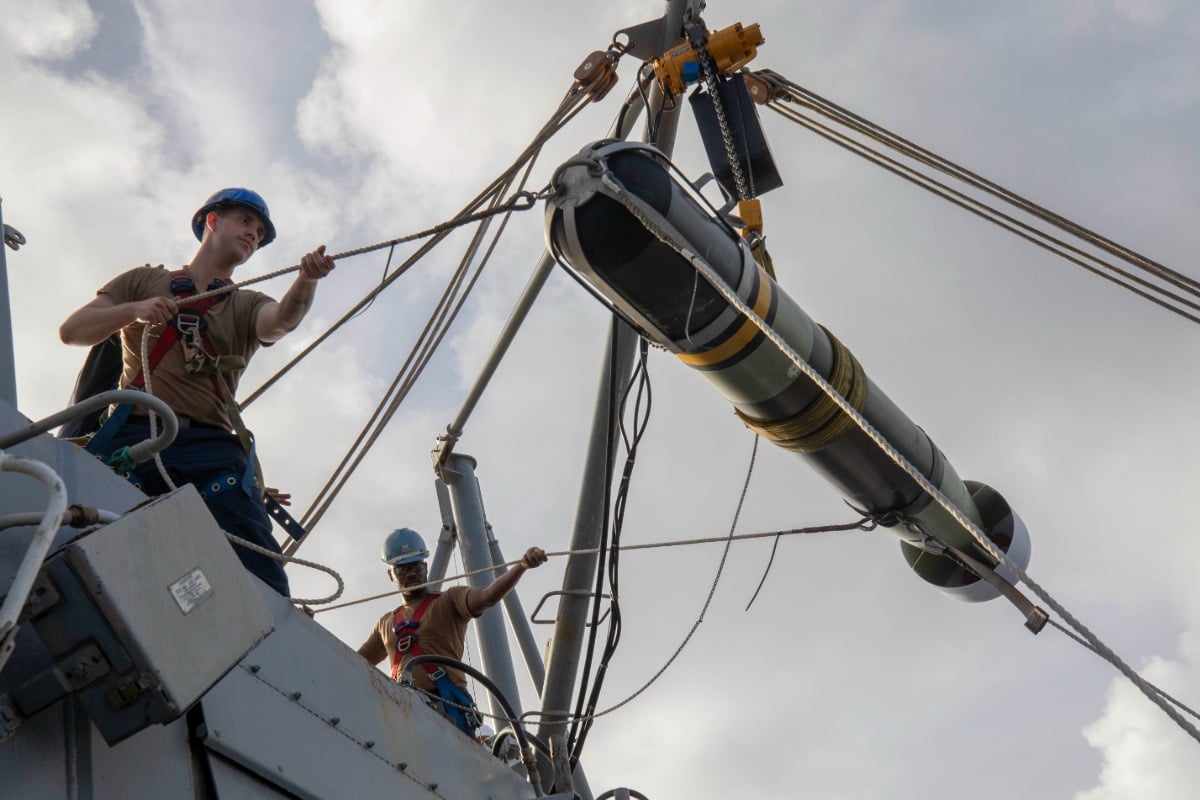
- The Navy awarded General Dynamics Mission Systems a $116.6 million contract modification on June 17, 2026, for MK 54 torpedo sonar equipment.
- The contract covers production through April 2029 across six U.S. states, funded through Navy weapons procurement budgets from three fiscal years.
Somewhere beneath the ocean’s surface, a submarine the U.S. Navy can’t see is the threat that keeps American admirals awake at night, and the weapon built to find it just received continued funding to keep its sensors sharp.
According to a June 17 contract notice, the Navy awarded General Dynamics Mission Systems a $116.6 million modification covering production of sonar assembly kits and related equipment for the MK 54 lightweight torpedo, the Navy’s primary lightweight anti-submarine weapon for surface ships, aircraft, and helicopters.
The contract exercises options under an existing agreement and covers production through April 2029, with work split across facilities in Pennsylvania, Utah, Massachusetts, Indiana, Virginia, and Washington state, paid for through Navy weapons procurement funds spanning three different fiscal years.
Understanding why a torpedo’s sonar matters more than the torpedo itself requires understanding how the MK 54 actually hunts a submarine, because the explosive warhead is almost beside the point until the weapon can find its target in the first place. The MK 54 is a lightweight torpedo, meaning it’s small enough to be dropped from a helicopter or a P-8 Poseidon patrol aircraft, or fired from a destroyer’s torpedo tubes, rather than the much larger heavyweight torpedoes carried by submarines themselves. Once in the water, the torpedo relies on its sonar section, the equipment this contract funds, and the sonar section supports detection, classification, and tracking of underwater targets in complex acoustic environments, distinguishing a genuine submarine from background ocean noise and the increasingly sophisticated decoys that adversary submarines deploy specifically to defeat exactly this kind of sensor.
The version of the MK 54 this contract supports, designated Mod 1, represents an upgrade the Navy has been pushing through for nearly two decades, and its history offers a useful reminder that modernizing a weapon system rarely happens in a single clean leap. The Navy began developing Mod 1 in 2007 specifically to improve the torpedo’s sonar array and onboard computing, eventually adopting the same Advanced Processor Build software the Navy uses in its heavyweight MK 48 torpedo to give the lightweight MK 54 a more capable brain for processing what its sonar hears. The Pentagon’s independent testing office, DOT&E, assessed Mk 54 Mod 1 Increment 1 as operationally effective but not operationally suitable because of reliability and availability issues, the kind of unglamorous maintenance and dependability metrics that determine whether a weapon actually works when a crew needs it rather than just whether it works during a controlled test. That assessment matters here, because it means today’s contract isn’t celebrating a finished, perfected weapon. It’s funding continued production and support for a system the Navy is actively still refining even as it relies on it as the fleet’s principal lightweight tool against enemy submarines.
None of this unfolds in a vacuum, and the timing connects directly to a strategic problem that has occupied American naval planners with growing urgency. U.S. naval intelligence has projected China’s submarine force could reach roughly 70 boats by 2027 and up to about 80 by 2035, with an increasing share of that fleet shifting from older diesel-electric submarines toward quieter, harder-to-detect nuclear-powered boats. Rear Admiral Mike Brookes, commander of the U.S. Office of Naval Intelligence, told a congressional commission earlier this year that China’s undersea forces could credibly challenge American maritime dominance by 2040, even as he acknowledged the United States still holds the advantage today. Vice Admiral Richard Seif, commander of Naval Submarine Forces, told the same commission that the Navy needs to advance its submarine readiness and invest in undersea surveillance to maintain that edge, framing anti-submarine capability as one of the genuine asymmetric advantages the U.S. still holds over a rapidly modernizing Chinese navy.
That broader competition explains why a contract modification covering sonar kits, hardly the kind of announcement that generates headlines on its own, fits into a pattern of steady, incremental Navy investment rather than a one-off purchase. The MK 54 isn’t just an American weapon either. Allied navies including Australia, Canada, India, and several NATO members have adopted versions of the torpedo or ordered conversion kits to upgrade older systems, meaning improvements funded through this contract eventually ripple outward to partner forces that rely on compatible American-designed anti-submarine technology. Australia alone ordered 200 additional MK 54 torpedoes in past years, and Canada’s request for hundreds of conversion kits underscored how widely allied navies have built their underwater defenses around this specific weapon family rather than developing entirely separate systems of their own.