

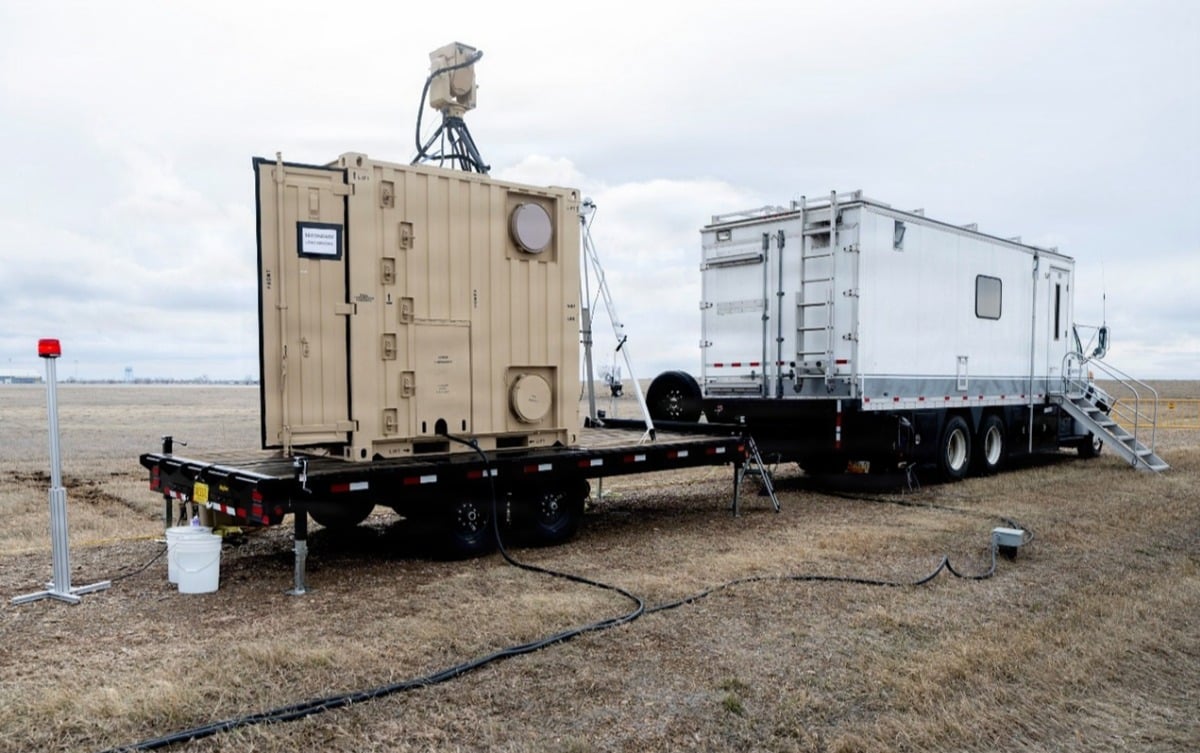
- Naval Research Laboratory scientists demonstrated a laser system that wirelessly transmits power and defends against drones using the same hardware.
- The test was conducted with Boeing and the Army's DEVCOM Ground Vehicle Systems Center, including trials in near-whiteout snow conditions.
Scientists at the U.S. Naval Research Laboratory, the Navy’s primary in-house science and technology arm, confirmed they successfully demonstrated a laser system that does both jobs without missing a beat, wirelessly transmitting power across long distances and then shifting into a defensive posture against drones, a dual-use capability the lab says could reshape how troops get electricity on the move.
The demonstration, sponsored by the Office of the Under Secretary of War for Acquisition and Sustainment and supported by the Operational Energy Capability Improvement Fund, brought together the Naval Research Laboratory with Boeing and the Army’s DEVCOM Ground Vehicle Systems Center, with additional input from the Navy, Marine Corps and Army. Researchers positioned a trailer-mounted laser across an airfield and transmitted power from a standard military vehicle to specialized receivers at a remote location, the kind of setup that could eventually let a forward operating base draw electricity from a power source miles away rather than hauling diesel generators and fuel convoys through contested terrain. Once that power transfer was running, the team redirected the same laser without interruption to address a simulated aerial threat, transitioning from wireless power transfer to a counter-UAS engagement scenario and back again without ever taking the equipment offline.
Alex Grede, an electrical engineer at the Naval Research Laboratory, framed the test as something beyond a controlled lab exercise. “This was not just a laboratory exercise we were building the pieces for what this capability could actually look like on the battlefield,” Grede said.
“We demonstrated that the same laser used to beam power remotely can immediately transition to counter a drone threat, giving Marines and soldiers greater flexibility without changing their operational footprint,” Grede said.
The laser hardware itself was not built for this test alone. NRL said the demonstration used a currently fielded Marine Corps directed-energy laser system, without naming the specific system or detailing its prior operational history, and the lab paired that existing platform with high-efficiency solar receivers and mobile vehicle-based power generation to build what it calls a practical pathway toward distributed, resilient energy delivery for troops operating away from established bases. That distinction matters because power beaming research has often lived in the realm of record-chasing demonstrations under tightly controlled conditions. NRL scientists contributed to DARPA’s POWER demonstration, which delivered more than 800 watts over 8.6 kilometers (5.3 miles), conducted at White Sands Missile Range in New Mexico under controlled test conditions, a program credited with shattering prior distance and power records for optical power beaming.
This latest test took a deliberately rougher path. Rather than chasing another distance or power record in tightly controlled conditions, the team pushed the system through realistic field environments and adverse atmospheric conditions, continuing trials through snowfall that approached whiteout conditions until visibility nearly disappeared entirely. Justin Lorentzen, a research physicist at the lab, explained why the team chose to test the equipment under harsh conditions rather than protect it from the elements. “We wanted to prove this could work where warfighters actually operate, not just in ideal conditions,” Lorentzen said.
“Testing in wind, snow and real atmospheric interference gives us the data we need to improve the system and move it toward a true operational capability,” Lorentzen said.
The Army’s fingerprints are all over why this test happened in the first place. While the Naval Research Laboratory continues developing the underlying technology for naval uses, Army operational requirements helped shape the field test, particularly scenarios involving expeditionary power needs where replacing fuel-dependent generators could meaningfully improve both logistics and survivability for troops who would otherwise need fuel convoys to keep equipment running. Grede pointed directly to the Army as the most likely service to field this kind of capability first.
“The service most likely to field this kind of capability first may be the Army, and that’s exactly why this collaboration matters,” Grede said. “We can take the expertise we’ve built at NRL and help accelerate capability development across the joint force. That’s good for the services and good for the country.”
Beyond the core power-and-defense demonstration, the test also validated something less glamorous but arguably just as important for a system meant to survive real deployment: how quickly it can be fixed when something breaks. During the event, researchers repaired a key system component in the field, demonstrating that the laser could be kept running by people without a workshop full of specialized tools. Lt. Cmdr. Brian Di Salvo, the Naval Research Laboratory’s Radar Division Military Deputy, explained why that mattered as much as the headline capability. “You can’t have a system that takes months to repair or months to train someone to use,” Di Salvo said. “This system showed both repairability and simplicity of operation, qualities that matter when you’re talking about real deployment with young operators in the field.”
Researchers say the program’s following phase includes additional demonstrations involving Marines, Soldiers and Sailors directly, gathering hands-on feedback from the troops who would actually operate the system rather than relying solely on engineers’ assumptions about what the field needs. The Naval Research Laboratory has not specified a timeline for when, or whether, this capability might move beyond demonstration status into a program troops could actually carry into a deployment, and the test described in this announcement remains a proof of concept rather than a fielded system.
A remote power system that can transmit energy by laser instead of relying only on fuel delivered to the forward site sounds like science fiction until you remember that fuel convoys have been getting attacked for as long as modern wars have been fought, and the same beam that charges a battery pack can just as easily pivot to track a drone trying to take that convoy out.