

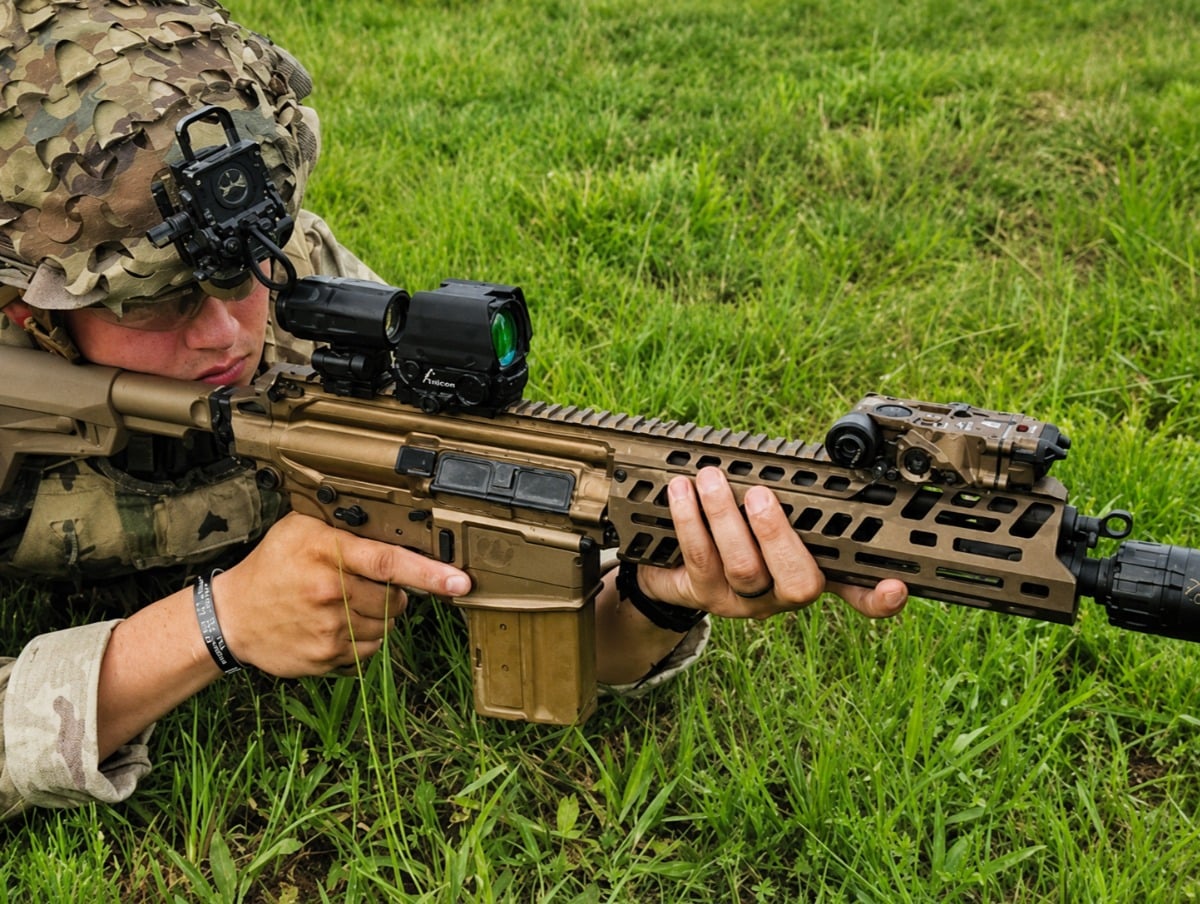
- The U.S. Army awarded B.E. Meyers & Co. a contract for 8,936 DAGIR-V1 laser aiming systems, to be delivered in fiscal year 2027.
- The contract supports the Army's M7 Surrogate Fire Control Program, tied to the M7 rifle that began replacing the M4 carbine in 2024.
The U.S. Army ordered 8,936 DAGIR-V1 laser systems to support the M7 rifle’s fire-control program, and the company building them happens to be a family-owned business that got its start making night vision gear five decades ago. B.E. Meyers & Co., a Redmond, Washington manufacturer, announced it has been awarded a contract to deliver the systems in fiscal year 2027, awarded through the service’s Program Manager Soldier Lethality office under the DLA Tailored Logistics Support Program.
The contract supports the Army’s M7 Surrogate Fire Control Program, a piece of the broader effort to field aiming and targeting equipment for the M7 rifle, developed under the Next Generation Squad Weapon program to replace the M4/M4A1 in close-combat units.
Understanding what the DAGIR-V1 actually does requires understanding the basic problem soldiers face fighting at night, which has shaped infantry tactics since night vision goggles became standard issue decades ago. A soldier wearing night vision can see in the dark, but aiming a rifle precisely still requires some way to mark exactly where the weapon is pointed, since standard rifle sights are difficult or impossible to use through night vision optics.
The DAGIR-V1 solves that by combining an infrared illuminator, which floods a wide area with infrared light invisible to the naked eye but clearly visible through night vision, with both infrared and visible aiming lasers mounted directly on the weapon, letting a soldier point the laser dot at a target and fire with confidence that the rifle is aimed where the dot lands. The system uses what’s called VCSEL technology, short for vertical-cavity surface-emitting laser, a more advanced and precise alternative to older laser diode designs that B.E. Meyers says produces a sharper, more consistently shaped beam than older laser aiming devices, improving a soldier’s ability to identify targets and assess threats in low light or total darkness.
The DAGIR-V1 didn’t emerge from nowhere. B.E. Meyers says the DAGIR family builds on its MAWL laser systems and has been developed for military users, with the MAWL line in production since 2016 and more than 30,000 units fielded worldwide across the U.S. Army, Air Force, and dozens of allied nations. The DAGIR-V2, a related variant, adds a separate visual laser override button, giving the broader DAGIR family multiple configurations aimed at different operational needs across the military.
The specific numbers behind the DAGIR-V1’s performance explain why the military keeps choosing this type of system over older aiming laser designs. The system pairs a 40-milliwatt infrared pointer with dual 350-milliwatt infrared illuminators, output levels that B.E. Meyers says let the laser punch through dense photonic barriers, the term for the haze of competing infrared light, smoke, or dust that can wash out a weaker laser’s visibility through night vision in cluttered or chaotic environments. The device lets a soldier adjust beam divergence and power output without taking a hand off the weapon, a design choice that matters during the kind of fast-moving, low-light engagements where fumbling with controls costs critical seconds, and the entire system seals into a rugged aluminum housing built to survive whatever environmental punishment a deployed rifle and its accessories typically take.
Matthew Meyers, CEO and second-generation owner of B.E. Meyers & Co., framed the contract as a continuation of the company’s existing relationship with the military rather than a new departure. “Following our deliveries of MAWL-X1 systems to the DoW in previous years, we are honored to continue our support of the US Army with our DAGIR laser system,” Meyers said. “These systems, proudly American Made, ensure that our Warfighters have multi-function laser technology that supports the clarity, speed, and precision of modern night lethality needs.” That continuity matters in a company whose own history reflects exactly the kind of generational, small-business defense manufacturing the Pentagon has increasingly tried to cultivate as an alternative to relying solely on the handful of largest prime contractors, with B.E. Meyers founded in 1974 and still privately held, veteran-operated, and run by the founder’s son five decades later.