

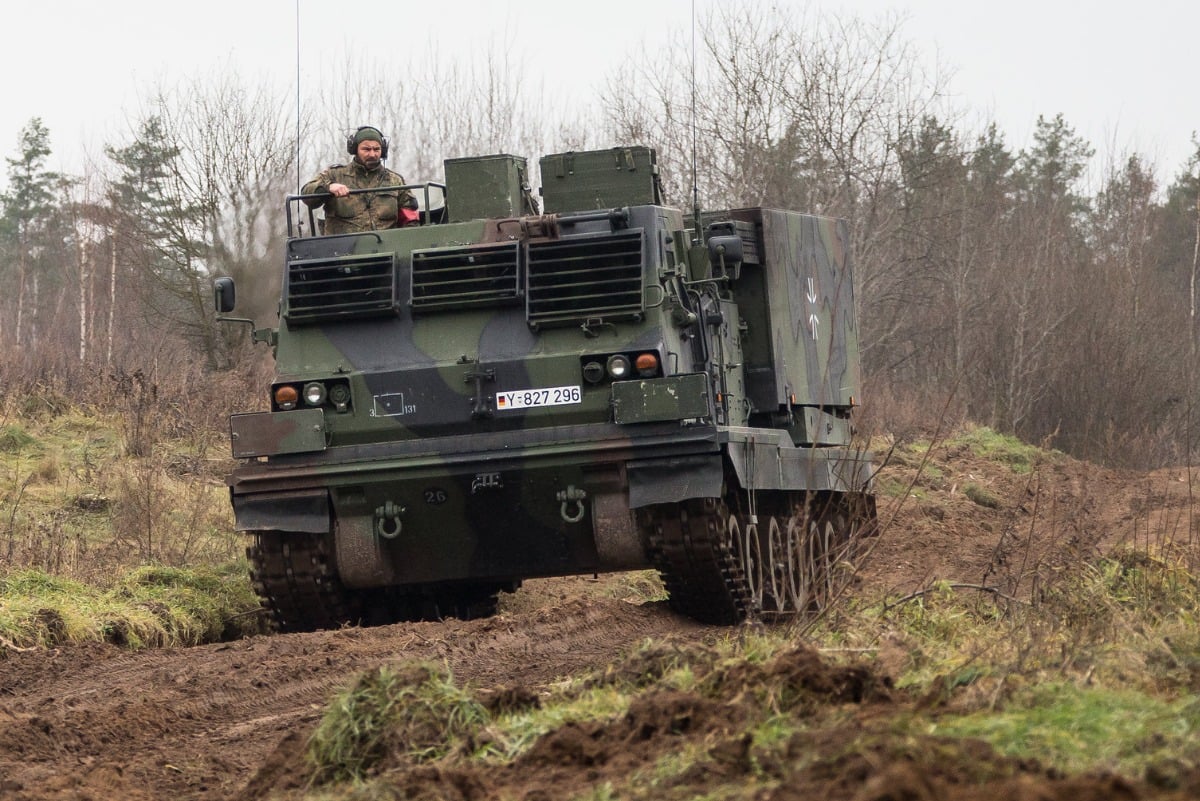
- Lockheed Martin and Rheinmetall signed a memorandum of understanding at the NATO Summit Defense Industry Forum in Ankara on July 7 to co-produce ATACMS missiles in Europe.
- The planned facility at Rheinmetall's Unterluess site in Germany would be the first ATACMS production line outside the United States.
Lockheed Martin and German defense giant Rheinmetall signed a memorandum of understanding at the NATO Summit Defense Industry Forum in Ankara, Türkiye, to establish co-production of the ATACMS missile system in Europe. The agreement, backed by both the American and German governments, sets up a joint venture aimed at creating what the companies describe as the first European center of excellence for manufacturing, integrating, and distributing ATACMS across NATO and allied European forces.
ATACMS, officially designated the MGM-140 Army Tactical Missile System, is a solid-fuel, ground-launched ballistic missile roughly 13 feet (4 meters) long that fires from the same M270 tracked launcher and M142 HIMARS wheeled launcher that the U.S. Army and dozens of allied militaries already operate. First fielded during Operation Desert Storm in 1991, the missile can strike targets up to 300 km (186 miles) away with precision-guided accuracy, giving ground forces the ability to hit command posts, ammunition depots, and air defense batteries far behind enemy lines without needing air support. Ukraine has used American-supplied ATACMS to strike targets inside Russian-occupied Crimea and deep behind the front lines since receiving the missiles, and that combat use has turned what was once a relatively obscure Cold War-era weapon into one of the most closely watched munitions in the current conflict.
Rheinmetall will build the new ATACMS manufacturing line at its Unterluess facility in Lower Saxony, a site the company has operated since 1899 and that now employs roughly 4,000 people across weapons systems, ammunition, and tracked vehicle production. Unterluess has already become the centerpiece of Rheinmetall’s wartime industrial expansion, having opened a nearly $585 million artillery shell factory there in August 2025 that is ramping toward 350,000 155mm shells a year by 2027, with rocket motor and rocket-artillery production also scheduled to begin at the site this year. Adding ATACMS guided missile production to that lineup would make Unterluess not just Europe’s largest ammunition hub but also home to the only ATACMS manufacturing line anywhere outside the United States.
“This partnership marks a watershed moment for European security and allied industrial cooperation,” said Jay Pitman, president, Lockheed Martin International. “By combining Lockheed Martin’s unmatched missile expertise with Rheinmetall’s manufacturing excellence, we’ll deliver combat-proven capabilities faster and more efficiently to our allies.”
Until now, every ATACMS missile has come off a single production line inside the United States, meaning any surge in demand from Ukraine or NATO allies has run through the same limited manufacturing capacity regardless of which country is placing the order, a bottleneck that a European co-production line would directly ease by adding an entirely separate manufacturing pathway that does not compete with American factories for the same tooling and workforce. PrSM, the missile’s successor, has already begun a similar diversification, with Australia producing the system domestically under a 2025 agreement, though that arrangement remains separate from the new ATACMS line planned for Germany.
“Bringing ATACMS co-production to Germany is a strong signal for Europe’s defense industry and for NATO’s long-term resilience,” said Dennis Goege, chief executive for Europe at Lockheed Martin. “This partnership combines proven U.S. technology with European manufacturing strength, creating industrial value in Germany while expanding the capacity allies need to meet growing security demands.”
Rheinmetall CEO Armin Papperger framed the deal as part of a longer campaign to build German and European weapons manufacturing capacity independent of any single country’s production limits, a strategy the company has pursued aggressively over the past two years through new ammunition plants in Lithuania, Bulgaria, and Romania alongside the flagship Unterluess expansion.
“Our aim is to strengthen the defence capabilities of Germany and Europe,” Papperger said. “Together with our friends at Lockheed Martin, we are now establishing the industrial base in Germany for modern defence systems, which are in great demand by the armed forces of Europe. By establishing ATACMS production at Rheinmetall’s Unterluess site, we are creating new capabilities for Germany and Europe, securing supplies for our customers and strengthening our autonomy in defence policy. We are grateful that Rheinmetall has been selected to set up and operate the world’s first and only production facility for ATACMS guided missiles outside the United States.”
The U.S. Army has been gradually replacing it since 2023 with the Precision Strike Missile, a newer Lockheed Martin design that fits two missiles into the same launcher pod that holds a single ATACMS, doubles the older missile’s range to more than 500 km (310 miles), and was designed from the outset around the more capable guidance and multi-domain targeting requirements the Army now prioritizes. That transition means the European co-production line will likely serve less as a hedge against the U.S. Army’s future needs and more as a dedicated supply channel for NATO allies and Ukraine, a distinction that matters given how much of the current global appetite for ATACMS comes specifically from European nations trying to build layered strike capability and from Ukraine’s ongoing need for long-range precision weapons that can reach targets across the front line and beyond it.
What the agreement does not yet specify is a firm production timeline, an expected annual output figure for the new ATACMS line, or a total dollar investment figure comparable to the roughly $585 million Rheinmetall already sank into its artillery shell plant at the same site. Both companies describe today’s signing as a memorandum of understanding rather than a finalized contract, meaning the joint venture itself still needs to be formally established before construction or missile production at Unterluess can begin in earnest. Given how quickly Rheinmetall moved from breaking ground to full ammunition production at the same facility, a roughly fifteen-month sprint for the 155mm shell plant, there is reason to expect the companies will try to compress the ATACMS timeline similarly rather than let the joint venture linger in planning stages while allied stockpiles remain under pressure.