

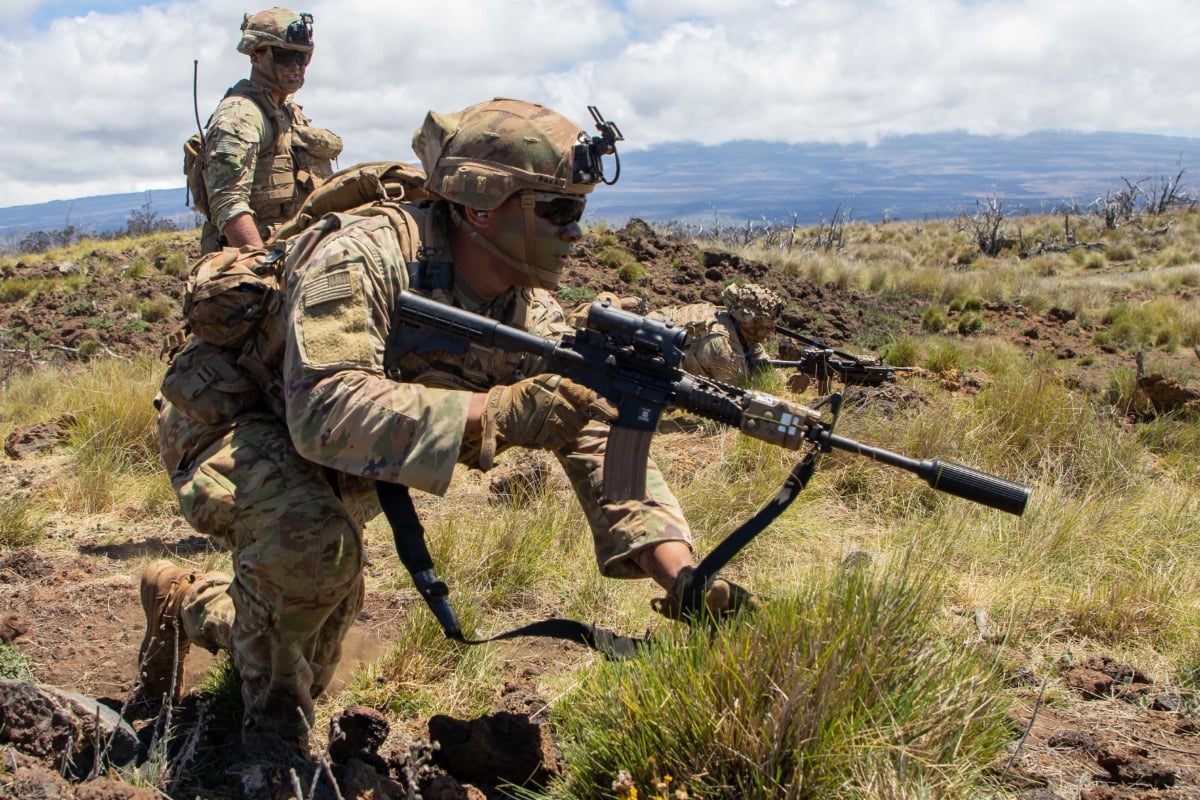
- Suppressors, or signature reducers, are shifting from special forces use to standard infantry equipment, hartpunkt reported on July 3, 2026.
- Canada's new CMAR rifle will use the Multi-Function Muzzle Device, a combined suppressor, muzzle brake, and flash hider from Strategic Sciences.
A firearm attachment once reserved almost exclusively for special operations units is quickly becoming standard-issue equipment for ordinary infantry soldiers worldwide, according to a July 3 report from German defense outlet hartpunkt.
The report examines the growing military adoption of what the article calls signature reducers, the more technically accurate term for devices commonly known as suppressors or silencers, and highlights one especially telling example of the trend: Canada’s newly adopted CMAR service rifle, set to replace the country’s decades-old C7 and C8 rifles, will ship with a combined suppressor, muzzle brake, and flash hider unit built specifically for close-combat use by regular troops rather than commandos.
The distinction between the terms “suppressor” and “signature reducer” matters more than it might seem, since the popular idea that these devices make a gun silent is almost entirely a Hollywood invention. A gunshot’s muzzle blast typically registers between 150 and 165 decibels depending on the weapon and caliber, a sound level so intense that anything above 140 decibels risks permanent hearing damage after even brief exposure, and suppressors work by letting the high-pressure propellant gas that creates that blast expand, cool, and slow down before it escapes the weapon, much like a car’s muffler handles exhaust gas from an engine. Even the best-designed suppressor still produces a noticeable, if reduced, bang rather than true silence, and a bullet traveling faster than the speed of sound generates an entirely separate crack of its own as it breaks the sound barrier, a noise no suppressor can eliminate since only switching to slower, subsonic ammunition removes that second sound source.
The technology traces back further than most people realize, since American inventor Hiram Percy Maxim, son of Hiram Stevens Maxim who invented the Maxim machine gun, began marketing the first commercially successful suppressor around 1902 and received a patent for it in 1909, the same year the U.S. Army tested his device and found it eliminated roughly 66 percent of a rifle’s noise and 67 percent of its recoil. That early promise led the Army to order small batches of Maxim’s suppressors, alongside a competing design from inventor Robert A. Moore, for field trials on the M1903 Springfield rifle, and American forces used the devices in limited numbers during the 1916 Pancho Villa Expedition and later with the American Expeditionary Force in France starting in 1917. Suppressor use expanded dramatically by World War II, when the Soviet Union fielded its Bramit device, Germany developed the L26 and L27 models, and Britain issued both the De Lisle Carbine and the infamous Welrod, a manually operated pistol built almost entirely around its integral suppressor for clandestine operations.
Two fundamentally different suppressor designs now dominate the market, each with distinct tradeoffs that explain why military planners choose different types for different weapons. Chamber-based suppressors, the original Maxim design and still the most common type, use a series of internal baffles or chambers to trap and hold expanding gas, offering strong noise reduction and relatively simple construction, but the trapped gas significantly increases backpressure inside the weapon, a problem that barely affects bolt-action rifles but can cause reliability issues, increased fouling, and gas blowback toward the shooter’s face on semi-automatic or fully automatic firearms. Flow-through suppressors, a newer approach first introduced in 2009 by the American company then called Operator Suppressor Systems and now known as Huxwrx, instead route gas through internal channels that lengthen its escape path without trapping it, reducing backpressure and keeping the weapon’s function closer to normal, though at the cost of somewhat less noise reduction and, in some designs, suppressors that are difficult or impossible to disassemble for cleaning.
The newest advance in flow-through design comes from Utah-based Strategic Sciences, whose Multi-Function Muzzle Device combines a flash hider, muzzle brake, and suppressor into a single compact unit built specifically to meet special operations requirements before expanding to broader use. That device is the suppressor selected for Canada’s CMAR rifle program, a contract that will see Colt Canada supply up to 65,402 rifles over the coming years to replace the aging C7 and C8 platforms that have served Canadian forces for more than three decades. Independent reporting on the Multi-Function Muzzle Device indicates it delivers sound levels below 140 decibels across configurations, reduces muzzle flash by roughly 99 percent, and improves recoil management enough to allow 60 percent faster follow-up shots, figures that illustrate how far suppressor technology has advanced since Maxim’s original 1909 tests.
The broader shift toward equipping regular infantry with suppressors, rather than reserving them for special forces, coincides with the introduction of new high-pressure small arms cartridges designed to hit harder at longer range, including the U.S. Army’s 6.8x51mm round developed for its Next Generation Squad Weapon program, an effort The Defence Blog has covered extensively as the service works to replace the M4 carbine and M249 machine gun with the M7 rifle and M250 automatic rifle. Higher chamber pressures generally mean louder muzzle blasts and sharper recoil, making effective signature reduction more valuable precisely as militaries adopt more powerful ammunition rather than less. Beyond combat applications, hartpunkt’s report notes that expanding civilian development near military training ranges has made noise reduction increasingly important simply to keep firearms training viable without generating community noise complaints, while the hearing protection suppressors provide benefits soldiers and instructors alike during the thousands of training rounds fired long before any unit deploys to combat.
None of this comes without real costs, since quality suppressors remain expensive, add another piece of equipment that must be maintained and supplied through military logistics chains, and physically lengthen and add weight to a weapon while shifting its center of balance in ways that can affect a shooter’s precision and point of impact. That so many armed forces around the world are adopting the technology regardless suggests military planners have concluded the tactical benefits, from hearing protection to reduced recoil to better battlefield communication in the deafening chaos of urban combat, outweigh those drawbacks. Whether that calculation holds up as suppressors become as routine as a rifle’s magazine or sling will likely become clearer the next time infantry units without them face infantry units with them in a fight where every advantage matters.