

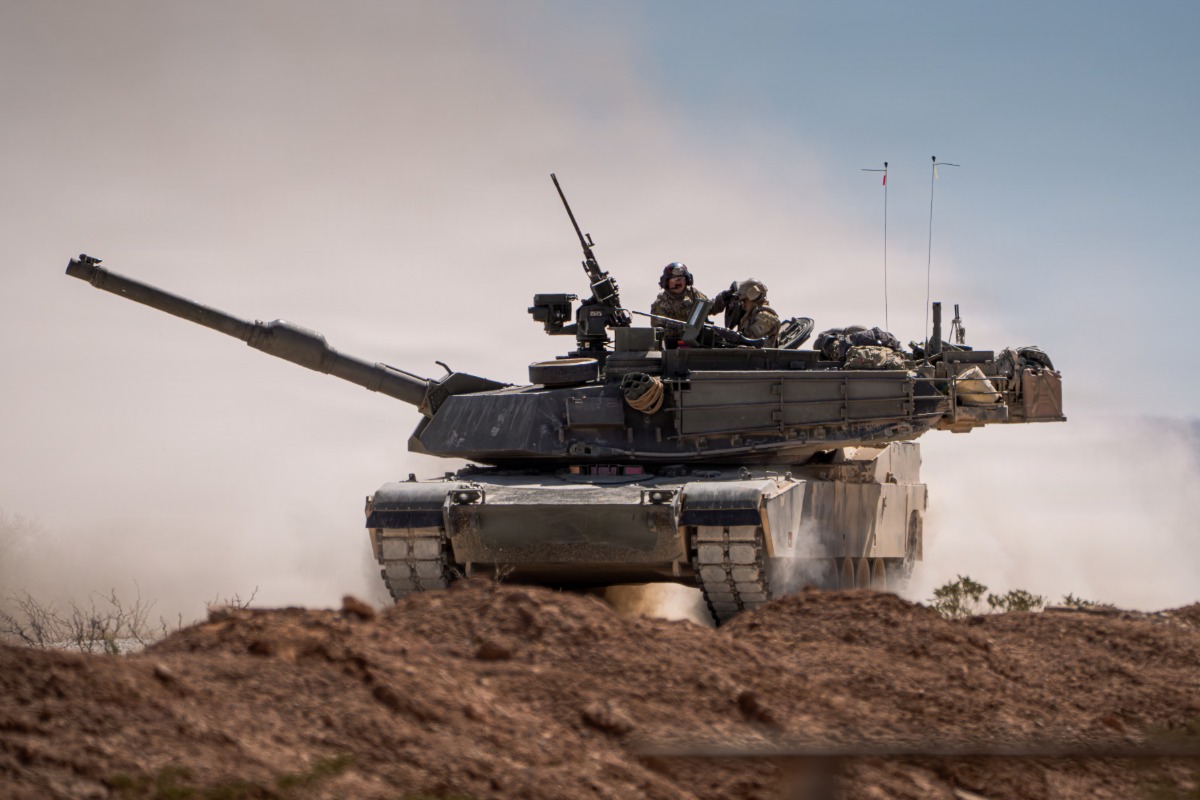
- According to a June 18 contract notice, the Army awarded General Dynamics Land Systems a $43.5 million modification supporting M1A2 SEPv3 Abrams tank production.
- Work locations and funding will be determined per order, with an estimated completion date of January 31, 2028.
According to a June 18 contract notice, the U.S. Army awarded General Dynamics Land Systems, the prime contractor for Abrams production and modernization, a $43.5 million contract modification in support of M1A2 SEPv3 Abrams main battle tank production, adding to the Army’s ongoing M1A2 SEPv3 production and modernization effort.
Work under the modification is expected to run through January 31, 2028.
The M1A2 SEPv3, which stands for System Enhancement Package Version 3, is the most advanced Abrams variant currently in production and operational service, while the Army is developing the future M1E3, and calling it an upgrade undersells how thoroughly it rethinks the tank from the inside out.
The SEPv3 retains the manually loaded 120mm M256 smoothbore gun used on later Abrams variants since the M1A1, but nearly everything around it has changed. The tank gets an under-armor auxiliary power unit, a generator that runs the vehicle’s electronics while the main engine is shut off, reducing both fuel consumption and the heat signature that enemy sensors use to find armored vehicles in the dark. A new Vehicle Health Management System monitors the tank’s mechanical condition in real time, cutting the time crews spend diagnosing maintenance problems in the field. Updated communications and network architecture allow the tank to share targeting data with other vehicles and command systems across the modern battlefield.
The fire control system has been improved to shoot faster and more accurately, and an ammunition data link allows the gun to interface with programmable rounds that can detonate at a set distance rather than only on impact. The package also adds improved counter-IED armor, enhanced thermal imaging using both long-wave and mid-wave infrared sensors, and a low-profile remotely operated weapon station that lets the commander engage targets without exposing himself above the turret. The Abrams is about 9.7 meters (31.8 feet) long with the gun forward, 3.7 meters (12.1 feet) wide, and 2.4 meters (7.9 feet) high, crewed by four soldiers.
The contract modification announced this week is a P00006, meaning the sixth amendment to the base contract W56HZV-24-F-0149, an agreement rooted in a broader Army procurement effort with a long production history. The Army Contracting Command at Detroit Arsenal in Michigan manages the contract, the same installation that has overseen Abrams procurement for decades, sitting adjacent to the Detroit-area supplier network that feeds the tank’s complex supply chain. Work locations and funding will be determined with each order rather than specified upfront, a structure that gives the Army flexibility to direct production activity as priorities evolve.
As The Defence Blog reported in December 2020, General Dynamics received a $4.6 billion contract to produce SEPv3 tanks for the Army, with the first delivery order alone valued at roughly $406 million. That production stream has since expanded to serve export customers as well. Poland ordered 250 M1A2 SEPv3 Abrams tanks, with deliveries beginning in 2025. As The Defence Blog reported in May 2025, 19 additional SEPv3 tanks arrived in Poland in a single delivery, with Polish Deputy Defense Minister Paweł Bejda confirming the shipment publicly.
The SEPv3 has also moved into active U.S. Army formations, with multiple brigade combat teams receiving the variant in recent years. As The Defence Blog reported in July 2025, the Ohio National Guard’s 1st Combined Arms Battalion, 145th Armor Regiment, conducted live-fire gunnery qualification with the SEPv3 at Camp Ripley Training Center in Minnesota, marking the first time that formation had trained with the upgraded platform. SEPv3 is the Army’s current Abrams production and modernization standard, although earlier Abrams variants remain in service across active, Reserve, and National Guard formations. That spread from active-duty heavy brigades to Guard armor units reflects how thoroughly the SEPv3 has taken hold as the benchmark against which the Army measures its armored readiness.
General Dynamics Land Systems manufactures Abrams tanks at the Joint Systems Manufacturing Center in Lima, Ohio, a government-owned facility that the company operates under contract, making it one of the few remaining government-owned, contractor-operated production arsenals in the American defense industrial base. That arrangement gives the Army a degree of control over tank production capacity that it does not have with purely commercial manufacturers, and it means that sustained contract funding like this modification directly keeps the Lima line running rather than simply enriching a private company’s balance sheet.
The Abrams has been the backbone of American armored warfare for more than four decades, surviving the Cold War, two Gulf Wars, and the persistent pressure to replace it with something newer. The SEPv3 is the Army’s answer to that pressure for now, a machine that keeps proven lethality while building in the digital architecture that modern combat demands. Another contract modification, another step forward on that line.