

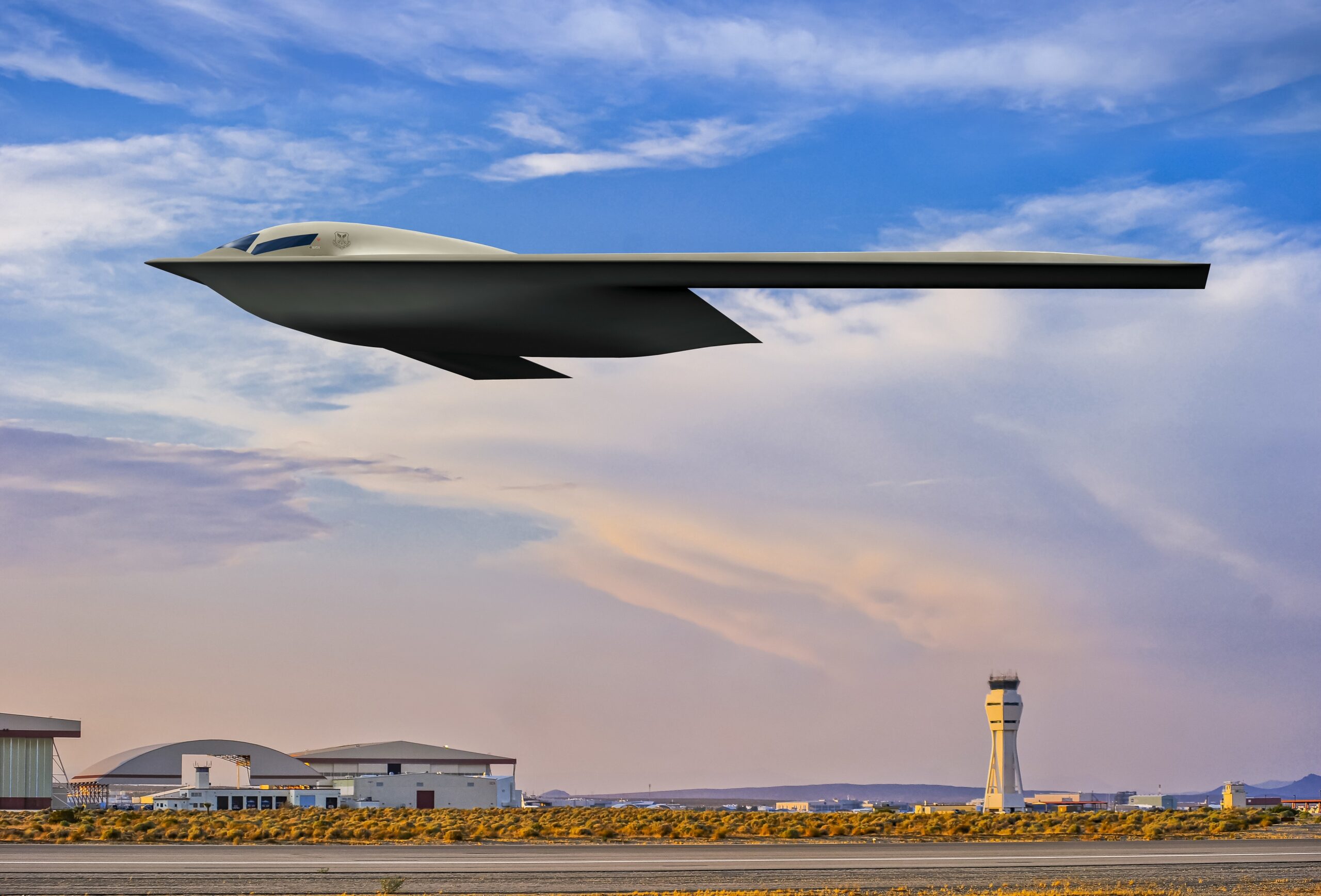
The new stealth U.S. Air Force B-21 bomber, also known as Raider, has taken yet another key technological step toward being ready for war.
Naturally, details regarding its specific developmental nuances are not available, as it is a classified Air Force program. However, the service released a new artistic rendering of the B-21 Raider bomber with some new visual improvements.
The latest Raider artist rendering graphic does not show any significant changes to the aircraft’s general planform from the one seen in the early official rendering, but new images show a previously unseen design of the cockpit windscreen.
According to a press release issued Tuesday by the Secretary of the Air Force, the new rendering highlights the future stealth bomber with Edwards Air Force Base, California, as the backdrop. The 420th Flight Test Squadron based at Edwards AFB will plan, test, analyze and report on all flight and ground testing of the B-21 Raider.
The B-21 program continues to execute the Engineering and Manufacturing Development phase and is focused on scaling the manufacturing infrastructure and capacity across the industrial supply base to prepare for low rate initial production. A critical design review conducted in 2018 concluded the aircraft has a mature and stable design.
Designed to perform long range conventional and nuclear missions and to operate in tomorrow’s high end threat environment, the B-21 will be a visible and flexible component of the nuclear triad.
“Nuclear modernization is a top priority for the Department of Defense and the Air Force, and B-21 is key to that plan,” said Randall Walden, Air Force Rapid Capabilities Office director. “The built-in feature of open systems architecture on the B-21 makes the bomber effective as the threat environment evolves. This aircraft design approach sets the nation on the right path to ensuring America’s enduring airpower capability.”
The Air Force plans to incrementally replace the B-1 Lancer and the B-2 Spirit bombers to form a two-bomber fleet of B-21s and modified B-52s. The B-21 program is on track to deliver B-21s to the first operational base, Ellsworth AFB, South Dakota, in the mid-2020s.