

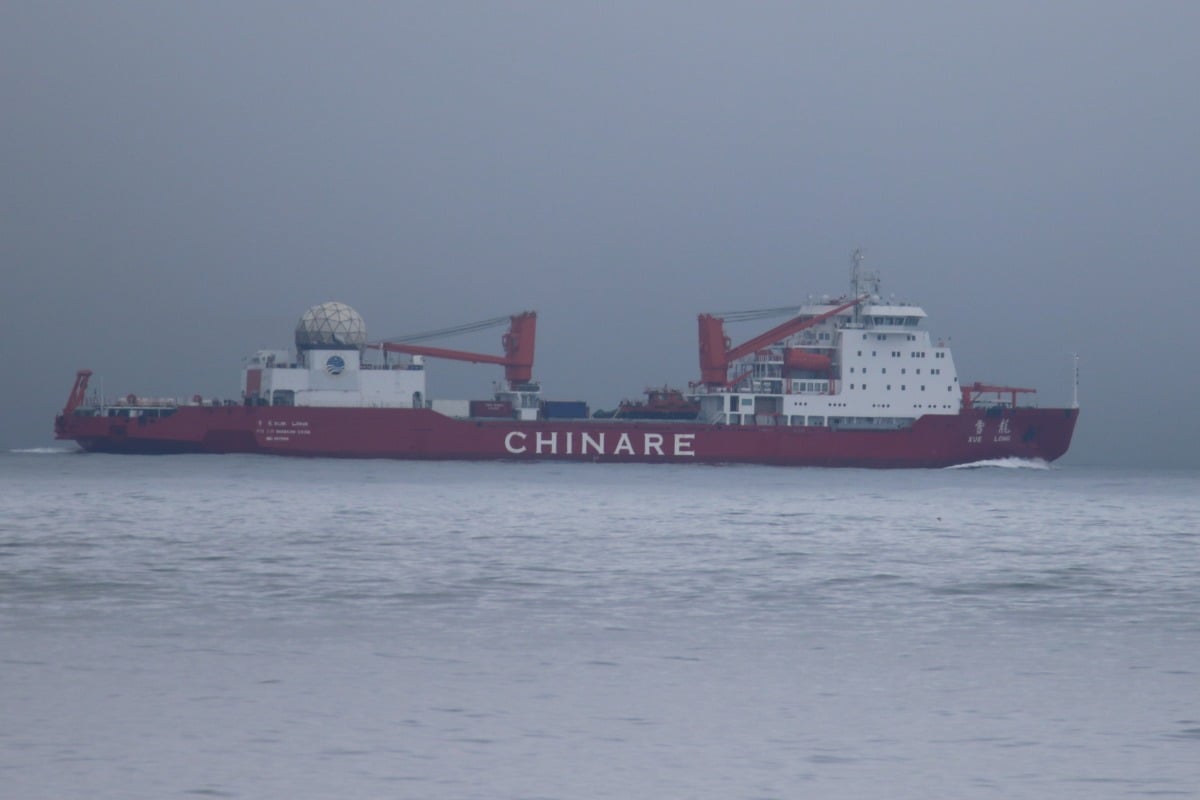
- The U.S. Coast Guard tracked Chinese research vessels Xue Long and Xue Long 2 transiting through the U.S. exclusive economic zone in the Bering Sea.
- The Coast Guard Cutter Munro executed Operation Frontier Sentinel to monitor the vessels during their northbound transit toward the Arctic.
Two Chinese research ships pushed north through American waters off Alaska this week, and for the first time this year, they didn’t just skirt past the edge of U.S. territory, they crossed directly through it. The U.S. Coast Guard confirmed it tracked the Chinese research vessel Xue Long as it transited north through the United States’ exclusive economic zone and over the U.S. extended continental shelf in the Bering Sea, accompanied by a second China-flagged research ship, the Xue Long 2, both declaring the Arctic as their destination.
An exclusive economic zone is a stretch of ocean extending 200 nautical miles (370 kilometers or 230 miles) from a country’s coastline where that nation holds special rights to manage fishing, energy exploration, and other economic activity, even though the water itself remains open to international navigation under maritime law. The extended continental shelf pushes that zone of specific American jurisdiction even further out, covering the underwater landmass that geologically extends beyond the standard 200-mile boundary, and Wednesday’s transit marked the first time this year that Chinese vessels were tracked moving through both zones simultaneously in the Bering Sea, the body of water separating Alaska from Russia’s far eastern coast.
The Coast Guard responded by deploying the Legend-class national security cutter USCGC Munro, a 418-foot (127-meter) vessel based on the West Coast, to execute what the service calls Operation Frontier Sentinel, an ongoing mission specifically built to monitor competitor activity in and around U.S. Arctic waters and respond quickly if that activity crosses into anything the Coast Guard considers a genuine threat to American sovereignty. Rear Adm. Bob Little, commander of the U.S. Coast Guard Arctic District, framed the response as part of a broader, coordinated effort spanning multiple federal agencies.
“Alongside the Department of War, the Department of State, and our international partners, we are actively responding to competitor activities across an increasingly contested Arctic,” Little said.
Foreign vessels are legally permitted to transit through an exclusive economic zone and extended continental shelf under international maritime law, and the Coast Guard has been careful to note that simply sailing through these waters does not violate any rule on its own. What does require advance American permission is conducting actual marine scientific research within those zones, along with a legal obligation to share any data collected with the United States afterward, a distinction that matters because research vessels like the Xue Long and Xue Long 2 carry exactly the kind of scientific equipment capable of mapping the seafloor, testing water conditions, and gathering data that could serve either genuinely civilian research purposes or feed into military planning, and the line between those two uses is not always visible from the deck of a passing cutter.
This week’s encounter extends a pattern that has grown steadily more frequent over the past three years. Coast Guard officials reported in August 2025 that Chinese research vessel activity in the U.S. Arctic had become part of a multi-year trend, noting that year alone had already seen five separate Chinese research ships operating in or near American Arctic waters, following a 2024 season that saw three such vessels conduct research north of the Bering Strait. That escalation has occasionally produced more pointed encounters than a simple monitored transit. In February 2025, the Coast Guard Cutter Kimball tracked four Chinese vessels, some clearly identified as military rather than research ships, operating within the U.S. exclusive economic zone near the Aleutian Islands, with the Chinese vessels telling Coast Guard radio operators they were conducting what they described as freedom of navigation operations, language that directly echoes the terminology the U.S. Navy itself uses to justify its own contested transits through waters claimed by other nations, including China’s own disputed claims in the South China Sea.
China has steadily expanded its icebreaker fleet and Arctic research infrastructure over the past decade, part of a broader strategic push the country has described using the term “Polar Silk Road,” aiming to secure a role in Arctic shipping routes and resource access even though China holds no Arctic coastline of its own. The United States, by contrast, has struggled for years with an aging and undersized icebreaker fleet, a gap the Coast Guard has moved to close through a $3.3 billion contract finalized this year for six new Arctic Security Cutters, alongside a separate procurement effort now underway for as many as seven smaller Homeland Security Cutter-Light vessels specifically built for lighter Arctic patrol duty.
Every tracked transit adds another data point to a pattern the Coast Guard says it expects to keep intensifying through the summer months, and the widening gap between how often Chinese vessels are showing up in American Arctic waters and how quickly the United States can field the ships needed to watch them may end up mattering more to the region’s future than any single ship’s declared destination ever could.