

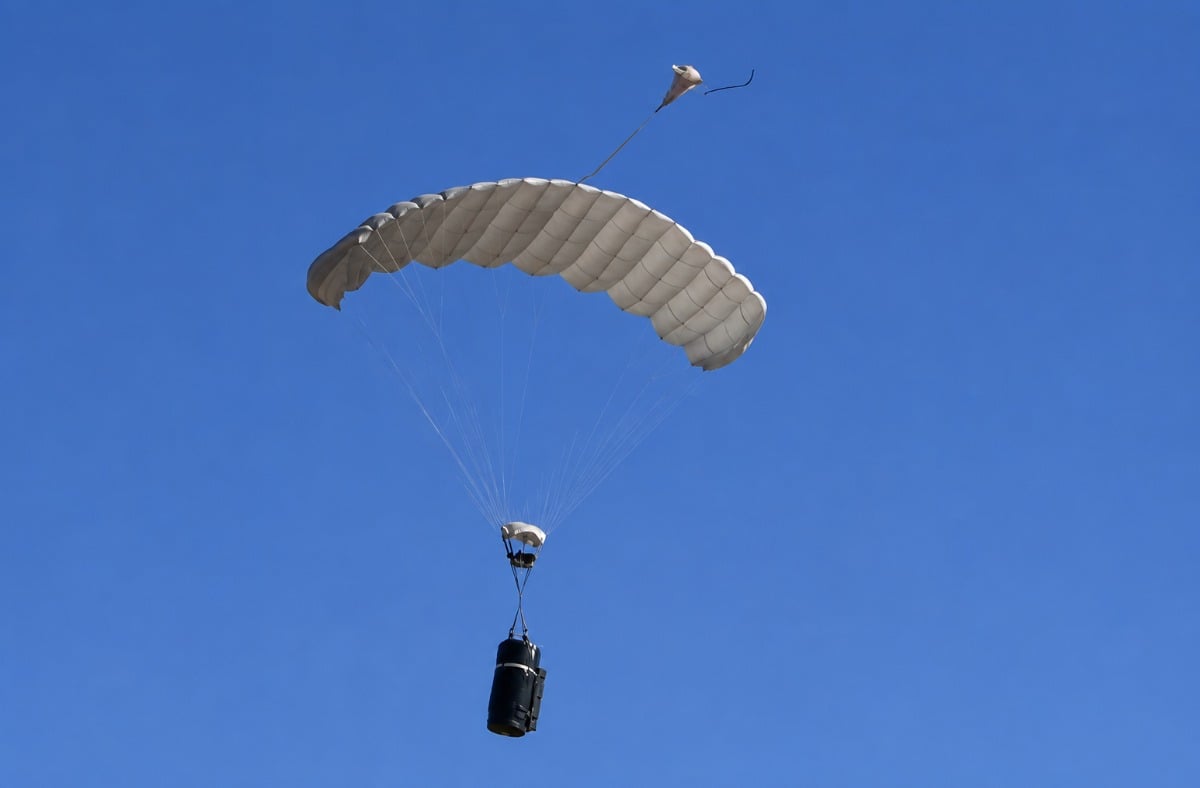
- Onyx Industries demonstrated its RAM-T air delivery system paired with a JPADS-guided parachute built by Airborne Systems.
- The demonstration used an inflatable payload barrel accessory to protect cargo delivered under an autonomously steered parachute.
Getting a piece of critical equipment out of an aircraft is only half the battle. Getting it to land exactly where troops need it, without a pilot flying dangerously low or slow over hostile territory, is the harder problem, and a Virginia-based company just demonstrated a system built to solve both at once.
Onyx Industries showcased its RAM-T air delivery system, short for Rigged Alternate Method Tandem, paired with a GPS-guided parachute built by Airborne Systems, delivering a payload under a static-line square parachute that steered itself autonomously to a designated landing point rather than drifting wherever the wind happened to carry it.
The guided parachute technology behind that precision is called the Joint Precision Airdrop System, or JPADS, a capability the U.S. Army and Air Force began developing jointly back in 1993 and first used in actual combat over Afghanistan in 2006. JPADS works by attaching a GPS-equipped guidance unit to a steerable parafoil parachute, letting an onboard computer continuously adjust the canopy’s steering lines throughout the descent so the payload corrects its own course in real time rather than following a single, unguided trajectory set the moment it leaves the aircraft.
Airborne Systems, the JPADS manufacturer partnering with Onyx on this demonstration, has sold more than 850 of its JPADS and FireFly systems to American and international customers, and the technology has become the most widely fielded precision airdrop system in the world, with variants capable of carrying loads up to 2,200 pounds (1,000 kilograms) from altitudes as high as 25,000 feet (7,600 meters) and steering to a target as far as 25 kilometers (15.5 miles) away from the release point.
That standoff distance is the entire point of pairing precision guidance with an air delivery system in the first place. Rather than forcing a cargo plane or helicopter to fly directly over a drop zone at low altitude, exposing the aircraft and its crew to enemy fire, a guided parachute lets the aircraft release its payload from farther away and higher up while the parachute handles the final approach itself, reducing risk to aircrews while still placing equipment precisely where ground forces need it.
“By continuously adjusting the parachute throughout descent, JPADS enables the payload to be delivered accurately while reducing drift and increasing stand-off options for the aircraft,” Onyx Industries said in a LinkedIn post announcing the demonstration.
The demonstration paired that guided descent with a specific piece of RAM-T hardware called the inflatable payload barrel, a protective container built from either 1.3-inch (3.3-centimeter) or 2.6-inch (6.6-centimeter) thick Hypalon-coated drop-stitch fabric, the same rugged, air-inflatable material commonly used in military boats and pontoons. The barrel comes standard with two of the smaller RAM-T variants and is available as an optional add-on for the larger models, and Onyx designed it to protect a wide range of cargo during the shock of landing, including unmanned systems, communications equipment, weapon systems, and general soft goods, while keeping the overall package light enough not to eat into the payload weight the parachute can actually carry.
The RAM-T platform itself comes in four main configurations, ranging from smaller units measuring 34 inches (86 centimeters) across and weighing around 124 pounds (56 kilograms) up to larger variants stretching 40 inches (102 centimeters) and weighing as much as 171 pounds (78 kilograms), each rated to carry a maximum exit weight of 1,000 pounds (450 kilograms) while the straps and hardware holding everything together are rated to withstand up to 10,000 pounds (4,535 kilograms) of force. Every variant rides on a wheeled carriage frame built from 316 stainless steel with polyurethane wheels, letting ground crews roll the loaded system into position for loading rather than having to lift a several-hundred-pound package by hand, and the entire platform supports multiple delivery methods depending on the mission, including tethered tandem drops, conventional static-line delivery, or fully guided parachute systems like the one used in this JPADS demonstration.
Onyx built additional modular accessories around the core RAM-T platform to handle the physics problems that come with dropping unpredictable cargo from an aircraft. A ballast system lets operators add precisely measured weight in 25, 50, or 100 pound (11.3, 22.7, or 45.4 kilogram) increments using sand, fuel, water, or any other granular material, letting crews fine-tune a package’s total weight for stable flight characteristics regardless of what the actual payload weighs on its own. A water-resistant liner protects sensitive cargo from moisture and dust during transit, while a separate inflatable stabilization system uses compressed-air cushions positioned between the payload and its container to prevent the load from shifting horizontally or vertically during the drop, keeping delicate equipment intact through the jolt of landing.
“Mission requirements evolve. Your delivery system should too,” Onyx Industries said in the same LinkedIn post.
A RAM-T unit rigged with an inflatable barrel and a JPADS guidance kit for a precision equipment drop into contested terrain could just as easily carry humanitarian aid supplies into a disaster zone or resupply a remote outpost, swapping accessories rather than swapping out the entire delivery system, an approach that matters increasingly as military logistics planners look for equipment that can do more with fewer dedicated, mission-specific tools cluttering an already overloaded supply chain.