


DZYNE Technologies today introduced its new Dronebuster vehicle kits at the Association of the United States Army (AUSA) Annual Meeting in Washington, D.C., expanding its existing counter-drone offerings to mobile platforms.
The company says the new systems will bring fast-deploying, vehicle-integrated protection against unmanned aerial systems (UAS) for use across convoys, mobile command posts, and forward-deployed infrastructure.
According to the company, the launch builds on the combat-tested Dronebuster product line that has been fielded in more than 50 countries, with over 2,500 units delivered worldwide.
“The Dronebuster Vehicle Kits are the next step in our integrated family of Counter-UAS systems,” said George Schwartz, Executive Vice President for Products at DZYNE. “They provide operators with a lightweight, affordable CUAS system that detects, tracks, identifies, and mitigates UAS threats. The optional networking capability enables a broad-area, distributed defense solution that keeps operators ahead of the threat.”
The company emphasized the kits’ low weight, ease of deployment, and reduced cost as key advantages over legacy counter-UAS systems, which are often larger, more expensive, and require extensive setup. The kits can operate autonomously or under manual control, and they support integration into mesh networks to create a layered defense across wide areas.
DZYNE’s offering includes two configurations tailored to different operational needs.
The Autonomous Dronebuster Vehicle Kit combines the Dronebuster 4 Fixed Site on a precision pan-tilt gimbal with a fully integrated Detection, Tracking, and Identification (DTI) system. It also includes an in-vehicle operator station equipped with TAK-enabled devices, allowing for real-time targeting and mitigation. According to DZYNE, this configuration can automate much of the kill chain using a simple point-and-click interface supported by AI- and machine learning-driven identification and a continuously updated drone library.
The autonomous system is designed for persistent protection of high-value targets such as convoys, bases, and critical infrastructure, where continuous drone surveillance is necessary.
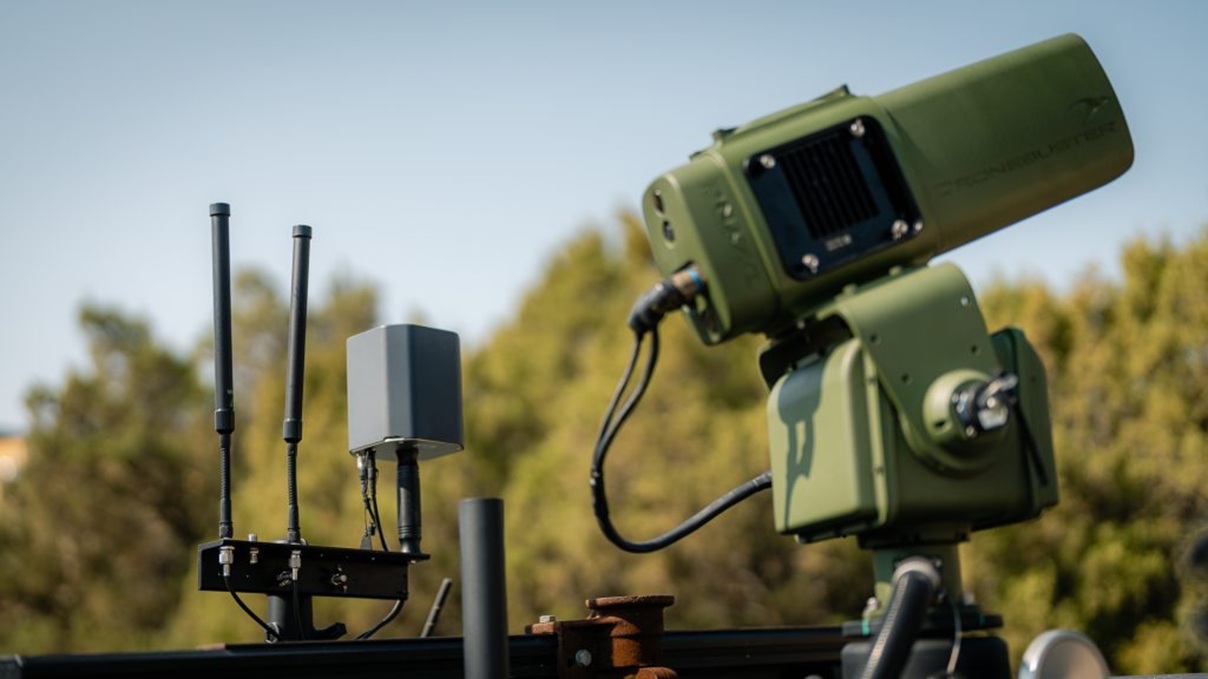
The Manual Dronebuster Vehicle Kit, meanwhile, provides a more flexible solution for operators who require mobility and responsiveness in complex environments. It features mounting hardware for the DTI system, an in-vehicle display, and a handheld Dronebuster 4 jammer for immediate threat engagement. DZYNE says this system is optimized for rapid deployment and dynamic missions, ensuring operators receive real-time alerts and can act quickly.
Both variants rely on DZYNE’s DTI system, which is capable of detecting up to 30 drones simultaneously at distances beyond 7 kilometers. It can distinguish between drones and their controllers, assign unique IDs, and support friend-or-foe recognition. The system operates passively across a wide spectrum (400 MHz to 6 GHz), with no emissions, allowing for stealth operation and high precision.
“This launch represents a milestone in DZYNE’s growth,” said Matthew McCue, CEO of DZYNE. “We’ve doubled our workforce in Portland this year to meet demand and expanded our Counter-UAS product line – underscoring our role as a leading provider of layered defense solutions.”
The company says the Dronebuster Vehicle Kits are ready for integration into U.S. and allied force structures, offering an off-the-shelf solution that aligns with evolving operational requirements.