

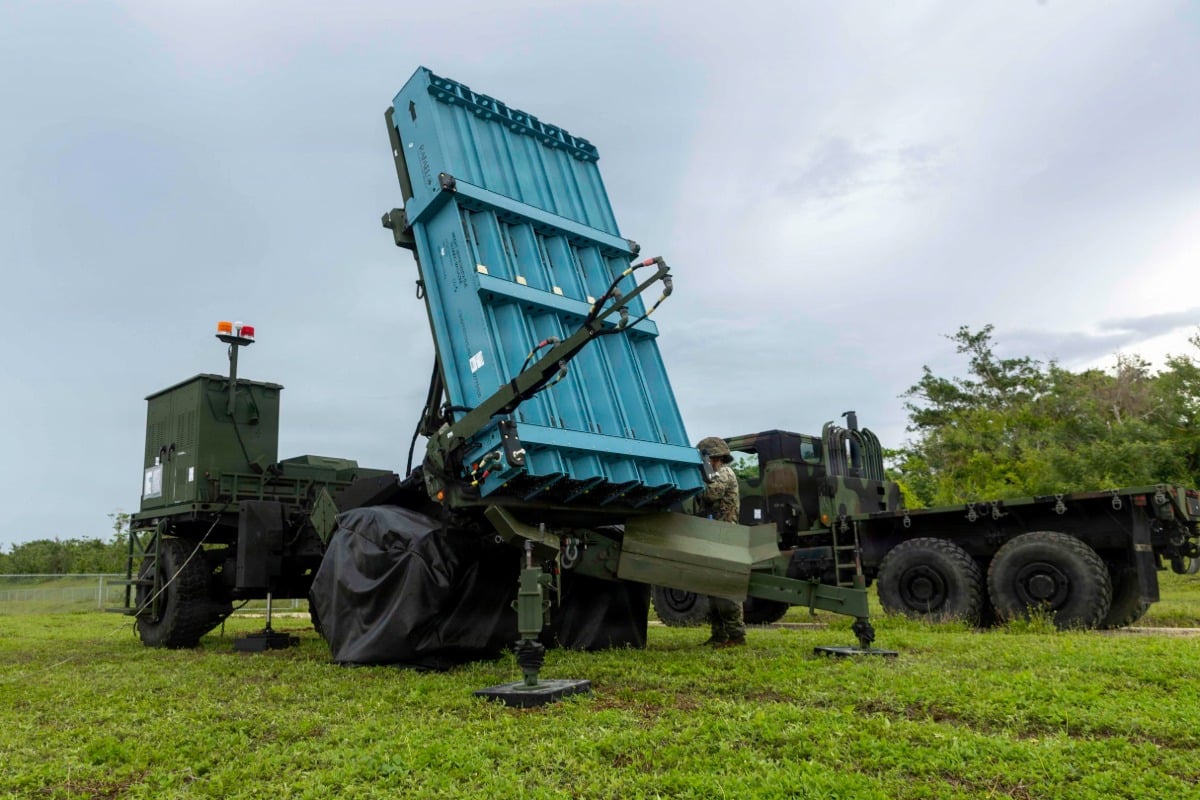
- U.S. Marines with III Marine Expeditionary Force evaluated the MRIC air defense system on Mason Range, Guam, on June 24, 2026, during Valiant Shield 2026.
- MRIC is a trailer-mounted Iron Dome-derived system carrying up to 20 SkyHunter interceptors with a range of 4 to 70 km, entering full fielding across three Marine battalions between 2026 and 2028.
U.S. Marines from III Marine Expeditionary Force were photographed calibrating and evaluating the Medium-Range Intercept Capability system on Mason Range, Guam, on June 24, 2026, as part of Valiant Shield 2026, the biennial U.S.-led exercise that assembles joint and allied forces across the Indo-Pacific to practice the kind of high-end multi-domain combat the Pentagon considers most likely in any future confrontation with China.
The appearance of MRIC at Guam during Valiant Shield is the first confirmed public deployment of the system in the Pacific theater during a major exercise, coming just weeks after Israel delivered the first batch of Tamir interceptors to the Marine Corps in May 2026 to support the system’s initial operational platoon.
MRIC is the Marine Corps’ answer to a capability gap that opened in 1997 when the service retired its last MIM-23 Hawk medium-range surface-to-air missile batteries and spent the subsequent two and a half decades without an organic medium-range air defense system, relying instead on the Army to provide Patriot and THAAD coverage for Marine forces in the field. That arrangement worked reasonably well when air threats were predictable and the tactical environment allowed deliberate theater-level air defense planning, but the proliferation of cheap drones, cruise missiles, and precision rockets across potential adversary arsenals in the Indo-Pacific fundamentally changed the calculation. A Marine Littoral Regiment maneuvering through island terrain in a contested Pacific scenario cannot always count on an Army Patriot battery being within supporting range, and the threats it needs to defeat at ranges between 4 km and 70 km (2.5 to 43 miles) are precisely the ones that neither the short-range Stinger nor the long-range Patriot is designed to handle most efficiently.
The MRIC system the Marines brought to Guam for Valiant Shield 2026 integrates Iron Dome technology developed by Israel’s Rafael Advanced Defense Systems into a mobile, trailer-mounted launcher configuration carrying up to 20 interceptor missiles in four levels of missile pods. The interceptor, known in U.S. service as the SkyHunter, is the American-manufactured variant of the Tamir missile that has intercepted thousands of rockets, drones, and cruise missiles in combat over Israel since 2011. SkyHunter carries an active radar seeker for terminal guidance, a two-way data link that allows updated targeting data to be transmitted during flight, and a fragmentation blast warhead with a proximity fuze that does not require a direct hit to defeat its target. Raytheon, which builds the SkyHunter through its R2S joint venture with Rafael at a facility in East Camden, Arkansas, that opened in November 2025, received a $380 million full-rate production contract for MRIC hardware in late 2025, bringing the program’s total contract value to $412 million.
The fire control architecture connecting the launcher to its targets integrates the Marine Corps Ground/Air Task-Oriented Radar, known as G/ATOR, which provides 360-degree coverage for target detection and tracking, with the Common Aviation Command and Control System that handles communications and engagement sequencing. The digital signal processing that ties these components together allows MRIC to simultaneously track and evaluate multiple aerial threats approaching from different directions and altitudes, prioritizing and cueing engagement sequences without requiring the operator to manage each track manually. That simultaneous multi-threat engagement capability is the operational feature that makes MRIC relevant to the scenario planners worry most about: a coordinated strike mixing cruise missiles, drones, and fixed-wing aircraft arriving from multiple axes at the same time.
Iron Dome’s combat record provides the evidentiary foundation that MRIC’s developers built on. Israel’s system has demonstrated an interception rate of 85 to 90 percent against real-world threats in operational conditions since its 2011 deployment, a figure drawn from engagements against actual rockets and missiles rather than test range targets. The Tamir interceptor itself has been progressively upgraded to expand the threat envelope it can handle, starting with short-range rockets and evolving to include cruise missiles by 2020 and showing limited capability against some ballistic missiles during the Iran conflict that began in 2025. The Marine Corps’ version inherits that evolution through the SkyHunter configuration, which is built to the same threat parameters while meeting U.S. military interoperability requirements.
Valiant Shield 2026, the exercise that brought MRIC to Mason Range on Guam, is the largest joint field training exercise in the Indo-Pacific, bringing together thousands of U.S. service members from all branches alongside allied and partner nations to rehearse precisely the kind of multi-axis, multi-domain operations that a Pacific conflict would demand. Guam’s strategic significance to that scenario is hard to overstate: the island hosts Anderson Air Force Base, a critical hub for long-range bombers and aerial refueling, and Naval Base Guam, and it sits within striking range of Chinese medium-range ballistic missiles that Beijing has spent years developing and fielding in quantity. An MRIC battery operating on Guam during Valiant Shield is not a public relations event; it is an operational readiness evaluation of a system that may one day protect those very bases from the threats China’s People’s Liberation Army Rocket Force has built to attack them.
The Marine Corps plans to field MRIC to all three of its Low Altitude Air Defense Battalions between 2026 and 2028, with the initial platoon using both Israeli-delivered Tamir missiles and U.S.-produced SkyHunters from the Arkansas facility. The appearance of the system on Guam during Valiant Shield suggests the initial platoon has reached the readiness level required for meaningful deployment in a complex joint exercise environment, a step beyond the live-fire evaluations conducted at White Sands Missile Range in New Mexico that built the operational baseline.