

- Esh-Tech raised $18 million in a funding round led by Kinetica Ventures, announced June 30, 2026, to scale production of its DroneLight counter-drone laser system.
- DroneLight uses pulsed-laser technology to neutralize drones in one to two seconds using approximately 4 kilowatts of power, debuted publicly at Eurosatory 2026.
Esh-Tech, the Israeli laser defense company behind the pulsed-laser counter-drone system DroneLight, raised $18 million in a funding round led by Kinetica Ventures, the company announced June 30, 2026. The Defence Blog previously reported on DroneLight’s public debut, where the system’s central claim was a radical departure from how laser weapons have traditionally worked: instead of burning a target with a sustained beam for ten to fifteen seconds, the system fires rapid pulses that drill physical holes into a drone’s structure, reaching critical components in one to two seconds.
This new funding round will finance the next phase, building an actual production line in Israel, completing remaining development work, hiring additional staff, and expanding sales and delivery operations internationally to meet what the company describes as growing customer demand.
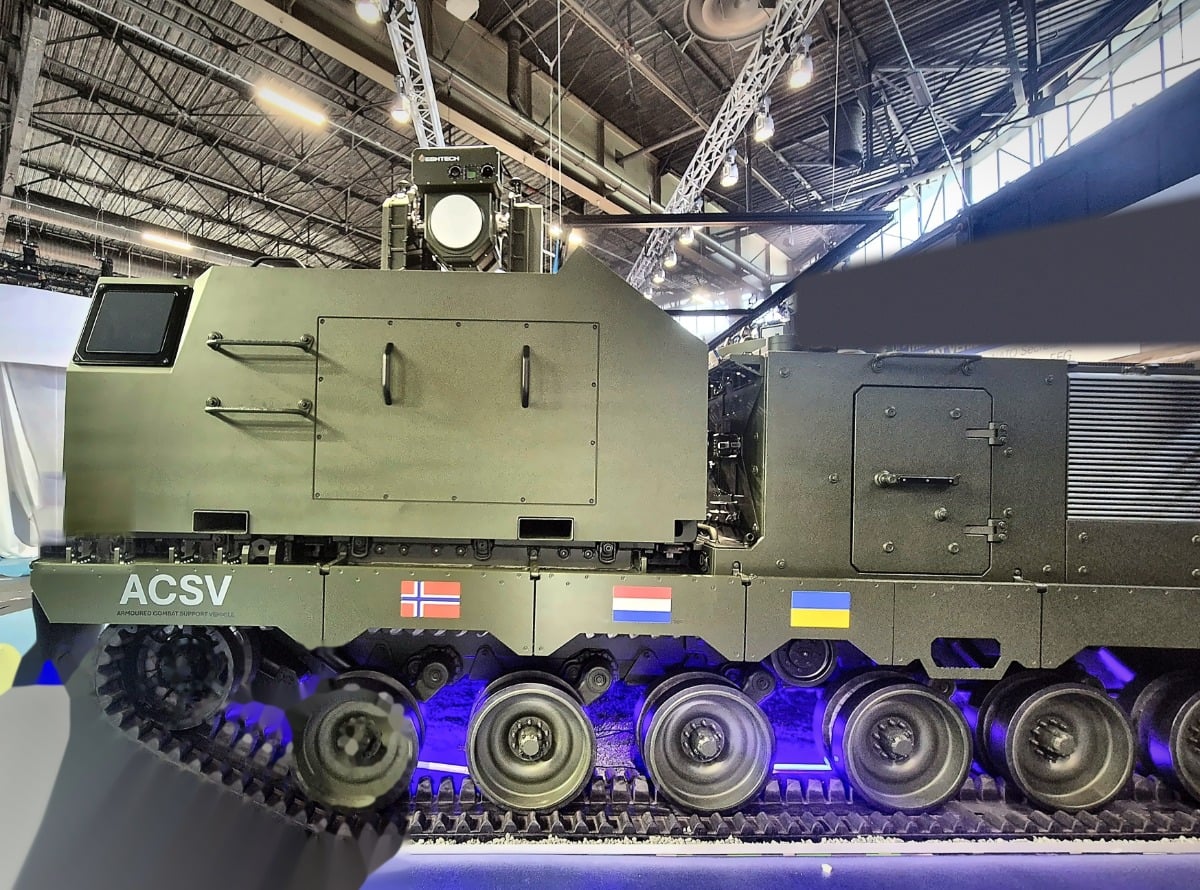
The investment follows DroneLight’s formal launch at Eurosatory 2026 in Paris in June, where Esh-Tech displayed the system mounted on a German FFG armored vehicle and detailed the technical approach that distinguishes it from competing laser weapons. Most directed-energy counter-drone systems use continuous-wave lasers, which heat a single point on the target until enough thermal energy accumulates to cause structural failure, a process that typically requires more than fifteen seconds of sustained exposure and significant electrical power, often 20 kilowatts or more.
DroneLight instead fires extremely short pulses, each lasting roughly 10 milliseconds at a repetition rate of 5 Hz, with every pulse mechanically removing material through rapid ablation rather than heating it. Esh-Tech CEO Erez Riahi has described the effect using a memorable comparison: each pulse functions like a precisely aimed bullet rather than a sustained burn, capable of penetrating several millimeters of plastic or aluminum to reach a drone’s battery, electronics, sensors, or camera, the components whose destruction actually brings the aircraft down.
That pulsed approach allows DroneLight to operate on approximately 4 kilowatts of input power, a fraction of what comparable laser weapons require and low enough that the system can draw power directly from a standard tactical vehicle’s electrical system without dedicated generators. The system’s optical head weighs approximately 450 kg (992 lb), with a separate 350 kg (772 lb) support module that installs inside the vehicle, and Esh-Tech has demonstrated the configuration mounted on an FFG armored tracked vehicle, positioning DroneLight as a mobile, vehicle-integrated capability rather than a fixed installation requiring permanent infrastructure. The system covers a defensive radius of approximately 1 km (0.6 miles) with 360-degree engagement coverage and is designed for single-operator control, with an automatic tracking system that synchronizes its pulsed laser modules to maintain consistent performance against moving targets.
The engagement rate Esh-Tech advertises is the figure most likely to draw attention from military buyers facing the drone swarm problem that has come to dominate modern ground combat. Operating at 5 Hz with a one-to-two-second kill time per target, the company says DroneLight can neutralize up to 30 drones per minute, a figure Riahi has directly connected to the swarm threat that has made coordinated multi-drone attacks one of the most pressing tactical problems facing ground forces, citing Ukraine specifically as the conflict that demonstrated how decisive that threat has become. Testing conducted on more than 20 drones reportedly showed that creating multiple perforations in vital internal areas produces a near-certain kill probability, with the system directing its pulses at identified vulnerable points and concentrating additional fire once a weak spot is located.
Erez Riahi, CEO of Esh-Tech, framed the funding round as a transition point for the company’s trajectory from prototype demonstration to fielded capability.
“This investment marks an important milestone for Esh-Tech as we move from development to large-scale deployment,” Riahi said. “The confidence shown by investors from leading global markets is a strong validation of our technology and its ability to address one of the most significant challenges facing modern armed forces. Building on the momentum generated at Eurosatory, we are accelerating our international expansion, deepening our presence in key markets while strengthening local capabilities and partnerships on the ground. We are fully focused on bringing DroneLight into operational service and delivering meaningful impact where it matters most.”
The round was led by Kinetica Ventures, a defense-technology focused venture capital fund managed by Aaron Applbaum, Yoav Knoll, Frederic Landau, and Brig. Gen. (res.) Amit Kunik, a former senior commander in Israel’s intelligence community, with the fund chaired by veteran investor Yitz Applbaum, a co-founder of Lightspeed Israel. Kinetica focuses specifically on early-stage Israeli startups operating in advanced manufacturing, artificial intelligence, electronic warfare, unmanned systems, and space, and has previously led investments in companies including Particle, Line5, and Limitless CNC. Joining Kinetica in the Esh-Tech round were Mahari, Renaton Capital, Q Fund, 2i Ventures, Hinkley, FFG, the German vehicle manufacturer whose armored platforms have hosted DroneLight in public demonstrations, and a number of angel investors, with what Esh-Tech describes as meaningful participation from the Israel Innovation Authority, the government body that supports technological development in Israeli industry.
Frederic Landau, General Partner at Kinetica, described the investment thesis behind backing a laser weapon company at this stage of its development.
“Our investment in Esh-Tech reflects our commitment to supporting breakthrough technologies that have the potential to redefine their market,” Landau said. “Esh-Tech combines deep expertise in laser technologies with a strong understanding of operational requirements, resulting in a solution that addresses a critical and rapidly evolving challenge. Beyond the investment itself, we look forward to working closely with Esh-Tech to accelerate its growth, support its entry into the European, U.S. and other markets, leveraging our industry expertise, operational experience and network of strategic partners to help scale the business internationally.”
The funding round arrives as Esh-Tech says it has already secured significant orders from customers worldwide and successfully completed operational testing under real-world conditions, claims the company has made publicly without disclosing specific customer names or order quantities. Riahi previously told Breaking Defense he expects production to scale from dozens of systems in early 2027 to hundreds of units annually the following year, with the company actively pursuing customers across the United States, Europe, Latin America, and Asia-Pacific. The company is also cooperating with Israel’s Ministry of Defense Directorate of Defence Research and Development, known as MAFAT, on potential integration into Israel’s own defense requirements, a market where the urgency of counter-drone capability has been demonstrated repeatedly across multiple active fronts.
DroneLight’s central economic argument, that it can deliver hard-kill laser capability at roughly 25 percent the cost of conventional continuous-wave systems, is the claim that will determine whether the technology spreads broadly across allied militaries or remains a niche solution. If the company’s production scaling proceeds on the timeline Riahi has described, with deployable units delivering to customers within months rather than years, the $18 million raised this week becomes the bridge between a successful trade show demonstration and an operational counter-drone capability genuinely fielded at the scale the drone threat demands.