

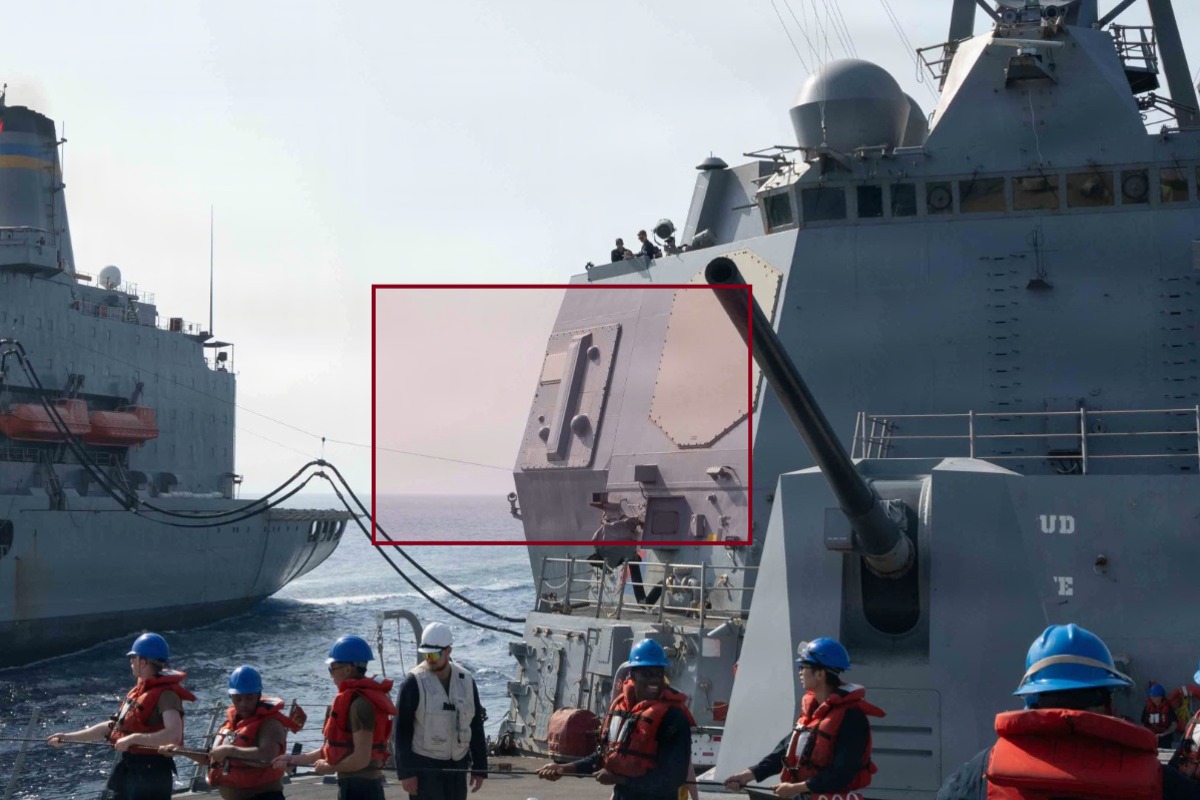
- Northrop Grumman received a $312 million contract from Naval Sea Systems Command on June 24, 2026, for SEWIP Block 3 Hemisphere and Quadrant electronic warfare systems.
- Work spans fifteen states and is scheduled for completion by August 2029, funded through fiscal year 2026 Navy shipbuilding funds.
Northrop Grumman secured a $312 million contract from the U.S. Navy on June 24, 2026, to produce additional Surface Electronic Warfare Improvement Program Block 3 systems in two configurations called Hemisphere and Quadrant, expanding a production line that is now arming destroyers, aircraft carriers, and amphibious assault ships with the most capable electronic jamming technology the surface fleet has ever fielded.
Naval Sea Systems Command awarded the firm-fixed-price contract modification, with work spread across fifteen states and the full $312 million in fiscal year 2026 shipbuilding funds obligated at signing. The contract is expected to be completed by August 2029, and it builds directly on a December 2025 order worth $334 million that brought Northrop Grumman’s total SEWIP Block 3 production commitment to as many as 24 systems across the fleet, with cumulative contract value approaching $783 million if all available options are exercised.
SEWIP Block 3, formally designated the AN/SLQ-32(V)7 once installed, represents the third major upgrade to a Navy electronic warfare lineage that traces back to the original AN/SLQ-32, developed by Raytheon in the 1970s as a passive system that could detect and warn crews about incoming radar-guided threats but could not actively fight back. SEWIP Block 3 changes that fundamentally by adding what the Navy calls electronic attack capability, the ability to not just detect an enemy missile’s guidance radar but actively jam and deceive it, breaking the missile’s lock on its target before impact. The system achieves this using sixteen active electronically scanned array antennas built with gallium nitride transmit and receive modules, split into four quadrants that each contain four transmit and receive faces, providing 360-degree coverage so a ship under attack from multiple directions simultaneously can respond to all of them at once rather than sequentially.
The two configurations named in the contract, Hemisphere and Quadrant, are not different products but different physical arrangements of the same underlying technology, tailored to fit the specific deck space and structural layout of different ship classes. The Hemisphere configuration installs port and starboard on the main deckhouse of Arleigh Burke-class Flight IIA destroyers, the most numerous warship type in the Navy’s surface fleet, requiring the construction of large sponsons, structural additions to the hull, that house the new antenna arrays and stand roughly 6.7 m (22 ft) tall in their diamond-shaped enclosures. The Quadrant configuration redistributes the same hardware building blocks around a vessel with different structural constraints, and this contract specifically funds the first Quadrant shipset destined for installation on a nuclear-powered aircraft carrier, a milestone that extends SEWIP Block 3 beyond destroyers for the first time. Industry reporting citing fiscal year 2026 budget documents indicates USS Harry S. Truman is the carrier currently slated to receive the system, set to begin a five-year refueling and complex overhaul at Newport News Shipbuilding in mid-2026, though Northrop Grumman has not officially confirmed the hull assignment.
The strategic logic behind this expanded production run centers on a specific arithmetic problem facing modern naval defense. When a ship faces an incoming anti-ship missile, the traditional response is a Standard Missile or other interceptor fired from the ship’s vertical launch system, a kinetic solution that costs hundreds of thousands to millions of dollars per shot and draws down a finite magazine that cannot be reloaded at sea. SEWIP Block 3 offers what defense planners call a soft-kill alternative: rather than physically destroying the incoming missile, it corrupts the missile’s guidance radar with jamming signals precise enough to break the seeker’s lock on the ship, causing the weapon to miss without expending a single interceptor. A ship that can jam its way through a missile salvo preserves its limited interceptor inventory for the threats that jamming cannot defeat, extending the ship’s effective defensive depth against the kind of saturation attacks that adversary navies have specifically designed to overwhelm conventional kinetic defenses.
Lara Kopf, vice president of Land and Maritime Systems at Northrop Grumman, framed the expanded order as part of a broader transformation in how the Navy approaches electronic warfare across the fleet.
“Our commitment to innovation means we’re not just delivering systems, we’re redefining naval capabilities,” Kopf said. “The SEWIP Block 3 technology transforms the future of electronic warfare by enhancing the adaptability and resilience of our fleet in a rapidly evolving threat landscape.”
SEWIP Block 3’s architecture was deliberately built to evolve rather than remain static, a design philosophy Northrop Grumman describes as software-defined and hardware-enabled. The system’s open architecture allows the Navy to update jamming techniques, add new electronic attack capabilities, and integrate emerging technologies such as artificial intelligence and machine learning without requiring a hardware redesign each time adversary radar systems change their behavior, a critical feature given how quickly potential adversaries, particularly China and Russia, have been fielding new generations of anti-ship missiles with improved seeker resistance to jamming. SEWIP Block 3 also incorporates a Soft Kill Coordinator, a management system that automates and sequences electronic attack engagements across the array, reducing the burden on ship crews who would otherwise need to manually manage jamming responses during the high-tempo, multi-threat scenarios the system is designed to counter.
The first operational installation of SEWIP Block 3 occurred aboard USS Pinckney, a Flight IIA Arleigh Burke-class destroyer, in 2023, providing the Navy with its initial real-world data on the system’s performance before committing to the larger production runs now underway. The Defence Blog previously reported on the completion of subsequent DDG Modernization 2.0 overhauls aboard USS Chung-Hoon and USS James E. Williams, both of which received the same AN/SLQ-32(V)7 system as part of broader mid-life ship modernizations led by General Dynamics NASSCO. This new $312 million order continues that production momentum while pushing the system’s reach beyond the destroyer fleet for the first time, into the carrier force that represents the Navy’s most strategically valuable and heavily defended assets.
Northrop Grumman is simultaneously developing a smaller variant called Scaled Onboard Electronic Attack, designed specifically for ships that lack the deck space, weight capacity, or power generation to support a full SEWIP Block 3 installation. That parallel development effort, currently in a rapid prototyping phase, signals the Navy’s intent to eventually extend electronic attack capability across the entire surface fleet rather than concentrating it solely on its largest combatants, a recognition that the saturation drone and missile threats driving this investment do not discriminate by ship size.