

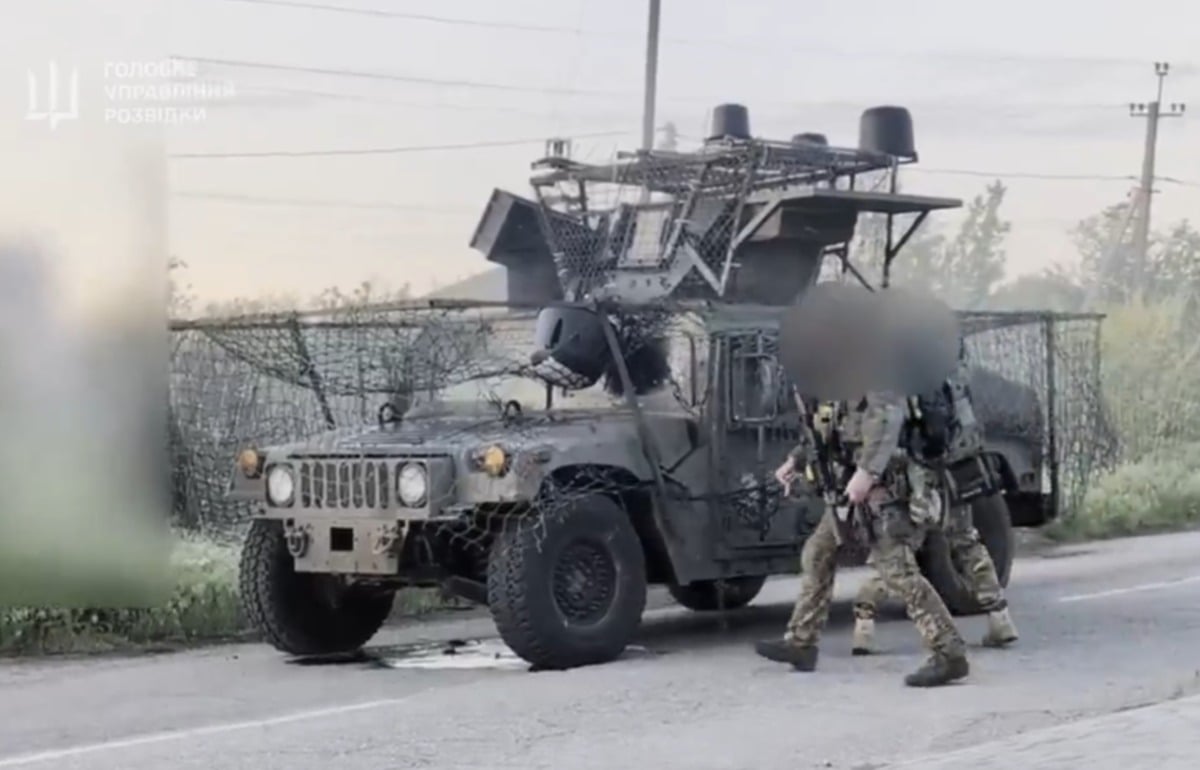
- Ukraine's GUR published video of a Bratstvo unit Humvee surviving a direct FPV drone strike on its armored windshield during a Zaporizhzhia mission.
- Ukraine operates an estimated 6,000 Humvees across its armed forces, up from roughly 100 at the start of the full-scale invasion in February 2022.
A First-Person View (FPV) drone, the cheap remote-controlled kamikaze weapon that has killed more soldiers in this war than almost any other single weapon type, struck a Ukrainian military Humvee directly in the windshield during a combat mission in the Zaporizhzhia direction. The crew inside survived. The glass held.
Ukraine’s Defense Intelligence directorate, known by its Ukrainian abbreviation GUR and the agency responsible for the country’s most sensitive special operations and intelligence missions, published exclusive frontline video of the incident under the title “Humvee Windshield Survives Enemy FPV Strike.”
The footage shows the moment of impact and its aftermath, documenting what the agency described as a direct hit by a Russian FPV drone on the vehicle’s armored windshield during a rotation mission carried out by fighters of the Bratstvo unit, part of the Special Unit Tymur operating under GUR’s command in the Zaporizhzhia region of southeastern Ukraine.
The Humvee, formally designated the High Mobility Multipurpose Wheeled Vehicle or HMMWV, is an American-designed military utility vehicle that has served as the workhorse of the U.S. military since the 1980s and has been transferred to Ukraine in substantial numbers since Russia’s full-scale invasion began in February 2022. Ukraine operates an estimated 6,000 Humvees across multiple branches of its armed forces, a figure that represents an extraordinary expansion from the roughly 100 vehicles in Ukrainian service at the start of the invasion. That growth reflects both the scale of Western military aid and the Humvee’s reputation among Ukrainian troops as a vehicle that combines reliability, mechanical simplicity, and battlefield durability in a package that front-line units can maintain without specialized support infrastructure.
The FPV drone that struck the vehicle belongs to a category of weapon that has fundamentally reshaped ground combat in Ukraine. FPV, which stands for first-person view, describes a drone piloted remotely through video goggles that give the operator a live feed from a camera mounted on the aircraft, allowing precise maneuvering at high speed toward a specific point of impact. These drones are typically small commercial quadcopters modified to carry explosive charges, costing anywhere from a few hundred to a few thousand dollars to build, and they have proven devastatingly effective against vehicles, fortified positions, and personnel in the open. Both Russian and Ukrainian forces have deployed them in enormous quantities, and the FPV drone strike has become one of the defining tactical realities of this conflict.
The significance of the Bratstvo footage lies not in the drama of the impact but in what happened after it. Armored glass on a military vehicle is designed to absorb and distribute the energy of an impact rather than shattering inward, protecting the occupants from fragmentation and blast overpressure. The fact that the windshield held against a direct FPV strike is a concrete data point about the protective value of armored Humvee variants under real combat conditions, the kind of information that unit commanders, vehicle crews, and the analysts responsible for evaluating military aid packages pay close attention to. A vehicle that survives a direct drone hit and keeps its crew operational is worth substantially more to a fighting unit than one that requires immediate evacuation of its occupants after every close engagement.
Ukrainian soldiers have developed a notably strong institutional preference for the Humvee over the course of the war, valuing the vehicle for exactly the qualities the Bratstvo incident illustrates. Its mechanical systems are straightforward enough that crews can perform significant repairs in the field without factory-trained technicians or specialized tooling. Spare parts are widely available across the supply chain that Western partners have built up around Ukraine’s armed forces. And the vehicle’s suspension and drivetrain handle the degraded road conditions of the front-line environment, where roads are often cratered, mined, or simply unpaved, with a reliability that more complex vehicles cannot always match under sustained operational stress.