

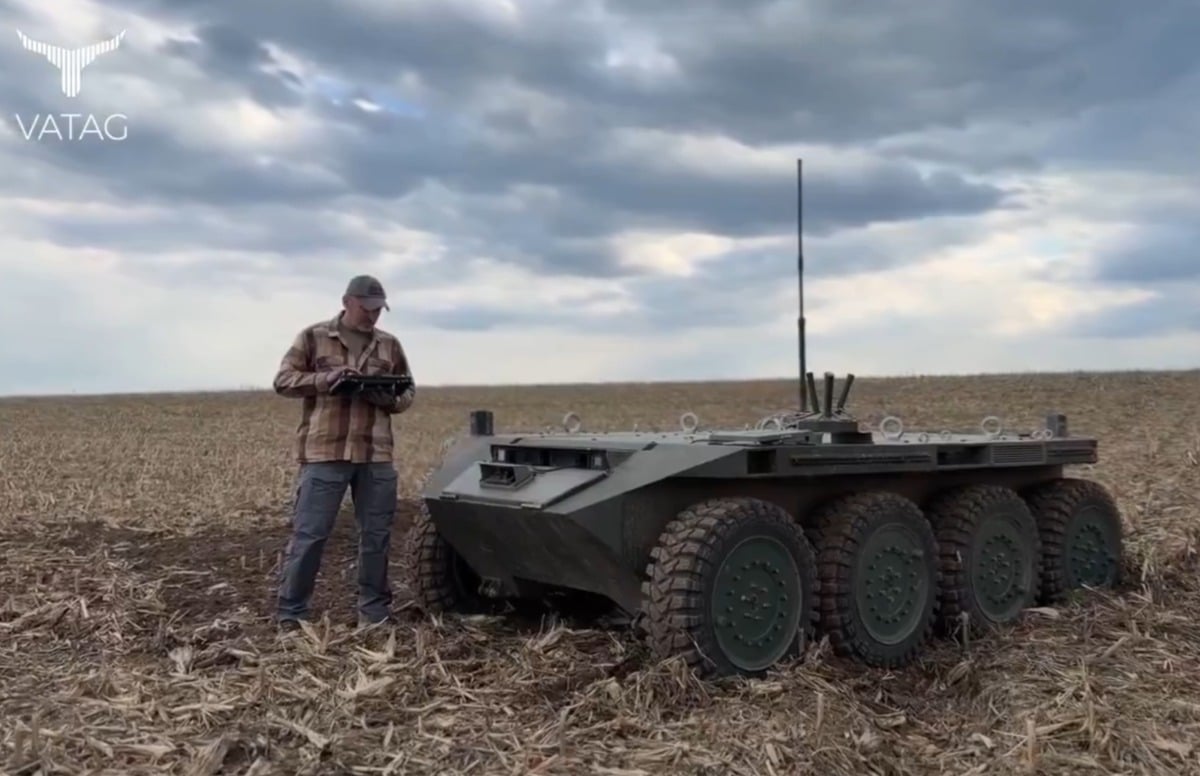
- VATAG released field test footage of its 8x8 heavy unmanned ground vehicle crossing rough terrain at up to 42 km/h.
- The platform first debuted at Brave1 Defense Tech Valley 2025 in Kyiv on September 16, 2025.
A Ukrainian robotics company released video footage of its heavy unmanned ground vehicle crossing a plowed field at speed, visual proof that a machine built to haul two tons of ammunition, food, or wounded soldiers can actually handle the kind of broken, rough terrain that would stop a human-driven truck cold.
Ukrainian developer VATAG posted the field test footage showing its 8×8 wheeled robot, also called VATAG after the platform itself, driving across cross-country terrain at speeds reaching 42 kilometers per hour (26 mph) while carrying up to 2 tons (4,410 pounds) of cargo capacity, with the video showing tracking and targeting markers overlaid on the footage consistent with the onboard optical system the company has said the platform uses for navigation and target detection. The platform first debuted publicly at the Brave1 Defense Tech Valley 2025 summit in Kyiv on September 16, 2025, and this new footage marks one of the clearest public demonstrations yet of the vehicle actually operating under real field conditions rather than simply sitting on a display stand at a trade show.
VATAG belongs to a category Ukrainian developers call H-UGV, short for heavy unmanned ground vehicle, a class of robot built with enough size and power to handle genuinely demanding logistics and combat support tasks rather than the smaller, lighter drones that have proliferated across the front lines for reconnaissance and light resupply. The company has said VATAG serves as the base platform for an entire planned ecosystem of specialized variants, including logistics-focused versions built purely for hauling supplies and combat-configured versions carrying weapons systems, all sharing the same underlying 8×8 chassis and control architecture rather than requiring separate development programs for each mission type.
The baseline armed configuration mounts a 25mm automatic cannon on what the company describes as a proprietary universal combat module, a remotely operated weapons station the developer has said can also accommodate cannons up to 30mm, a 40mm Mk19 automatic grenade launcher, a 12.7mm heavy machine gun, or anti-tank guided missile systems depending on the specific mission a unit requires. That modularity matters because it lets the same physical platform serve dramatically different roles, delivering ammunition to a forward position on one mission and providing direct fire support with a stabilized cannon on the next, without requiring separate vehicle types and separate training pipelines for each capability.
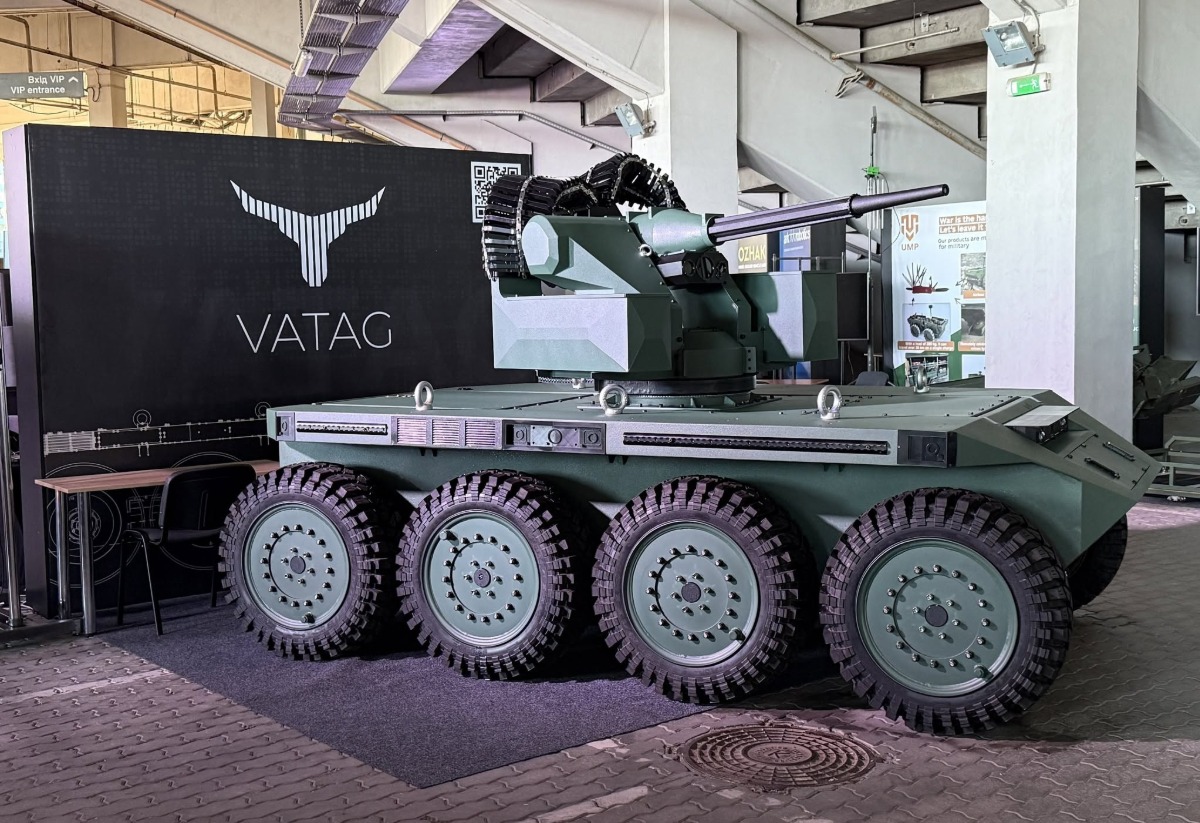
Autonomy sits at the center of VATAG’s design rather than functioning as an add-on feature, with the company describing an intelligent navigation and control system capable of executing supply missions in environments where GPS signals are jammed or unavailable entirely, a capability that matters enormously given how aggressively both Russian and Ukrainian forces now jam satellite navigation across contested sectors of the front. The system can also detect and maneuver around obstacles along its route independently and operate in a following mode that lets multiple VATAG units form a convoy with minimal human intervention, reducing how many personnel need to expose themselves to danger simply to move supplies from one point to another. A hybrid powerplant combining fuel efficiency with a near-silent electric mode supports that autonomous operation, letting the vehicle move covertly when stealth matters while also functioning as a mobile power source capable of recharging communications equipment or other gear for the units it supports in the field.
VATAG’s ambitions have since extended well beyond Ukraine’s own battlefield, with the platform appearing at CES 2026 in Las Vegas as part of the Ukrainian Pavilion, where its developers marketed a civilian-oriented transport module adapted for use in mining, forestry, and emergency response operations, sectors that share the military platform’s core need for reliable cargo transport across difficult terrain without risking human drivers in hazardous conditions. That dual-use marketing push reflects a broader pattern among Ukrainian defense technology companies, many of which have found that combat-tested autonomous systems translate readily into commercial applications once a war-driven engineering problem gets solved, giving Ukrainian firms a potential export and revenue pathway that extends beyond military procurement contracts alone.