

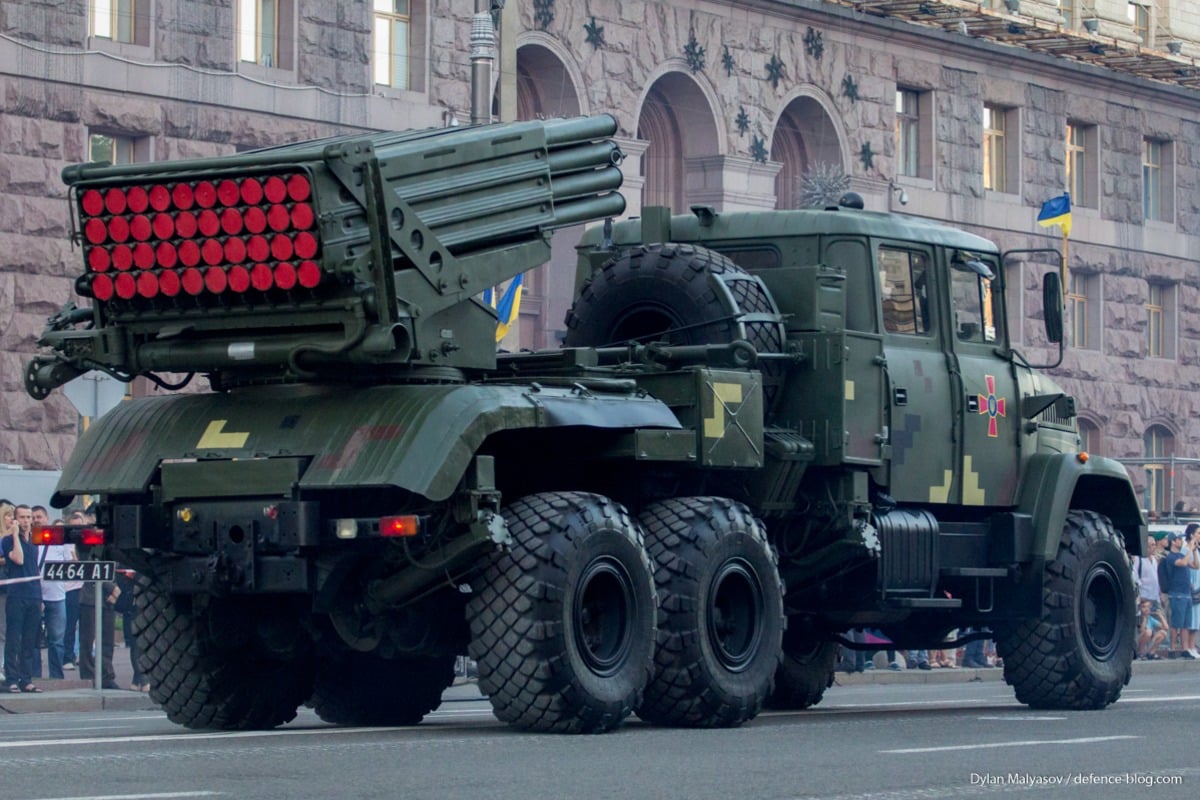
- Ukrainian Commander-in-Chief General Syrskyi approved the Concept for the Development of Rocket Forces and Artillery through 2030, prioritizing domestic production and phasing out Soviet-era systems.
- The concept targets strike capability reaching 2,000 km through Ukrainian-developed ballistic and cruise missiles combined with unmanned systems, as stated by General Syrskyi.
Ukraine’s commander-in-chief has approved a formal development concept for the country’s rocket forces and artillery through 2030, setting out a blueprint that prioritizes domestic weapons production, targets strike capability reaching 2,000 kilometers (1,243 miles), and commits to phasing out Soviet-era artillery systems that can no longer be repaired or modernized.
General Oleksandr Syrskyi, Commander-in-Chief of the Armed Forces of Ukraine, announced the approval of the Concept for the Development of Rocket Forces and Artillery of the Armed Forces of Ukraine in a statement published by the General Staff. The document covers the medium-term development trajectory of one of Ukraine’s largest military branches through 2030 and represents the most comprehensive public articulation of how Ukraine intends to reshape its fires capability as the war continues and, eventually, transitions toward a post-conflict military posture.
The concept’s most strategically significant element is its declared intent to develop and serially produce Ukrainian-designed ballistic and cruise missiles, combined with unmanned systems, to create what Syrskyi described as a balanced long-range strike system capable of hitting targets up to 2,000 km (1,243 miles) away. That figure is not incidental. Russia’s depth, from the Ukrainian border to Moscow, is approximately 450 km (280 miles). A 2,000 km strike radius places virtually all of Russia’s European territory, including its strategic infrastructure, command nodes, and military-industrial facilities, within reach of Ukrainian-developed weapons. Ukraine has already demonstrated indigenous long-range strike capability through its Palianytsia, Neptune, and various drone programs, but formalizing 2,000 km as a doctrinal planning horizon in an official military concept document represents a public commitment of a different order.
Syrskyi stated explicitly that Ukrainian-made systems should form the core of artillery units’ equipment, marking a deliberate shift away from the dependency on partner-supplied weapons that has defined Ukraine’s war effort since 2022. That dependency has been both Ukraine’s lifeline and one of its most significant vulnerabilities: Western partners have supplied M777 howitzers, Caesar wheeled self-propelled guns, PzH 2000 and Krab self-propelled guns, HIMARS and M270 rocket artillery, and a wide range of ammunition types, but deliveries have been inconsistent, subject to political conditions, and occasionally interrupted at critical moments. Building a domestic production base that can supply the bulk of artillery needs reduces that exposure while simultaneously developing an industrial capacity with long-term economic and strategic value.
The concept also addresses what Syrskyi identified as the operational liabilities Ukraine’s artillery forces currently carry: critical dependence on partner-supplied weapons and ammunition, complex logistics driven by the sheer diversity of system types in service, the limited range of certain platforms, and a deficit in artillery reconnaissance assets. Ukraine operates what its commander-in-chief described as one of the broadest nomenclatures of artillery systems in the world, a direct consequence of absorbing weapons from dozens of countries with incompatible calibers, maintenance requirements, and ammunition standards. The HIMARS fires 227 mm (8.9 in) rockets from American-standard pods. The PzH 2000 fires 155 mm NATO-standard shells. Soviet-era 2S3 Akatsiya and D-30 howitzers fire 152 mm and 122 mm rounds that require different logistics chains entirely. Managing that diversity under combat conditions while simultaneously executing thousands of fire missions daily has placed extraordinary strain on Ukrainian logistics and maintenance infrastructure.
The planned rationalization of that arsenal, phasing out worn Soviet-caliber systems that cannot be upgraded and retaining only the most capable foreign systems alongside a growing domestic production base, would reduce that strain while moving toward greater standardization. The concept points toward that consolidation, but Syrskyi did not publicly specify which caliber or platform family would form the backbone of the future force.
Syrskyi addressed directly the argument, increasingly made in some quarters, that precision strike systems and drones are rendering traditional artillery obsolete. The experience of this war proves the opposite, he wrote. Ukrainian artillery units execute thousands of fire missions daily, causing substantial enemy losses. Artillery, in his framing, retains unique advantages: it operates in all weather conditions, functions regardless of terrain, and can respond to threats and changing situations faster than most other fire support options. The implicit contrast is with precision-guided systems, which can be jammed, require clear targeting data, and are constrained by unit cost in ways that volume artillery fire is not. The concept treats unmanned systems not as artillery’s replacement but as its force multiplier, particularly in the reconnaissance role where drones have already transformed how Ukrainian gunners find and engage targets.
The emphasis on developing modern artillery reconnaissance capability as a key priority reflects one of the most consistent lessons of the conflict. Syrskyi stated that the effectiveness of artillery depends directly on the quality of reconnaissance and the speed of information transfer, a principle that Ukraine has validated through its development of drone-enabled fire control systems that have substantially compressed the time from target detection to first round impact. Institutionalizing investment in that reconnaissance architecture through the 2030 concept ensures the capability gap does not reopen as the war evolves.
Ukraine entered this conflict operating a mix of Soviet-era systems and whatever Western partners could provide quickly. The concept Syrskyi approved describes the army Ukraine intends to field in its place: domestically armed, domestically supplied, capable of striking 2,000 kilometers into enemy territory, and built on a reconnaissance architecture fast enough to exploit that reach. Whether the industrial base can deliver on that ambition within the timeline is a separate question.