

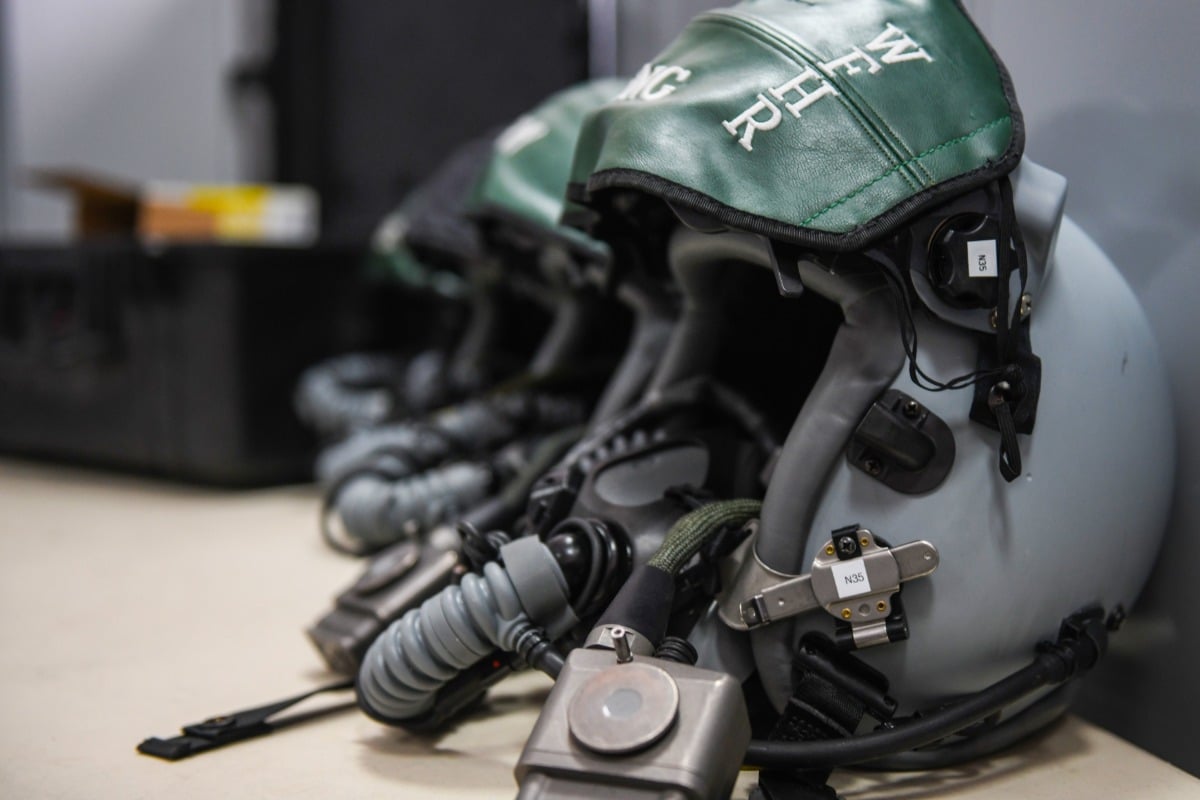
- The U.S. Defense Logistics Agency awarded Rockwell Collins ESA Vision Systems an estimated $332,623,964 contract for Joint Helmet Mounted Cueing System spares and repairs.
- The six-year contract covers F-15, F-16 and F-18 aircraft for the Air Force, Navy and 13 allied nations, running through July 23, 2032.
The U.S. Defense Logistics Agency awarded Rockwell Collins ESA Vision Systems, a Fort Worth, Texas company, an estimated $333 million contract to supply spare parts and repair services for the Joint Helmet Mounted Cueing System, a fighter pilot’s helmet that doubles as a targeting computer.
The system, known in defense circles by its acronym JHMCS, tracks exactly where a pilot’s head is pointed and projects targeting information directly onto the visor, letting the pilot lock a missile onto an enemy jet simply by looking at it rather than pointing the entire aircraft’s nose at the threat first.
Paired with the AIM-9X Sidewinder missile, that capability lets a pilot engage targets in a cone stretching more than 80 degrees to either side of the aircraft’s nose, a technique the military calls high off-boresight targeting. In plain terms, a pilot can shoot at something well off to the side of where the jet is actually flying, a battlefield edge that has mattered in close-in dogfights for more than two decades.
Rockwell Collins ESA Vision Systems is not a household name, but the joint venture behind it certainly is. The company pairs Collins Aerospace, the aerospace and defense electronics arm of RTX, with Elbit Systems of America, the U.S. subsidiary of the Israeli defense technology firm Elbit Systems, and the partnership has built and supported Joint Helmet Mounted Cueing Systems since 1996. Over that span the venture has delivered thousands of these helmet displays to more than 20 air forces worldwide and now serves as the current provider for the F-35’s own advanced helmet display system, giving the company deep institutional knowledge of exactly the kind of parts and repair work this new contract covers.
This new award covers what the Pentagon calls consumable spares, meaning parts that get used up and replaced during routine maintenance, along with what the contract terms depot-level reparable spares, the more expensive components that get sent back to a repair depot and fixed rather than simply thrown away and replaced. Both categories keep JHMCS units flying on three of the U.S. military’s workhorse fighters, the F-15 Eagle, the F-16 Fighting Falcon, and the F/A-18 Hornet, aircraft that together form the backbone of American and allied tactical airpower even as newer stealth fighters like the F-35 enter service alongside them.
The Defense Logistics Agency structured this as a sole-source acquisition, meaning it awarded the work directly to Rockwell Collins ESA Vision Systems without opening the contract to competing bidders, citing a specific legal justification under federal acquisition rules that permits skipping competition when only one source can reasonably supply the parts. That makes sense given the company’s decades-long role as the sole provider of JHMCS hardware, a position that leaves the Defense Logistics Agency with little practical alternative if it wants parts that fit the helmets already worn by thousands of pilots.
The contract runs as a six-year base period with an additional six-month option, stretching performance out to a completion date of July 23, 2032, and the work will happen at sites in Texas, Oregon and Israel, a footprint that reflects both Rockwell Collins ESA Vision Systems’ domestic operations and Elbit Systems’ Israeli engineering base. Funding flows from fiscal year 2026 through fiscal year 2032 defense working capital funds along with military service and Foreign Military Sales funds, spreading the financial burden across the Air Force, the Navy, and a long list of allied nations that also fly JHMCS-equipped fighters.
That international customer list is itself a snapshot of how widely this American helmet technology has spread. The contract names Greece, Morocco, Singapore, Chile, Denmark, Norway, Thailand, Oman, Taiwan, Portugal, Canada, Switzerland and Australia as Foreign Military Sales customers who will draw on this same contract for their own JHMCS spares and repairs, meaning a single supply chain in Fort Worth, Texas now underpins fighter pilot readiness on nearly every continent. The Defense Logistics Agency Weapon Support office in Warner Robins, Georgia, is managing the contract on behalf of all of these customers, a level of logistical coordination that rarely makes headlines but keeps allied air forces flying missions that depend on split-second targeting decisions.
The contract announcement does not specify how many individual helmet units or repair jobs the $332.6 million ceiling is expected to cover over its six-year span, nor does it break down how funding will be split among the Air Force, Navy and the thirteen allied nations named as customers. What is clear is that a technology first fielded more than two decades ago, one that lets a pilot kill a target simply by turning their head, remains central enough to modern air combat that keeping it supplied and repaired is worth a nine-figure Pentagon commitment stretching into the next decade, a reminder that some of the most consequential pieces of military hardware are not the jets themselves but the gear strapped to the pilot’s own head.