

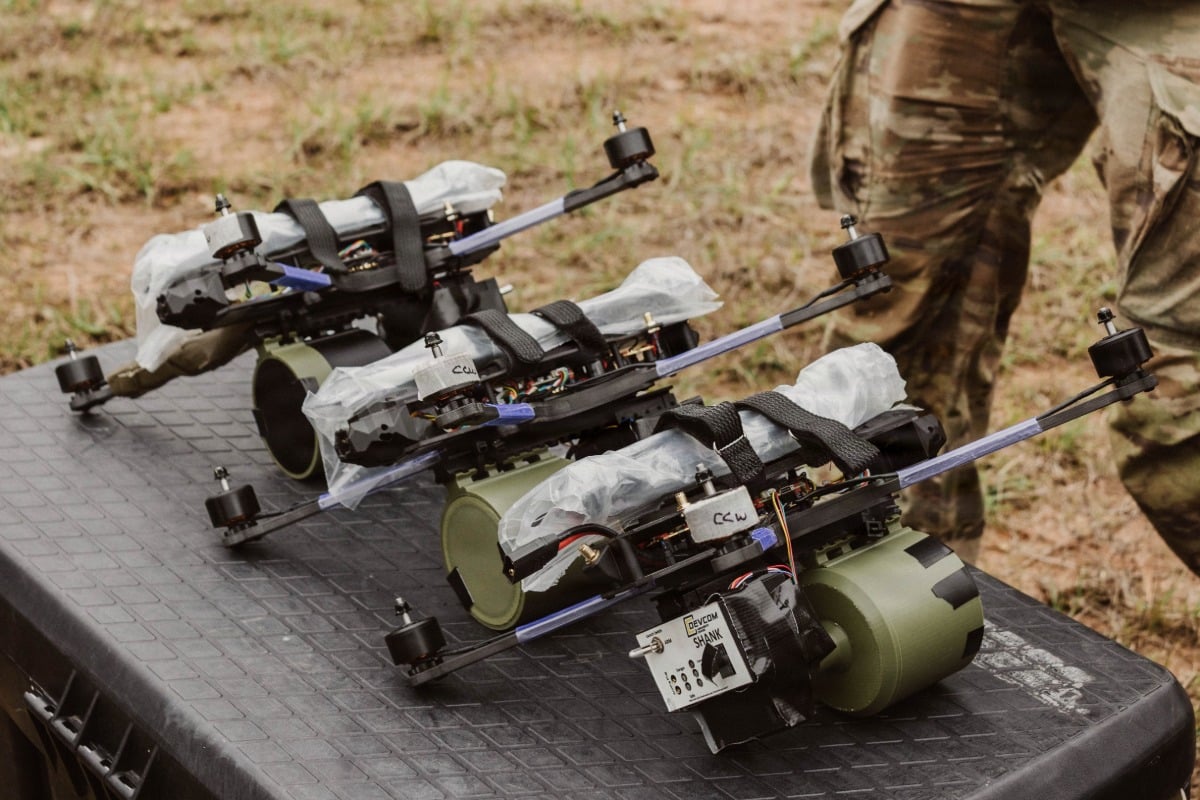
- Orqa announced plans to scale annual manufacturing capacity from roughly 290,000 to 500,000 products by the end of 2026.
- Orqa is one of 18 founding members of the EU-Ukraine Drone Alliance, launched by the European Commission on July 17, 2026 in Kyiv.
A Croatian drone manufacturer has laid out an ambitious bet that Europe’s appetite for weapons it doesn’t have to import from China or the United States is only getting bigger.
Orqa announced Wednesday it is scaling its annual manufacturing capacity from roughly 290,000 products today to 500,000 by the end of 2026, a jump the company says is driven by a series of new strategic partnerships and its selection as one of just 18 founding members of the newly launched EU-Ukraine Drone Alliance.
The European Commission formally launched the EU-Ukraine Drone Alliance on July 17 during a defense industry forum held in Kyiv, two days after European Commission President Ursula von der Leyen and Ukrainian President Volodymyr Zelenskyy signed what officials are calling the Drone Deal, a broader defense industrial partnership targeting joint drone and counter-drone production between Europe and Ukraine by the end of this year, with joint anti-ballistic missile production planned to follow by 2028. The Commission selected 18 founding companies for the alliance following an open call for applications that closed in May, splitting the roster evenly between nine European Union firms and nine Ukrainian companies, with Orqa representing Croatia alongside European names like Indra Group, Fincantieri and German drone maker Quantum Systems, and Ukrainian counterparts including Skyfall Industries and Vyriy Industries.
Orqa’s push to scale up its own manufacturing lines directly at its Osijek, Croatia headquarters reflects a broader strategy the company has built its identity around: keeping its entire supply chain out of the hands of countries European officials no longer fully trust. Orqa says all of its products are built without any Chinese components, a deliberate choice given how heavily the global drone industry has historically depended on Chinese-made batteries, motors, cameras and flight controllers, components that European and American militaries have grown increasingly wary of using in weapons systems given the risk that Beijing could restrict exports or build in surveillance vulnerabilities. By keeping design, engineering and production entirely in-house rather than outsourcing critical components abroad, Orqa says it can adapt faster to changing battlefield requirements while avoiding the kind of supply chain disruption that a geopolitical dispute with a foreign supplier could otherwise trigger overnight.
Srdjan Kovacevic, co-founder and CEO of Orqa, framed the expansion as proof that a drone alone doesn’t equal military capability.
“Increasing our manufacturing capability and expanding our strategic license partnerships are key to bringing sovereign defense transformation to Allied nations,” Kovacevic said.
“A drone by itself is not a defence capability; it’s a tactical commodity. Drone capability comes from having the right industrial system behind it, characterized by a sovereign supply chain, local manufacturing, and the ability to train, deploy, and replace drones at the speed required by modern combat operations, where the rate of attrition demands full-scale transformation,” Kovacevic added.
It draws directly from Ukraine’s own wartime experience, where drones on both sides of the front line are frequently destroyed within days or weeks of deployment, forcing manufacturers to iterate designs constantly based on what’s actually working in combat rather than locking in a single design for years the way traditional defense procurement has historically operated. Orqa’s expanded capacity builds on a partnership the company struck earlier this year with Ukrainian drone maker General Cherry, one of Ukraine’s leading interceptor drone developers, to establish what the two companies have described as sovereign manufacturing capacity spanning both countries. That deal includes plans for an underground component factory inside Ukraine itself, built under the country’s Build in Ukraine program, alongside parallel serial production launching in Croatia, giving General Cherry’s combat-tested interceptor designs a manufacturing base outside Ukraine’s own front-line production capacity for the first time. General Cherry’s flagship interceptor, the Bullet, is a fixed-wing vertical takeoff drone that reaches roughly 309 km/h (192 mph) in testing and costs around $2,100 per unit, a price point that stands in stark contrast to far more expensive traditional air defense interceptors and helps explain why European buyers have grown eager to bring that kind of low-cost counter-drone technology onto their own soil.
Kovacevic also connected Orqa’s expansion directly to what he described as the operational lessons Ukraine can teach the rest of Europe about how a defense industry actually needs to function during a prolonged conflict.
“Ukraine has demonstrated that successful drone capability depends upon a continuous connection between operational experience, engineering and production,” Kovacevic noted.
“This isn’t a conventional procurement cycle in which a product is designed, purchased and then expected to remain unchanged for years. Today, technology is evolving in just weeks or months. Industrial systems must therefore learn, adapt and manufacture continuously. I am hugely encouraged by the EU-Ukraine Drone Alliance which can help Europe build exactly such systems. Our role will be to contribute a scalable, vertically integrated manufacturing model that turns innovation into deployable capability,” Kovacevic said.