

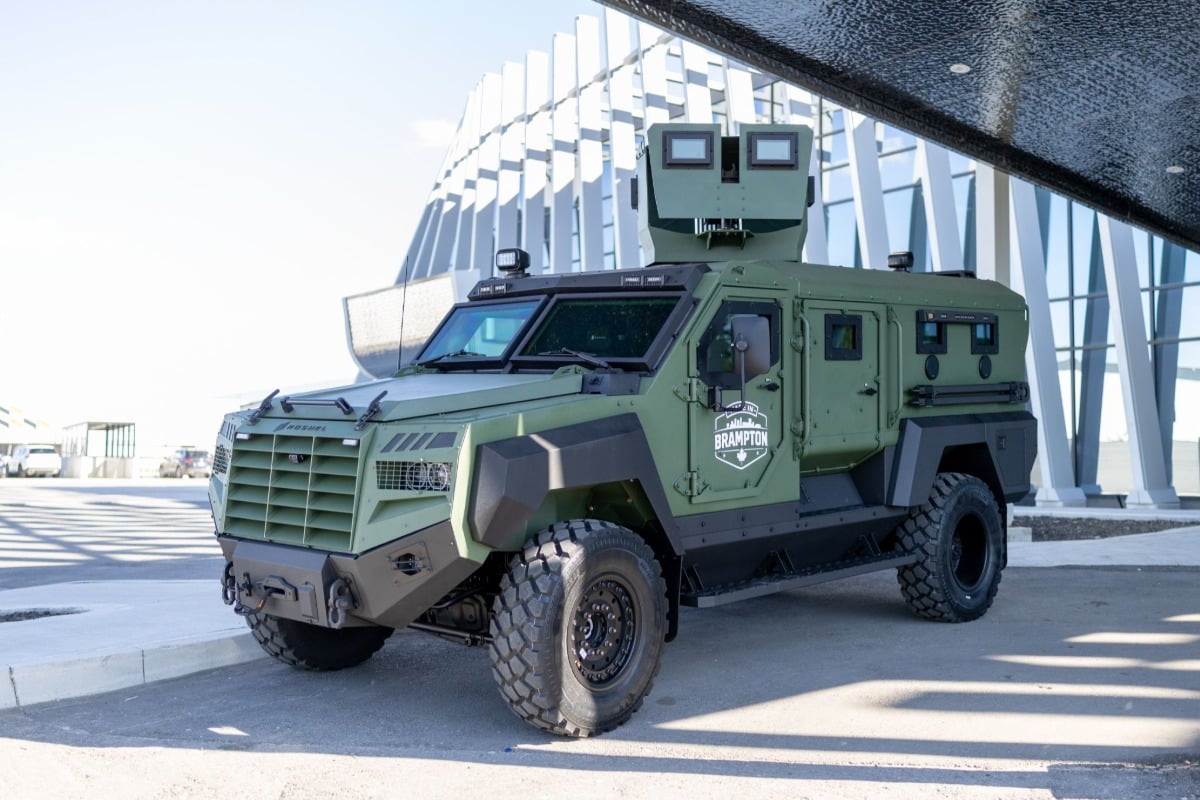
- Only two bidders remain for Canada's nearly $5 billion light utility vehicle program, and Brampton-based Roshel is one of them, CityNews reported.
- Roshel has produced more than 2,500 armored vehicles for Ukraine and exports 100% of its output, but has not yet sold vehicles to Canada's own government.
Only two bidders remain in the running for Canada’s nearly $5 billion program to supply new armored and unarmored land utility vehicles to the military, and one of them is Brampton-based Roshel, CityNews reported, citing reporting from Cristina Howorun.
Roshel has built its reputation almost entirely outside Canada despite being headquartered just outside Toronto. Founded roughly a decade ago, the company has become, by its own account, the largest armored vehicle manufacturer in the world, driven largely by supplying more than 2,500 vehicles to Ukraine’s military since Russia’s full-scale invasion began. Company founder and CEO Roman Shimonov described that track record as central to what sets Roshel apart from rivals competing for the same Canadian contract.
“Roshel produced over 2,500 vehicles for Ukraine alone, which made us the largest armoured vehicle manufacturer in the world,” Shimonov said, according to CityNews.
The vehicle at the center of Roshel’s pitch is the Senator series, an armored platform built entirely in Canada that Shimonov says can be reconfigured from a policing or border patrol vehicle into a military-grade one in a matter of hours simply by swapping out doors and windshields. That modularity gives a single vehicle platform flexibility across very different missions, letting the same underlying chassis and design serve law enforcement one day and a military unit the next without requiring an entirely separate production line for each use case.
Despite that global track record, Roshel has struggled to sell to the one customer closest to home. Shimonov said the company currently exports 100% of its production, supplying allies including the United Kingdom, United States, Germany, France, Brazil, Mexico and Chile, while Canada’s own government has yet to place an order.
“We’re bidding right now on a number of programmes, but so far we weren’t able to sell to our own government. One hundred per cent of our product is being exported; our closest allies are buying from a Canadian company, including the United Kingdom, United States, Germany, France, Brazil, Mexico, Chile, and many other countries,” Shimonov noted.
“Many of those countries are buying from a Canadian company, and one of the challenges we have is that we don’t sell to our own government,” Shimonov said.
Prime Minister Mark Carney announced earlier this month that Canada’s order for between 1,600 and 2,100 armored and unarmored vehicles, along with 400 to 500 light utility trailers, would go to one of two Canadian companies, with Roshel among the finalists. The move followed a notable shift in how Ottawa has been running the broader procurement process. Public Services and Procurement Canada quietly canceled the next phase of what had been an open competition worth up to roughly $4.9 billion in early July, abandoning a field that originally included six companies, among them American contenders AM General and Oshkosh Defence, in favor of inviting a smaller pool of Canadian-only suppliers to bid directly, a move that effectively sidelined foreign manufacturers from the program entirely.
The contract sits alongside a broader wave of Canadian defense spending tied to Carney’s pledge to hit NATO’s target of spending 2% of GDP on defense by the end of this fiscal year. Just a week before the CityNews report, Carney unveiled a nearly $2 billion, four-year deal with General Dynamics Land Systems-Canada in London, Ontario, for 190 additional Armoured Combat Support Vehicles, expanding that fleet from 360 to 550 vehicles and creating what Carney’s office described as thousands of jobs in southwestern Ontario, even though General Dynamics’ ultimate parent company is headquartered in Reston, Virginia rather than Canada. Carney separately announced an $800 million contract with Norway’s Kongsberg Defence and Aerospace for Joint Strike Missiles designed to fire from F-35 fighter jets, and Canada has also committed $307 million to buy new army rifles from Colt Canada, part of the same broader push toward domestic and allied defense manufacturing.
Brampton Mayor Patrick Brown framed Carney’s spending commitments as a genuine growth opportunity for his city’s economy rather than just a one-off contract.
“Since Prime Minister Carney committed to Canada meeting our NATO defence spending commitments, it means a lot of opportunity for defence companies, and we are hoping that we can see a defence sector grow in Brampton and obviously this is a huge one,” Brown said, according to CityNews.
Winning the contract would force Roshel to expand well beyond its current footprint almost immediately. Shimonov said the company’s existing 400,000 sq ft (37,161 sq m) Brampton facility already runs 24 hours a day, and landing the Canadian order would mean scaling up fast enough to begin deliveries within the year rather than waiting years to ramp up production the way a traditional defense contract timeline typically allows.
“If we get the award for the Light Utility Vehicle Programme, we will be able to create thousands of jobs, and not in a few years. We’re talking about starting delivery in 2026. And that’s quite challenging,” Shimonov said, according to CityNews.
“We’re the only company, not just in Canada, but in the world that can start delivering this year. We’re the only company with thousands of vehicles in combat operation. We’re 100% Canadian company, so when it comes to buy Canadian policy, we would expect the government to choose real Canadian companies and not companies that promise to become Canadian, subject to getting the award,” Shimonov said, according to CityNews.