

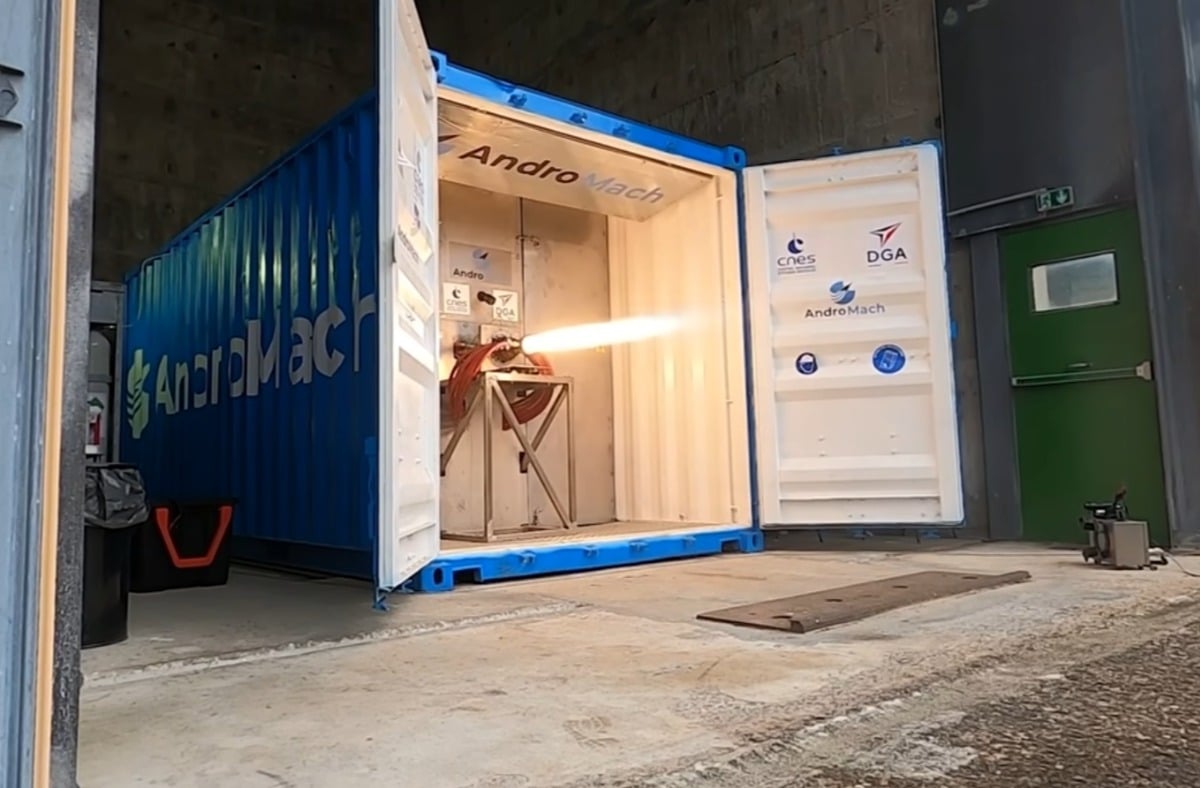
- French startup AndroMach completed about 20 test firings of its Envol hypersonic drone engine at the DGA's DGAEM missile test center in Gironde, France.
- The campaign, run with France's CNES space agency, achieved 21 successful ignitions and seven minutes of total burn time, confirming the engine's reusability.
A French rocket engine just fired 21 times in a row, and the company behind it says the hardware survived well enough to fly again. That combination, repeated ignition and confirmed reusability, is exactly what a small aerospace startup needs to prove before anyone lets its hypersonic drone near real flight testing, and this week the French government’s own weapons-procurement agency confirmed it happened.
The Direction Générale de l’Armement (DGA), France’s state agency responsible for developing, testing and procuring military equipment for the country’s armed forces, announced that startup AndroMach has completed a test campaign of roughly twenty engine firings on a purpose-built test bench.
The trials took place at DGA Essais de Missiles (DGAEM), a specialized government test center located in the Gironde region of southwestern France that evaluates missile and rocket propulsion systems under controlled, high-risk conditions before they are cleared for further development.
The engine under evaluation powers Envol, a suborbital hypersonic drone that AndroMach is developing. A suborbital vehicle is one that reaches the edge of space and beyond typical aircraft altitudes but does not achieve the speed or trajectory needed to enter a stable orbit around Earth, instead following an arc that brings it back down. Hypersonic generally refers to speeds above Mach 5, or roughly five times the speed of sound, a threshold that puts extreme thermal and structural stress on any vehicle attempting to sustain it. Building an engine that can survive repeated ignition at those conditions, and be reused afterward, is one of the hardest engineering problems in modern propulsion.
According to the DGA, the campaign was carried out in partnership with the Centre National d’Études Spatiales (CNES), France’s national space agency, which brought its own institutional expertise in propulsion testing and spaceflight systems to the project. The stated goal of the trials was to observe how the Envol engine behaves during startup, a moment of extreme mechanical and thermal stress for any rocket motor, and to identify the optimal operating conditions for the system going forward.
The results the DGA disclosed are specific and, for a startup this size, notable. AndroMach’s engine achieved 21 successful ignitions across the campaign, accumulated seven minutes of total burn time, and demonstrated that the drone’s engine could be reused rather than discarded after a single firing, a capability that dramatically changes the cost calculus for any organization hoping to run repeated flight tests rather than treating each engine as disposable hardware.
The DGA said its support for AndroMach went beyond simply providing a facility. Engineers, technical experts and test technicians from the DGAEM center contributed test-engineering expertise throughout the campaign, while also providing operational support that included setting up the trials, verifying that each test proceeded correctly, and managing the safety risks inherent in igniting an engine of this kind. Rocket motor testing, even at the bench scale, involves handling volatile propellants and managing failure scenarios that can be destructive or dangerous if mismanaged, which is why access to a government-run facility with specialized safety protocols matters for a startup working on unproven hardware.
Once operational, AndroMach’s rocket-drone is intended to serve several purposes beyond simply proving its own propulsion technology. The DGA said the vehicle will be capable of conducting microgravity experiments, allowing researchers to test how materials, fluids or biological samples behave in near-weightless conditions during its suborbital arc. It will also be used to test other technologies in actual flight conditions rather than in a lab, and to serve as a target vehicle capable of complex trajectories for evaluating the effectiveness of civilian or military detection and interception systems, a role that has direct relevance for anyone developing radar, tracking or missile-defense systems that need to be tested against genuinely difficult targets.
The DGA’s announcement stopped short of offering a timeline for that next phase, leaving the most consequential question, whether this engine ever leaves the test stand and takes to the sky, still unanswered.