

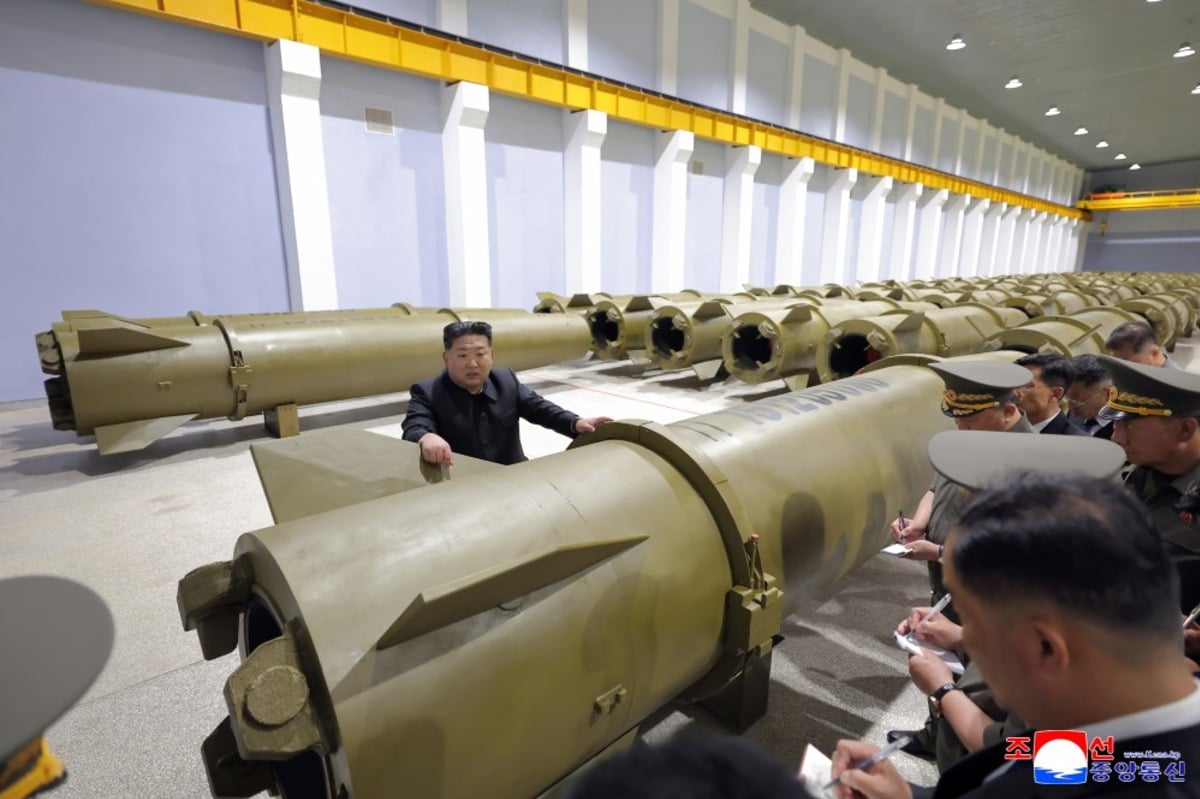
- Ukrainian OSINT account Polkovnik GSH reported North Korea resumed KN-23 ballistic missile shipments to Russia, citing sources tied to Ukraine's military.
- Ukraine's Defense Intelligence directorate previously said Russia received more than 100 KN-23 and KN-24 missiles from North Korea since December 2023.
North Korea has resumed sending Russia one of its deadliest ballistic missiles, a weapon that started this war as a punchline for its terrible aim and has since become one of the most accurate short-range missiles in Moscow’s arsenal. That’s according to Polkovnik GSH, an open-source intelligence account with close ties to Ukraine’s armed forces, which reported the resumed shipments this week.
Anonymous sources inside Ukrainian military intelligence backed up the claim to The Defence Blog, saying Russia turned back to Pyongyang because its own factories simply can’t build ballistic missiles fast enough to keep up with the war.
The weapon in question is the KN-23, known inside North Korea as the Hwasong-11A, a road-mobile, solid-fuel ballistic missile that flies on a low, “depressed” trajectory designed to make it harder for air defenses to track and intercept, closely resembling Russia’s own Iskander-M in both shape and performance. North Korea first tested it in 2019, but the missile only entered this war on Dec. 30, 2023, when Russia fired one into Ukraine for the first time, kicking off a strange, quietly consequential partnership that’s been reshaping both countries’ missile programs ever since.
That first batch of KN-23s was bad, really bad. According to a Ukrainian prosecutors’ report, roughly half of the earliest missiles either veered wildly off course or exploded mid-air before ever reaching their target. Ukrainian troops watched North Korea’s supposedly advanced weapon miss by a kilometer or more, over and over, and treated it as a punchline as much as a threat.
Kyrylo Budanov, who led Ukraine’s Defense Intelligence directorate at the time and has since moved on to head the Office of the President of Ukraine, told South Korean newspaper The Chosun in February 2025 that Russian missile specialists had gone in and fixed the problem directly.
“Initially, its accuracy was severely flawed, with an error margin of 500 to 1,500 meters. But Russian missile experts made technical modifications, resolving the issue. The missile is now significantly more precise and a far greater threat,” Budanov said, according to the interview.
North Korea handed Russia a flawed weapon, Russian engineers got to test and refine it against real Ukrainian targets night after night, and the resulting upgrades flowed straight back into North Korea’s own missile program. Independent estimates of exactly how accurate the KN-23 has become since then still vary. The Foundation for Defense of Democracies reported in May that Russia had tightened the missile’s accuracy down to a 50 to 100 meter margin of error, while more recent Ukrainian sources cited by Militarnyi put the number even lower, somewhere between one and five meters, which would place it among the most precise short-range ballistic missiles in the world. The sources behind this week’s resumed-shipment claim cited a slightly different, more recent figure, an 800 to 1,000 meter margin of error, tied to the missile’s most recent documented use in early 2025. Whichever number turns out to be closest to reality, everyone tracking this agrees on the direction: dramatically more accurate than where it started.
Russia’s own missile production has struggled badly to keep pace with what the war actually demands, which helps explain why Moscow keeps coming back to Pyongyang for more. Colonel Oleksandr Zaruba, a researcher at Ukraine’s State Scientific Research Institute of Armament and Military Equipment Testing and Certification, told a briefing attended by Militarnyi in June that Russia’s monthly Iskander-M production sits at roughly 60 units, with another 10 Iskander-K cruise missiles added on top. That’s simply not enough to match how many missiles Russian forces burn through on Ukraine in a typical month, and North Korean deliveries have consistently filled the gap. Ukraine’s Defense Intelligence directorate previously said Russia had received more than 100 KN-23 and KN-24 missiles from North Korea by early 2024, alongside more than 10,000 North Korean troops sent to fight alongside Russian forces, and Budanov said in January 2025 that Pyongyang was expected to deliver another 148 KN-23 missiles to Russia that year alone, matching the pace of deliveries in 2024.
The technology transfer hasn’t been one-directional. Zaruba’s briefing also detailed how Russia has folded North Korean engineering solutions back into its own Iskander-M missiles, including an upgraded 9B899 countermeasure module that fires decoys, dipole reflectors and heat traps during a missile’s final approach to confuse enemy air defenses. North Korea, for its part, unveiled an upgraded KN-23 variant called the Hwasong-11M at the 2025 Pyongyang Arms Expo, built around a hypersonic glide vehicle borrowed from technology North Korea uses on its intercontinental-range missiles. Analysts at Military Watch Magazine have pointed out the KN-23 shares enough design DNA with the Iskander-M to suggest Russian know-how flowed into North Korea’s program well before this war even started, and the fighting in Ukraine has simply accelerated a relationship that was already quietly underway.