

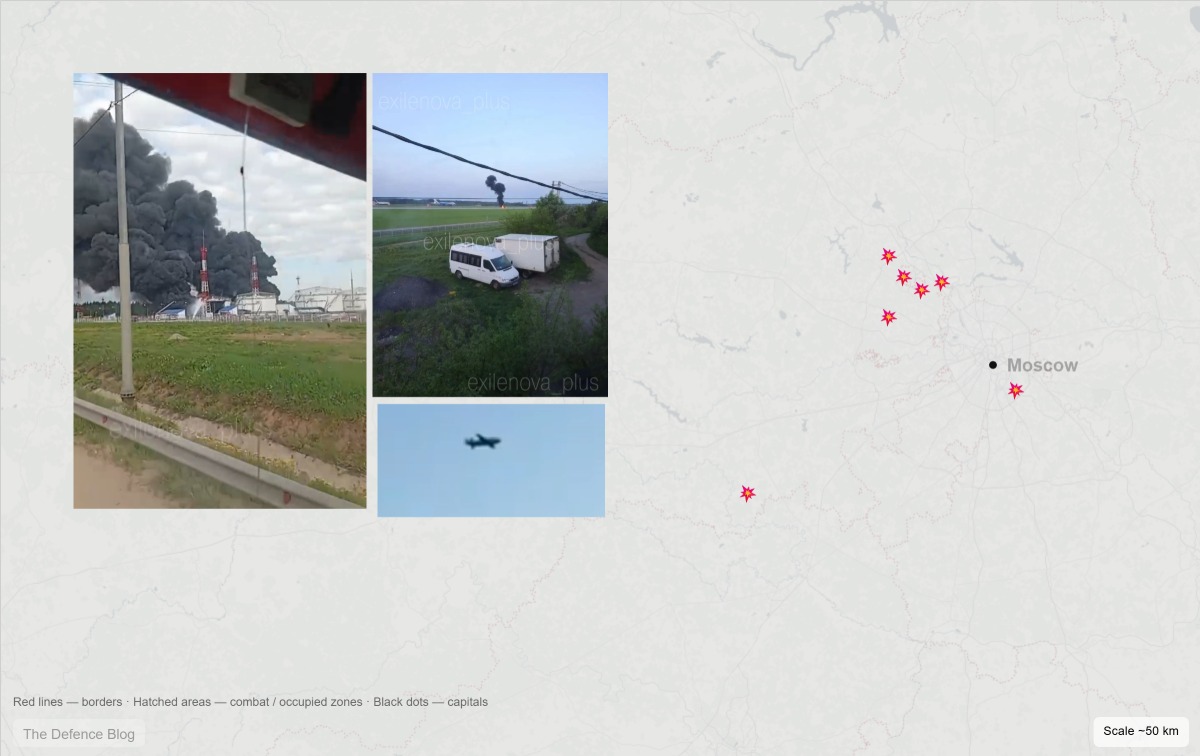
- Ukraine launched over 130 drones at Moscow overnight May 17, injuring 12 people and causing fires at the Elma technopark and near the Moscow Oil Refinery.
- All four Moscow airports temporarily suspended operations; Russia simultaneously attacked Ukraine with 287 drones, of which 279 were intercepted by Ukrainian air defenses.
Ukraine launched one of its largest drone strikes on Moscow in the war’s history overnight into May 17, sending more than 130 unmanned aerial vehicles into the Russian capital and surrounding region, triggering fires at an electronics manufacturing facility and a major oil refinery, forcing all four of Moscow’s major airports to suspend flight operations, and injuring 12 people, according to Moscow Mayor Sergei Sobyanin.
Russian authorities confirmed the attack’s scale, with Sobyanin stating that most of the injured were construction workers located near the entrance to the Moscow Oil Refinery, one of the largest petroleum processing facilities in the Russian capital. A fire broke out at the Elma technopark, an industrial complex in the Moscow region that specializes in the production of electronic equipment, control and measurement instruments, optical technology, and materials processing, precisely the kind of dual-use industrial capacity that Ukraine has consistently targeted in its long-range drone campaign against Russian defense industrial infrastructure.
All four of Moscow’s major airports, Vnukovo, Domodedovo, Sheremetyevo, and Ramenskoye, also known as Zhukovsky, temporarily suspended arrivals and departures during the attack, a disruption that underscores the scale of the drone penetration into one of the world’s most heavily defended airspaces.
Moscow maintains an extensive layered air defense network including Pantsir-S1 and S-400 systems deployed in rings around the capital, yet Ukrainian drones continued to reach the city in numbers sufficient to trigger airport closures and cause fires at industrial targets, a pattern that has repeated across multiple strike campaigns over the past two years.
The context behind this strike is the relentless pace of Russian aerial bombardment against Ukrainian cities in the days and weeks preceding it. Ukrainian President Volodymyr Zelenskyy stated that in the single week leading up to May 17, Russian forces launched more than 3,170 attack drones, over 1,300 guided aerial bombs, and 74 missiles of various types, the majority of them ballistic, against Ukraine. The results were devastating: 52 people killed, 346 others injured including 22 children, and widespread damage to residential buildings and civilian infrastructure across the country. That weekly assault represents an operational tempo that has few precedents in modern aerial warfare against a civilian population, and Ukraine’s retaliatory strikes on Moscow are the most direct response available to a country that lacks the conventional air power to contest Russian strikes at their source through traditional means.
On the same night Ukraine struck Moscow, Russian forces attacked Ukraine with approximately 287 drones, according to Ukraine’s Air Force. Of those, 279 were intercepted and destroyed, the Air Force reported via its official Telegram channel, with impacts recorded in eight locations across Ukraine. The interception rate of more than 97 percent reflects the sustained improvement in Ukrainian air defense performance that Western-supplied systems and domestically developed counter-drone capability have produced over the course of the war, though the eight impact locations confirm that even a small percentage of penetrating drones can cause significant damage and casualties when the attack volume is this high.
Ukraine’s long-range drone strike campaign against Moscow and Russian industrial targets has evolved significantly since the first drones reached the capital region in 2023. Early strikes were largely symbolic, demonstrating reach without consistently hitting high-value targets. The campaign has matured into a systematic effort to degrade specific categories of Russian industrial and military capacity, with petroleum refining, electronics manufacturing, and defense production facilities emerging as recurring target sets. The logic mirrors the targeting philosophy that Russia has applied to Ukrainian energy infrastructure: degrade the industrial and energy base that sustains the opposing military rather than attempting to defeat it in direct combat alone.
The Elma technopark attack, if confirmed as a successful strike rather than a proximity fire, carries particular significance given the facility’s involvement in electronics and optical equipment production. Russia’s defense industry has faced severe component shortages driven by Western export controls and sanctions imposed after the full-scale invasion began in February 2022, and domestic electronics manufacturing facilities have taken on heightened importance as Moscow attempts to maintain weapons production and replace components previously sourced from foreign suppliers. Targeting those facilities imposes costs on Russian defense production that accumulate over time even when individual strikes do not produce immediately visible effects.